


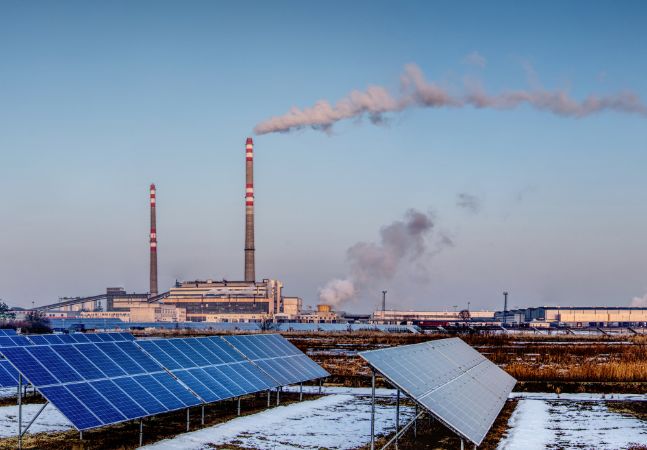
Coal Pollution Significantly Stifles Global Solar Energy Yields
New research reveals that particulate matter from coal-fired plants acts as a “hidden drag” by blocking sunlight from reaching solar panels.
A global interaction between fossil fuel emissions and renewable energy is creating a significant barrier to the green transition, according to a study published in Nature Sustainability. Researchers found that atmospheric aerosols reduced global solar electricity output by 5.8% in 2023.
The energy loss, totaling 111 terawatt-hours, is equivalent to the annual generation of 18 medium-sized coal-fired power plants. Using satellite data to map 140,000 installations, a team from the University of Oxford and University College London found that the expansion of coal and solar capacity side by side, particularly in China, directly undermines renewable performance.
While solar capacity is growing rapidly, aerosol-related losses from existing systems reached 74.0 terawatt-hours annually between 2017 and 2023. This figure represents nearly one-third of the average yearly gains from new solar capacity. The findings suggest that the effectiveness of the energy transition may be overestimated if air quality is not managed in tandem with infrastructure.
China, the world’s leading solar producer, saw the most significant impact, with output reduced by 7.7% due to pollution. Researchers traced approximately 29% of these losses directly to coal-fired generation. Fine particles emitted by these plants scatter radiation and alter cloud formations, further reducing the light available for photovoltaic cells.
Despite these challenges, the study highlighted that China is the only major region showing sustained improvement in solar clarity. Losses there declined by roughly 1.4% annually over the last decade, a trend researchers attribute to stricter emission standards and ultra-low-emission technologies.
Experts warn that failing to account for these pollution-induced losses could lead governments to miscalculate progress toward climate goals. The study advocates for shifting fossil-fuel subsidies away from coal to address the problem at its source and improve the real-world efficiency of global solar networks.
About the Author
Jesse Jacobs is Assistant Editor of EPOnline.com.
