


Indoor Air Quality Doesnt Reset When You Move In
Moving day doesn’t mean a clean slate for your lungs. Learn how to identify and clear out the chemical and biological history left by previous owners.
There’s a common assumption tucked into the excitement of moving into a new home: that you’re starting fresh. New space, new chapter, clean slate. But indoor air quality doesn’t work that way. The air inside a home carries a history of the people who lived there before, the materials used to build it, the paint applied last spring, the pets that slept on the carpet and the cleaning products stored under the sink.
None of that disappears when the keys change hands. Understanding what you’re actually breathing on move-in day is one of the most overlooked parts of taking ownership of a new home.
What Do You Inherit When You Move Into a New Home?
The previous occupants left more than furniture marks on the floor. They left behind chemical residues, biological particles and ventilation habits that shaped the air for months or years. A home’s air chemistry is cumulative, not instant, and it doesn’t get wiped clean during a standard turnover.
What Does “Indoor Air Quality” Actually Mean?
Indoor air quality (IAQ) refers to the condition of the air inside a building and how it affects the health and comfort of the people in it. It’s influenced by factors ranging from humidity and temperature to airborne particles, gases and biological contaminants like mold spores.
The main issue is that indoor air can be two to five times more polluted than outdoor air. That’s not a worst-case scenario. It’s a fairly consistent finding across occupied buildings, and it holds even in homes that look and smell clean.
Does Cleaning Before You Move In Actually Help?
Yes — but only if it’s done right.
A surface-level wipe-down before the boxes arrive removes visible grime but doesn’t address chemical residues in flooring adhesives, mold spores in poorly ventilated corners or particulates embedded in HVAC ducts.
Deep cleaning before occupancy, including washing walls, shampooing carpets, disinfecting high-contact surfaces and replacing HVAC filters, makes a measurable difference in creating a fresh starting point when you move into a new home. It won’t eliminate every inherited pollutant, but it resets the baseline.
What Invisible Pollutants Might Be Waiting for You?
Not everything that affects air quality can be seen, smelled or noticed on a walkthrough. Some of the most common and consequential pollutants in a recently occupied home are silent, building up over time before symptoms appear.
What VOCs Linger After Renovation or Repainting?
Volatile organic compounds (VOCs) are gases emitted by a wide range of household materials, like paints, adhesives, flooring, cabinetry and cleaning products. When a previous owner renovated, repainted or installed flooring, those materials may still be off-gassing into the air months later. New carpet is one of the most significant sources. Some building materials continue emitting VOCs for years after installation, not days.
The smell of “new” is often a sign that off-gassing is still active, and that’s not harmless novelty. It’s airborne chemistry. Opening windows and running ventilation consistently in the first weeks of occupancy helps flush VOCs out. If the home was freshly renovated before sale, treat it as an active chemical environment and ventilate aggressively before moving furniture in.
Should You Test for Radon Before You Settle In?
Radon is a radioactive gas that seeps up from soil and rock beneath a home’s foundation. It’s colorless, odorless and tasteless, so you cannot detect it without a test. The EPA identifies it as the leading cause of lung cancer among non-smokers in the United States, responsible for approximately 21,000 deaths annually.
It accumulates in lower levels of homes, particularly basements and ground-floor rooms with limited air exchange. If the previous owners didn’t test, you may not have any data on what’s coming up through the floor.
Test kits are inexpensive and available at most hardware stores. If levels exceed 4 picocuries per liter (pCi/L), mitigation systems can reduce them significantly with professional installation.
How Do Your Home’s Systems Shape Air Quality Over Time?
Even after a thorough pre-move-in clean, your home’s HVAC system, heating method and ventilation design will continue shaping what you breathe every day. These systems either dilute and remove indoor pollutants or circulate them.
What Role Does Home Heating Play in Indoor Pollution?
The way a home is heated has a direct impact on IAQ. Wood-burning stoves and fireplaces release particulate matter and carbon monoxide into the indoor environment. Gas-powered heaters emit nitrogen dioxide.
Even electric baseboard heaters can release dust-bound particulates when they cycle on after months of inactivity. Understanding the relationship between home heating and air pollution is vital for planning the next steps to reduce its impact on air quality in your home.
The first time a heating system runs in a new home, have the filters inspected or replaced first. Dust, dander and debris from the previous occupants are often sitting in the ductwork, and the first heat cycle sends them directly into the living space.
How Often Should You Replace Filters and Monitor Air Quality?
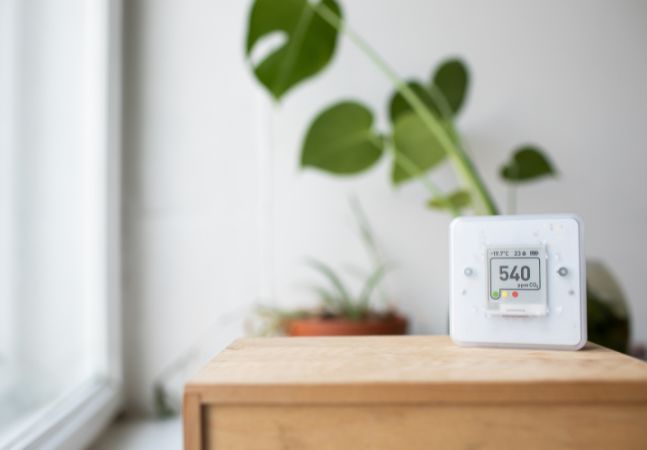
HVAC filters should be replaced at move-in, regardless of what the previous owners claim about their maintenance schedule. After that, standard 1–3 inch filters typically need replacement every 60–90 days in an occupied home, and even more frequently with pets or occupants with respiratory conditions. For homes with known air quality concerns, a standalone air quality monitor provides ongoing data on particulate levels, humidity and VOC concentrations.
According to theEPA’s guidance on VOCs and indoor air quality, concentrations of many VOCs are consistently higher indoors than outdoors. Monitoring helps you know when ventilation or filtration needs attention. Smart monitors are now widely available and inexpensive enough to run continuously in bedrooms and main living areas.
Prepare Your New Home
A new home represents a genuine opportunity to build a healthy indoor environment, but only if you treat it as something that requires active management, not passive assumption. Indoor air quality in any home is shaped by its history, its materials, its systems and its occupants.
Moving in without assessing what you’ve inherited means accepting those unknowns. Test for radon. Ventilate early and often. Replace the filters. Clean thoroughly before the furniture arrives. These aren’t extraordinary measures: they’re the baseline actions that give the air in your new home a chance to actually be yours.
