


Pakistan’s BISP shows what a poverty program looks like when its accounting collapses faster than its caseload grows. But BISP was never short on precedent for the opposite: two models sitting right next door — one across the eastern border, one across town in Lahore — built their design around a question BISP’s audits keep exposing gaps in: what is a safety net actually supposed to do, and how do you keep it honest at scale?
The Purpose Question
A cash-transfer program can aim at one of two things: keep people alive at the bottom, or move them across the line and off the rolls. BISP does the former, with no clear exit ramp. Bangladesh’s poverty architecture and Pakistan’s own Akhuwat Foundation were built to do the latter — and each started from a specific, stated proposal about why the poor stay poor, not just a delivery mechanism.
Bangladesh’s Sprawl, By the Numbers
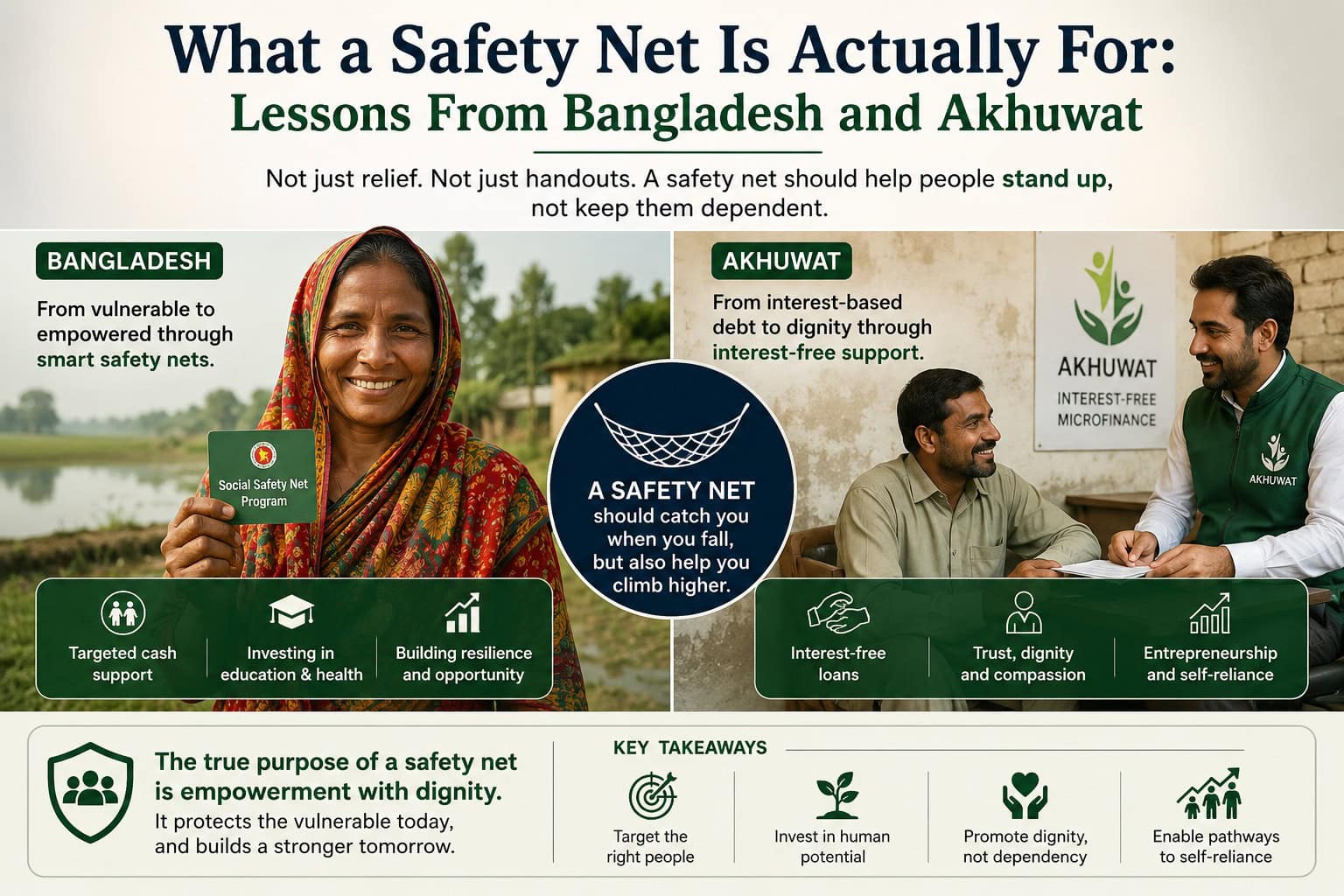
Bangladesh’s safety net began after 1971 as food relief for a war-shattered country, then deliberately shifted toward cash transfers and “graduation ladders” meant to build income-generating capacity rather than permanent dependency — the proposal being that relief alone traps people, and skills plus assets don’t. In practice, the system shares BISP’s habit of disagreeing with itself on the count: government tallies cite anywhere from roughly 115 overlapping programmes (FY2023-24) to about 140 — the number the FY2025-26 budget is trying to shrink to under 100 by merging schemes, while raising the allocation over 12% to more than Tk 95,900 crore. The results are real: a World Bank assessment from late November 2025 found Bangladesh lifted roughly 34 million people out of poverty between 2010 and 2022, extreme poverty falling from 12.2% to 5.6%. But targeting is weak — over a third of the richest households still received benefits in 2022, while roughly half of the poorest got nothing — and progress has stalled since 2016, leaving some 62 million people one shock from falling back below the line.
Grameen Bank: Credit Instead of a Stipend
Muhammad Yunus’s founding proposal, in 1976, was that poverty wasn’t a personal failing but a failure of access — the poor weren’t uncreditworthy, conventional banks simply refused to lend to them without collateral they didn’t have. Grameen Bank, formalized in 1983, answers the same fraud problem BISP’s auditors keep flagging with a different mechanism entirely. Instead of a stipend, it offers capital: a cumulative $42.1 billion disbursed to 10.6 million borrowers, 97% women, across 94% of Bangladesh’s villages, with recovery holding around 95-96%. There’s no biometric layer or database check — enforcement runs on peer group lending, where borrowers guarantee each other and later loans depend on earlier repayment. The community verifies identity up front instead of an auditor catching fraud after the fact.
BRAC’s Graduation Model: An Exit Ramp, Not a Stipend
BRAC’s proposal in 2002 was narrower and more specific: some households are too poor even for microcredit to reach, and what they need isn’t a loan or a stipend but a bundled, time-bound push — an asset, training, and coaching — that ends on a fixed schedule rather than continuing indefinitely. The Ultra-Poor Graduation programme built on exactly that logic: two years, then it’s over. BRAC’s 2025 annual report puts cumulative reach at over 2.3 million Bangladeshi households graduated out of extreme poverty, with independent studies finding 95% still out at programme end and the gains holding for up to a decade for most. Researchers estimate a return near $3.20 for every $1 spent.
Akhuwat: Zero Interest, Mosque-Based, Community-Enforced
Akhuwat, founded in Lahore in 2001 by former civil servant Dr. Amjad Saqib, rests on the Islamic principle of Mawakhat, or brotherhood: the proposal that lending should restore a borrower’s dignity rather than create dependency, and that interest — not a lack of charity — is what traps the poor in debt. Its interest-free Qarz-e-Hasna loans are disbursed through mosques, churches, and temples rather than banks, keeping overhead low. Recovery sits at 99.8-99.9%, achieved through mandatory non-family guarantors and community vetting rather than NADRA-style verification. Its own cumulative disbursement figures vary by source — from roughly PKR 220 billion to over PKR 400 billion — a small, honest echo of BISP’s own budget mismatches.
Same Purpose, Different Machinery
None of this is a case for microfinance as a cure-all — Grameen’s recovery isn’t perfect, Bangladesh still misdirects coverage at scale, and debt-trap critiques of microcredit are well documented. But the throughline holds: each of these programs started with an explicit theory of why the poor stay poor, then built fraud resistance and purpose into the same mechanism — peer guarantee instead of a database check, a fixed exit instead of an open-ended stipend. BISP’s problem was never that Pakistan lacks a working template. It has one, operating a few hundred kilometers from Islamabad.
How Pakistan’s BISP Safety Net Lost Rs 166 Billion to Fraud in Two Years
