


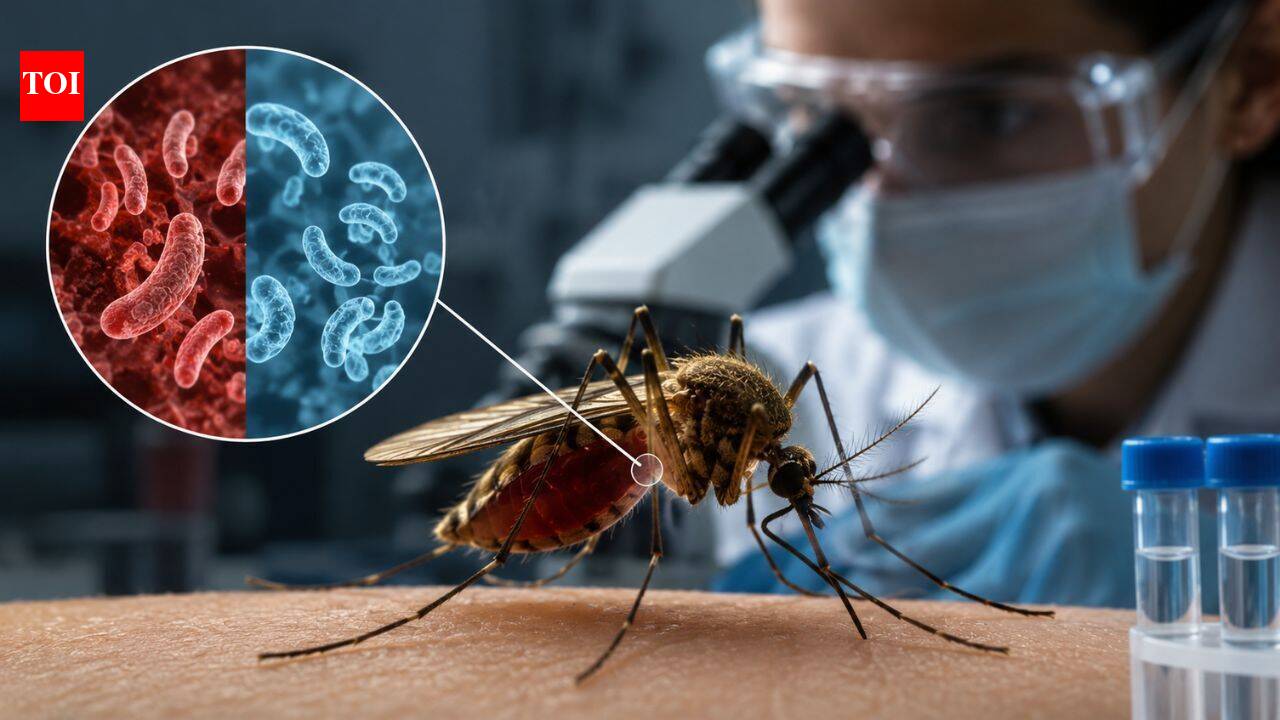
A mosquito does not need to die for its role in malaria transmission to be interrupted. That idea sits at the centre of a 2025 study led by researchers associated with Harvard T.H. Chan School of Public Health, who tested a different way of using bed nets: instead of relying entirely on insecticides to kill mosquitoes, the treated material can deliver antiparasitic compounds when mosquitoes come into contact with it. The compounds are designed to act after they enter the mosquito, where they interfere with the development of Plasmodium falciparum, the parasite responsible for most human malaria. The approach is particularly relevant as conventional insecticides are losing effectiveness against resistant mosquito populations.
Why insecticide-treated bed nets are becoming less effective against malaria
Long-lasting insecticide-treated nets have been among the most important tools used against malaria. Their success has been closely tied to reducing contact between people and mosquitoes, while insecticides on the nets kill or incapacitate mosquitoes that land on the material. That system is becoming harder to maintain in areas where mosquito populations have developed resistance to commonly used insecticides. According to the study published in Nature, titled ‘In vivo screen of Plasmodium targets for mosquito-based malaria control’, the decline in malaria deaths has stalled in recent years, with insecticide resistance in Anopheles mosquitoes threatening the effectiveness of long-lasting insecticide-treated nets. In 2023, malaria was estimated to have caused 263 million cases and 597,000 deaths worldwide.The researchers were therefore looking at the same familiar point of contact, a mosquito landing on a treated surface, but asking a different question. What if the target was not the mosquito itself? Earlier work had already suggested that this could work. The team had shown that atovaquone, an antimalarial drug, could interfere with P. falciparum after mosquitoes encountered a treated surface.
Scientists search for compounds that can stop malaria parasite development
Malaria parasites spend part of their life cycle inside mosquitoes. After a mosquito takes an infectious blood meal, Plasmodium undergoes a series of developmental changes in the insect before eventually reaching the salivary glands. From there, another bite can transmit the parasite to a person.As per the researchers focused on this comparatively vulnerable period. They screened 81 compounds with known antimalarial activity, representing 28 different mechanisms of action. The compounds were applied directly to female Anopheles gambiae mosquitoes before the insects received infected blood. Seven days later, the researchers examined the mosquito midguts for oocysts, an important stage in parasite development. Twenty-two compounds showed significant activity against the parasite, with the strongest results pointing towards several distinct targets.Two compounds became particularly important to the work. Both belonged to a group known as endochin-like quinolones, or ELQs, which interfere with the parasite’s mitochondrial cytochrome bc1 complex. One acted at the Qo site and the other at the Qi site of that complex.The distinction matters because the researchers were not simply searching for a chemical that happened to kill parasites. They were looking for compounds that could reach the parasite after a mosquito encountered a treated surface.
Why malaria bed nets needed compounds that could enter mosquitoes through their legs
A laboratory application directly onto a mosquito’s body is very different from what would happen on a bed net. In a real setting, a mosquito is likely to make brief contact with the net using its legs. That meant the researchers needed to establish whether a compound could enter through the mosquito’s tarsi, the small structures at the ends of its legs.The results were surprisingly selective. Of 13 compounds tested in tarsal-contact experiments, ELQ-456 was the only one that clearly showed antiparasitic activity. Several compounds that had performed well when applied directly to the mosquito were ineffective when the exposure occurred only through the legs. That finding pushed the researchers towards changing the chemical structures of the ELQs.Small alterations mattered. Compounds with different side-chain lengths behaved differently when mosquitoes contacted them through their tarsi. The researchers found that ELQ-453, a modified Qo-site inhibitor, could completely prevent infection in the relevant assay, while changes to related compounds produced weaker results. On the Qi side, ELQ-613, which carried a seven-carbon alkyl chain, performed better than versions with shorter chains. The work showed that the chemistry had to be suited not only to attacking Plasmodium, but also to getting from a net surface into a mosquito.
Why targeting two sites could make malaria resistance harder to develop
The researchers then combined ELQ-453 and ELQ-613. The two compounds act at different sites of the same mitochondrial complex. In the experiments, using them together produced stronger inhibition of P. falciparum infection than either compound alone or atovaquone. The combination had an interpolated EC50 of 0.10 micromoles per square metre in the tarsal-contact experiments. That dual approach also has a potential advantage when resistance is considered. The study specifically examined whether parasites resistant to compounds acting at one site would also become resistant to compounds acting at the other. They did not find cross-resistance between the Qo-site and Qi-site inhibitors tested.The researchers also found something important about parasites that did develop certain Qo-site mutations. Some of these resistant parasites had major problems progressing through the mosquito. In one experiment involving the V259L mutant, mosquitoes had far fewer oocysts, and no sporozoites were detected in their salivary glands. That means resistance in the parasite did not automatically translate into successful transmission.
Researchers test ELQ compounds in bed-net materials under real-world conditions
Finding activity in a laboratory assay was only part of the challenge. A practical bed net needs to withstand manufacturing conditions and retain its active ingredients over time.The team incorporated ELQ-453 and ELQ-613 into low-density polyethene films, heating the material to 150°C during preparation. Brief contact between mosquitoes and the treated films eliminated detectable P. falciparum infection in the experimental groups. The treated films also remained active when tested one year later after storage at room temperature with exposure to light. They continued to work against an insecticide-resistant strain of A. gambiae.That result is central to the proposed use of the compounds. The aim is not to create an entirely separate mosquito-control system, but to explore whether antiparasitic chemistry can be built into the same kind of material already used for long-lasting nets. The researchers also tested dipped polyester nets. The combination completely inhibited parasite infection at 50 milligrams per square metre, while some activity was still detected at much lower concentrations. The ELQs also retained their activity when incorporated directly into high-density polyethene films using an extrusion process intended to resemble the production of compound-containing yarn for bed nets.
Mosquitoes can survive contact with treated nets but still fail to transmit malaria
Another interesting result came from the timing experiments. A mosquito exposed to the treated material does not necessarily have to become infected immediately for the compounds to matter. In the experiments, exposure to the ELQ combination two days before an infectious blood meal completely prevented parasite infection. Four days after exposure, the researchers still observed a substantial reduction in both infection prevalence and intensity. That gives the approach a different quality from simply killing a mosquito on contact. A mosquito could encounter the treated surface, survive, and later take an infectious blood meal, yet still be unable to support normal parasite development.Mosquitoes that were already carrying established infections. Contact with ELQ-453 and the combination slowed parasite development, reduced oocyst size and lowered the prevalence of salivary-gland sporozoites at later stages. The researchers suggest that extending the parasite’s development time inside the mosquito could have consequences for transmission because mosquitoes in the field have relatively short lifespans.
Why parasite-targeting bed nets could avoid the resistance problem of insecticides
The central difference between this approach and conventional insecticide-treated nets is the biological target. An insecticide places selection pressure directly on the mosquito population. Mosquitoes that survive exposure can reproduce, potentially increasing the frequency of resistance traits over time.An antiparasitic compound aimed specifically at Plasmodium changes that equation. A Plasmodium-specific compound does not impose the same fitness cost or selection pressure on the mosquito, meaning the insect itself is not being selected for resistance to that compound. The parasite population inside a mosquito is also much smaller than during its blood-stage infection in humans, which may reduce opportunities for new resistance mutations to arise.Using two compounds with different sites of action could add another barrier. In the experiments, parasites carrying Qo-site mutations remained susceptible to the Qi-site inhibitors, while Qi-site mutants remained susceptible to the tested Qo-site compounds. It does not mean resistance becomes impossible. The experiments themselves produced resistant parasite lines under laboratory selection. But the findings suggest that a combination targeting separate sites could make resistance harder to establish and maintain during the mosquito stage.
Why the new malaria bed nets are not yet ready for widespread use
Despite the strong laboratory results, the study does not establish that these treated nets are ready to replace insecticide-treated nets in malaria-endemic communities.The experiments were performed with mosquitoes under controlled conditions, including specific mosquito strains, parasite infections and contact assays. The researchers themselves describe the results as supporting the potential use of the inhibitors in field applications rather than demonstrating field effectiveness.There are also practical questions left to answer. A compound has to move reliably from the material to the mosquito, remain effective through storage and everyday use, and work under the environmental conditions encountered by nets in malaria-endemic regions. Human exposure and safety would also need to be assessed before such a technology could become part of widespread malaria control.The chemistry presents its own complications. Several compounds that were effective when applied directly to mosquitoes failed when exposure was restricted to the tarsi, showing how strongly activity depended on the compound’s ability to enter the insect. The study’s chemical modifications were, in part, an attempt to solve that problem.
Scientists explore a second layer of protection against malaria parasites
The significance of the research lies less in creating a new kind of mosquito trap than in changing what a bed net is expected to do. For decades, the basic logic has been relatively straightforward: mosquitoes approach a sleeping person, encounter an insecticide-treated net and are killed or otherwise prevented from continuing. The Harvard-led research explores a second layer of protection. The mosquito can survive the encounter, but the parasite it carries may not.The study’s combination of ELQ-453 and ELQ-613 completely blocked parasite infection in several bed-net-like material experiments, retained activity after long-term storage and remained effective against an insecticide-resistant mosquito strain.That does not make insecticide resistance disappear. It does, however, point towards a way of reducing dependence on the mosquito-killing mechanism itself. As the authors put it in the Nature paper, their results “demonstrate the promise” of incorporating ELQ compounds into long-lasting insecticide-treated nets to counter insecticide resistance and reduce malaria transmission.
