


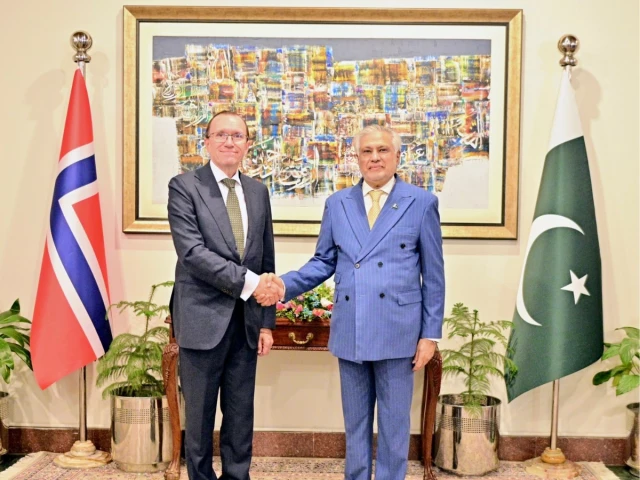
The two review bilateral cooperation, discuss trade, investment, climate change, maritime affairs and education
Norwegian Foreign Minister Espen Barth Eide holds bilateral talks with Deputy Prime Minister and Foreign Minister Ishaq Dar at the Ministry of Foreign Affairs in Islamabad. PHOTO: X
Norway’s Foreign Minister Espen Barth Eide commended Pakistan’s “important and constructive role” during the recent Iran-US conflict, including the leadership and contributions of Prime Minister Shehbaz Sharif, Deputy Prime Minister Ishaq Dar and Chief of Defence Forces Field Marshal Syed Asim Munir, during delegation-level talks in Islamabad on Thursday, the Foreign Office (FO) said.
Eide and Dar led the talks at the Ministry of Foreign Affairs (MoFA), where the two sides reviewed the “whole gamut of bilateral cooperation” and discussed trade, investment, climate change, maritime affairs and education, according to the FO.
The two sides also held “in-depth discussions on regional and international developments of mutual interest”. This is the first visit by a Norwegian foreign minister to the country in a decade.
Deputy Prime Minister/Foreign Minister Senator Mohammad Ishaq Dar @MIshaqDar50 and H.E. Mr. Espen Barth Eide @EspenBarthEide, Minister of Foreign Affairs of the Kingdom of Norway, led delegation-level talks at the Ministry of Foreign Affairs.
Both sides reviewed the whole gamut… pic.twitter.com/2yrfD8Lm0b
— Ministry of Foreign Affairs – Pakistan (@ForeignOfficePk) August 13, 2026
During the talks, Pakistan and Norway “expressed satisfaction at the warm and cordial state of Pakistan-Norway relations” and agreed to “further deepen cooperation in areas of mutual interest”.
The two sides also recognised the “important role of the Pakistani diaspora in Norway” and agreed to strengthen people-to-people ties between the two countries.
Speaking at a joint press briefing with Dar in Islamabad after their talks, Eide said Pakistan had taken on a “massive task” by offering Islamabad not only as the venue but also as the facilitator of negotiations.
“I know how hard it is,” Eide said, referring to peace mediation and facilitation. “I know what a massive task you’re taking on when you offered Islamabad, not only as the venue, but also as the facilitator of these talks.”
“What you personally, but also your prime minister, the field marshal, that you have been doing is really a service to the world, and hence also to us,” he said.
Eide said he wanted to “reiterate again strong support for the very important role that Pakistan has taken” since the conflict began on February 28.
“Norway was one of the Western countries that were clearest and earliest in stating that this war in itself is a violation of international rules,” he said.
Eide said Norway, as a “large shipping nation”, shared Pakistan’s interest in keeping sea lanes open and protecting freedom of navigation.
“We share an interest in open sea lanes, in the ability to trade in the high seas,” Eide said, stressing the importance of respecting the “very important constitution of the oceans”, the UN Convention on the Law of the Sea. “Whatever emerges from this tragic and unnecessary war in the Gulf, we need to protect the principle of free passage,” he said. “I’m so happy that we see completely eye-to-eye on what has to be this,” Eide added. He said that this is a global issue that the two countries have a shared interest in promoting.
“Even if we have significant disagreements with Iran on other issues, they also have the right to be protected and sustained, as we all have,” Eide said. He further added that Norway’s relations with both Iran and the United States gave it “an entry point to Iran”, while it remained “a close ally of the US”. “And knowing this field of peace mediation, facilitation, I know how hard it is,” Eide said.
Eide said he was “really happy and honoured” to be in Pakistan, noting that it had been 10 years since the last Norwegian foreign minister visited the country. He said he had promised Dar many months ago that he would come, “and today I live up to my promise.” Describing the visit as “short but very effective”, Eide said it was a “strong partnership” between Pakistan and Norway and between the two countries’ people.
He highlighted Norway’s “sizable diaspora of Pakistani descent”, saying Norwegian-Pakistani citizens held key positions in politics and society and were “a very welcome contribution to our country”. The diaspora, he said, also provided “an argument for strengthening our economic ties”.
Eide said Norway wanted to strengthen trade relations with Pakistan “in more structural ways”, including through the EFTA-Pakistan partnership. “That would provide for more economic relations for mutual benefit,” he said. Dar, speaking before Eide, said Pakistan and Norway had agreed to “enhance relations and cooperation in all other areas of mutual interest”, including trade, education, defence, investment, climate change, information technology and maritime affairs.
“Pakistan greatly values relations with Norway,” Dar said, adding that Islamabad wanted to strengthen the relationship “in the days, weeks and months to come”. He said both sides had agreed that bilateral trade remained below the potential of their respective economies and “needs to be enhanced through effective measures”.
“Pakistan offers enormous investment opportunities to Norwegian companies,” Dar said, pointing to Norwegian company Yara International’s joint venture with Fauji Fertilizer in Pakistan. “I hope this initiative will be a trailblazer for many more future projects between our two great countries,” he said.
On technology cooperation, Dar said that Pakistan IT exports to Norway have grown more than fivefold in the last two years. The two sides had also agreed on the “expeditious finalisation” of agreements and memorandums of understanding being processed by their respective ministries, Dar said.
On climate change, he said Pakistan and Norway shared “a convergence of perspectives”, noting that the two countries had signed an MoU under Article 6 of the Paris Agreement on April 1 this year. Dar also highlighted maritime cooperation, saying Pakistan’s strategic location made it “the most competitive and nearest recycling destination in this maritime region for ships coming from Norway”.
He thanked Norwegian maritime authorities for helping Pakistan build capacity and providing technical training for the ship-breaking industry in line with the Hong Kong Convention.
“Both Pakistan and Norway agreed to enhance people-to-people contacts,” Dar said, describing such ties as “social and cultural bridges” between the two countries.
On labour mobility, Dar said, “We agreed to continue work on legal pathways for Pakistan’s skilled manpower,” while stressing the need to combat “human smuggling and illegal migration”.
Dar said Pakistan and Norway shared a commitment to “multilateralism, the principles of the United Nations Charter, respect for sovereignty and territorial integrity, and the peaceful settlement of disputes”. “Both sides affirmed their desire to continue mutual support and consultations” in international bodies and multilateral forums, he said.
Dar said he had also briefed Eide on Indian Illegally Occupied Jammu and Kashmir (IIOJK), calling it “one of the long-standing unresolved international disputes” that had remained on the UN Security Council agenda since 1948.
He said India had “added a new dimension to an already volatile security situation” by unilaterally announcing the suspension of the Indus Waters Treaty “in contravention of international law”.
“We reiterate that India must end the weaponisation of water and uphold its treaty obligations,” Dar said. He also briefed Eide on Pakistan’s diplomatic efforts to promote “dialogue, de-escalation and peaceful settlement” of the US-Iran conflict. “I am grateful to His Excellency for appreciating Pakistan’s role as a mediator in the conflict,” Dar said.
He said the two ministers had remained in contact during the crisis, “exchanging notes and updating each other” on developments. Dar also discussed the Makkah Joint Defence Agreement, saying both sides agreed on the need for peaceful solutions to international conflicts “in full respect of the principles of international law and the UN Charter”.
Eide said the two sides had also discussed regional issues including Kashmir, Afghanistan and the situation in the Middle East. He said Norway was pleased to learn more about Pakistan’s new trilateral defence cooperation with Turkey and Saudi Arabia, describing the three countries as states with which Norway had “very good and close relations”.
Eide also highlighted Norway’s work with Saudi Arabia through the Global Alliance for the Implementation of the Two-State Solution.
“Norway has always had a strong dedication to making sure that the promise of what once was the Oslo Agreement one day is fulfilled,” he said, referring to the goal of a “free, sovereign and independent Palestinian state living in peace with its neighbour Israel and all other neighbours”. “We keep working on that,” he said, adding that Pakistan and Norway “totally agree and cooperate” on the issue.
On climate change, Eide said he had closely followed its impact on Pakistan, particularly the “extreme effects on Pakistan of floods and other expressions of climate change”.
He said the two countries had agreed that climate change was “also a foreign policy issue”. “That includes combating nature loss, climate change, promoting global health and fighting poverty,” Eide said. Dar said the visit was a “great privilege and satisfaction” and expressed confidence that it would “open a new chapter in Pakistan-Norway relations” and contribute to greater cooperation and prosperity for the people of both countries.
Earlier, the two counterparts held a restricted-format meeting, discussing the “full range of bilateral relations” and regional and international developments, and both sides reaffirmed their commitment to strengthening cooperation in areas of mutual interest.
According to the FO, Dar “warmly welcomed” Eide to Pakistan during the meeting, as the Norwegian foreign minister arrived in Islamabad for the first visit by a Norwegian foreign minister to the country in a decade.
The two sides also “reaffirmed their commitment to strengthening bilateral cooperation in all areas of mutual interest”.
Deputy Prime Minister/Foreign Minister Senator Mohammad Ishaq Dar @MIshaqDar50 held a restricted-format meeting with H.E. Mr. Espen Barth Eide @EspenBarthEide, Minister of Foreign Affairs of the Kingdom of Norway.
DPM/FM warmly welcomed Foreign Minister Espen Eide to Pakistan.… pic.twitter.com/JsWI11khxq
— Ministry of Foreign Affairs – Pakistan (@ForeignOfficePk) August 13, 2026
Eide arrived in Islamabad earlier on Thursday for an official visit and was received at the airport by Additional Foreign Secretary (Europe) Ambassador Ayesha Ali. His visit marked the highest-level visit between Pakistan and Norway in a decade.
The talks between Dar and Eide were part of a two-day visit aimed at advancing bilateral relations and expanding cooperation between Islamabad and Oslo.
According to a post on X, Eide, who is visiting Pakistan at Dar’s invitation, was received at the airport by Additional Foreign Secretary (Europe) Ambassador Ayesha Ali.
H.E. Mr. Espen Barth Eide (@EspenBarthEide), Minister of Foreign Affairs of the Kingdom of Norway, arrived in Islamabad this morning on an official visit to Pakistan. He was received at the airport by Additional Foreign Secretary (Europe) Amb. Ayesha Ali. pic.twitter.com/Wa502xiHKD
— Ministry of Foreign Affairs – Pakistan (@ForeignOfficePk) August 13, 2026
He later arrived at the Ministry of Foreign Affairs (MoFA), where Dar received him for talks that the Foreign Office described as the “highest-level visit between Pakistan and Norway in a decade”.
The two foreign ministers held delegation-level talks covering the “full spectrum of Pakistan-Norway relations”, according to the FO.
Deputy Prime Minister/Foreign Minister Senator Mohammad Ishaq Dar @MIshaqDar50 received H.E. Mr. Espen Barth Eide @EspenBarthEide, Minister of Foreign Affairs of the Kingdom of Norway, at the Ministry of Foreign Affairs today. The visit marks the highest-level visit between… pic.twitter.com/9edtQYeXw1
— Ministry of Foreign Affairs – Pakistan (@ForeignOfficePk) August 13, 2026
The sides discussed “avenues for further expanding bilateral cooperation”, with particular emphasis on trade and investment, climate change, renewable energy, education and people-to-people contacts.
The FO said the two sides also exchanged views on “important regional and international developments” during the talks.
According to an earlier statement issued on Wednesday, the FO said Eide was visiting Pakistan at the invitation of Dar and described the trip as the first visit by a Norwegian foreign minister in a decade.
🔈 PR No. 2️⃣0️⃣9️⃣/2️⃣0️⃣2️⃣6️⃣
Curtain Raiser: Visit of the Norwegian Foreign Minister to Pakistan
🔗⬇️ pic.twitter.com/unWEL2b9hz
— Ministry of Foreign Affairs – Pakistan (@ForeignOfficePk) August 12, 2026
The ministry said the visit would provide an opportunity to “further strengthen the longstanding and cordial relations between Pakistan and Norway” and “explore new areas of mutually beneficial cooperation”.
According to the statement, Dar and Eide were expected to hold delegation-level talks covering the “full spectrum of Pakistan-Norway relations”.
The two sides were also expected to discuss “avenues for further expanding bilateral cooperation”, particularly in trade and investment, climate change, renewable energy, education and people-to-people contacts.
The FO said they would also “exchange views on important regional and international developments”.
The ministry said the visit built on “sustained high-level engagement between the two countries”, including telephone conversations between Dar and Eide in March and April 2026.
It also referred to the visit of Norway’s State Secretary Andreas Motzfeldt Kravik to Islamabad in May, saying the latest engagement would build on those contacts.
The FO said the visit would offer an opportunity to further strengthen bilateral relations while exploring “new areas of mutually beneficial cooperation” between Pakistan and Norway.
