


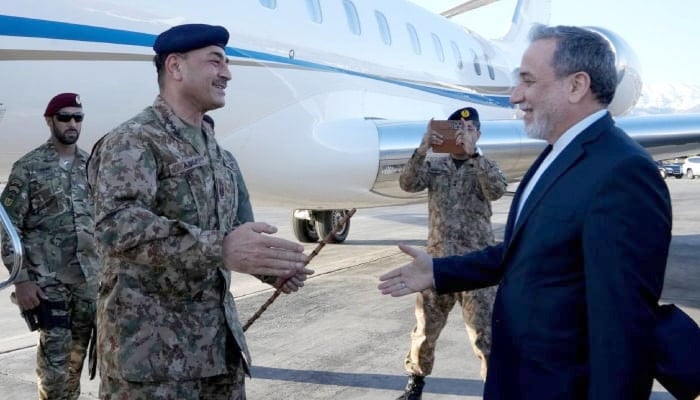
- CDF Munir to meet senior Iranian leaders in Tehran: security sources.
- US, Iran at odds over uranium stockpile, Strait of Hormuz: report.
- Rubio says ‘Plan B’ if Iran refuses to reopen Strait of Hormuz.
Chief of Defence Forces (CDF) and Chief of the Army Staff (COAS) Field Marshal Syed Asim Munir left for an official visit to Iran on Friday, security sources said.
The CDF Munir will hold discussions on the ongoing Iran-US talks, regional peace and stability, and other matters of mutual interest during the visit, the sources said.
During the visit, the COAS will also meet senior Iranian leadership to discuss bilateral cooperation and the evolving regional situation, the sources added.
A shaky ceasefire is in place in the war that began with US-Israeli strikes on Iran on February 28, after which Iran fired at Gulf states hosting US military bases and fighting broke out between Israel and Hezbollah in Lebanon.
But there has been no big breakthrough in peace efforts, with a US blockade of Iranian ports and Tehran’s grip on the Strait of Hormuz, a vital global oil supply route, complicating negotiations mediated by Pakistan.
The visit comes amid Pakistan’s ongoing efforts to mediate between the United States and Iran after plans for a second round of negotiations in Islamabad did not materialise.
The first round of direct US-Iran talks was held in Islamabad on April 11 and 12 following a Pakistan-brokered ceasefire on April 8. The negotiations ended without an agreement, but the talks did not collapse.
Pakistan has intensified its diplomatic efforts to break the deadlock by sending Interior Minister Mohsin Naqvi to Tehran on Wednesday for the second time in less than a week in an effort to revive negotiations.
During his previous visit over the weekend, Naqvi held meetings with Iran’s president, parliament speaker and foreign minister.
‘Pakistan remains primary interlocutor’
United States Secretary of State Marco Rubio said on Friday that they would all love to see an agreement with Iran but added that they are “not there yet.”
“There needs to be a plan B if Iran refuses to reopen the Strait of Hormuz,” Rubio added and noted that there was no concrete ask of Nato help on the strait.
A Qatari negotiating team also arrived in Tehran on Friday in coordination with the United States to help secure a deal to end the war with Iran and resolve outstanding issues, a source with knowledge of the matter told Reuters on Friday.
Rubio noted some progress on Thursday: “There’s some good signs,” he said. “I don’t want to be overly optimistic … So, let’s see what happens over the next few days.”
Asked on Friday about the Qatari team in Iran, Rubio told reporters on the sidelines of a gathering of Nato foreign ministers in Sweden that Pakistan was the primary interlocutor in the Iran talks and they had done an “admirable job”.
He added: “Obviously, other countries have interests, because especially Gulf countries that are, you know, in the middle of all this — they have their own situation going. And we talk to all of them. I would just say that the primary country we’ve been working with on all of this, is Pakistan, and that remains the case.”
Doha, which has worked as a mediator in the Gaza war and other areas of international tensions, had till now distanced itself from playing a mediation role in the Iran war after it came under attack from Iranian missiles and drones during the latest conflict.
The war has wreaked havoc on the global economy, with the surge in oil prices stoking fears of rampant inflation. About a fifth of the world’s oil and liquefied natural gas shipments travelled through the Strait of Hormuz before the war.
The US dollar was near its highest level in six weeks on Friday amid the uncertainty over the peace talks, while oil prices climbed as investors doubted the prospects of a breakthrough.
— With additional input from Reuters
