


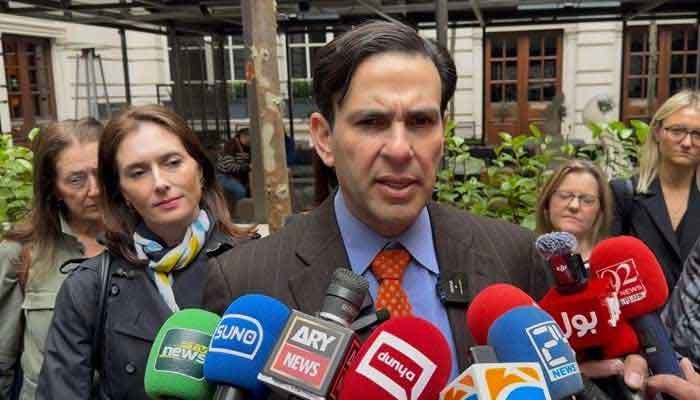
Pakistani-American technology entrepreneur Zia Chishti has won a landmark victory at the Supreme Court of Pakistan as the top court of the country dismissed a series of appeals filed by Greentree Holdings Limited, The Resource Group International Limited (TRGI) and The Resource Group Pakistan Limited (TRGP) against businessman Chishti in a major corporate dispute linked to the TRG group.
A three-member bench comprising Justice Naeem Akhter Afghan, Justice Muhammad Shafi Siddiqui and Justice Miangul Hassan Aurangzeb heard the connected matters and announced its short order, dismissing the petitions which were converted into appeals. In a highly unusual ruling, the bench ordered that the appellants pay Chishti’s costs, estimated in the millions of dollars. The order stated that detailed reasons would be recorded separately.
The case was brought to the Supreme Court of Pakistan after the Sindh High Court ruled a year ago that TRG Pakistan’s management had acted fraudulently and had directed the company to hold long-overdue board elections without further delay.
The court also blocked an attempted takeover of TRG Pakistan Limited by Greentree Holdings, declaring that nearly 30% of TRG shares acquired by Greentree were unlawfully financed. TRG Pakistan is led by its Chairman Mohammed Khaishgi and its CEO Hasnain Aslam, both Harvard graduates.
A large number of senior lawyers appeared in the proceedings, including Makhdoom Ali Khan, Abid S. Zuberi, Munir A. Malik and Mustafa Ramday, among others.
Pakistan’s Supreme Court heard that the years-long corporate battle involving TRG Pakistan Limited, The Resource Group International Limited and Greentree Holdings Limited revolves around an alleged “equitable fraud” orchestrated by directors accused of illegally consolidating control over billions of rupees in corporate assets while depriving more than 13,000 shareholders of their rights.
In detailed written submissions filed before the Supreme Court in CPLA No. 2543 of 2025, Zia Chishti alleged that certain directors of TRG Pakistan (TRGP), TRGI and Greentree unlawfully engineered transactions to entrench themselves in power, avoid shareholder accountability and gain personal financial benefits despite allegedly holding almost no meaningful economic interest in the companies.
The submissions stated that the dispute centres on TRGP surrendering a contractual right to sell part of its stake in TRGI in exchange for $120 million in cash and 5.4 million shares of publicly traded company Ibex Limited.
According to the filing, these assets were instead diverted into the offshore shell company Greentree to acquire shares in TRGP itself, thereby consolidating control of both TRGP and TRGI in the hands of a small group of directors.
According to the submissions, Greentree allegedly spent around $90 million acquiring TRGP shares, whose value later fell significantly alongside TRGP’s declining share price. The filing also claims that the directors extracted more than $100 million through share repurchases while paying themselves over $10 million in emoluments and causing the companies to incur more than $40 million in legal fees.
The dispute traces back to December 2021 when TRGI allegedly approved the allocation of substantial liquid assets among shareholders. The filing says that while most shareholders accepted share repurchases and received cash and Ibex shares, TRGP was allegedly prevented from doing so. Instead, TRGP’s board, allegedly controlled by conflicted directors sitting on both sides of the transaction, rejected the offer.
The submissions also accused the directors of deliberately delaying TRGP board elections due in January 2025.
According to the filing, a series of allegedly coordinated lawsuits were filed in civil courts in Kamalia, Lahore and Islamabad seeking injunctions to halt elections, often through proxy plaintiffs.
In the Supreme Court submissions, Chishti’s legal team rejected allegations concerning his personal conduct and argued that the case was fundamentally about protecting shareholder rights and corporate governance.
Exactly a year ago, Britain’s leading newspaper The Telegraph issued an apology to Zia Chishti for publishing allegations that he had engaged in sexual misconduct.
The newspaper said a series of articles it published from November 2021 and February 2023 reported on allegations made by a former employee of Afiniti, Tatiana Spottiswoode, to the United States Congress, about the company’s founder and CEO Zia Chishti.
Chishti disputed these allegations. Although Chishti sought to do so, Congress did not give him the opportunity to refute the allegations.
Chishti issued libel proceedings against The Telegraph in 2022 in the High Court of England and Wales. In an initial trial in June 2023 to determine meaning, Justice Susan Collins Rice determined that the allegations made by the paper carried factual imputation and were plainly defamatory of Chishti.
Finding against The Telegraph’s argument that it was simply reporting what Spottiswoode alleged and no further, Justice Rice concluded that The Telegraph’s reporting was not balanced and that it created a distinct impression of “where there is smoke there is fire.”
The Telegraph posted its apology in front of each of the thirteen articles it wrote between 2021 and 2023 that were critical of Chishti, and made its apology available without a paywall on The Telegraph’s online edition and in the Sunday print edition of The Telegraph. The Telegraph also paid Chishti substantial damages and legal fees.
Muhammad Ziaullah Khan Chishti also appeared in person before the court during the proceedings. During the case an associate belonging to a local law firm physically assaulted Zia Chishti within the Islamabad High Court.
There was later an attempted kidnapping of Chishti outside the Islamabad High Court, which he successfully fought off until the attackers scattered when bystanders gathered and started filming.
Zia Chishti, the founder and former chief executive of TRG, said he intended to seek a board seat following the ruling in his favour. He told Geo News: “I plan to contest for a seat on the board, and I am hopeful that we get three, possibly four seats on the board.
The allegations against me have repeatedly been proven false, in defamation and litigation in Pakistan and UK. I don’t perceive any reputation risk. It took me four years to adequately establish that the allegations against me are untrue. That’s all that matters.”
