


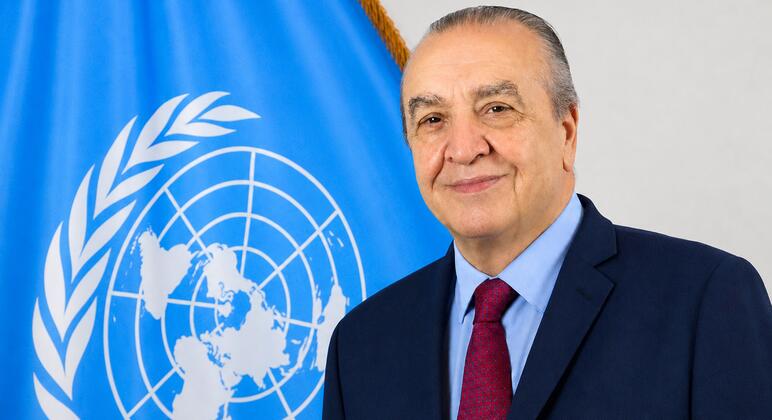
In a speech to Member States on Thursday, the veteran diplomat said his three priorities would be inclusivity, accelerating the Sustainable Development Goals (SDGs) and renewing trust in multilateralism, including by prioritising “substance over procedural routine” when it comes to the council’s work.
ECOSOC is the UN’s central platform for coordinating economic, social and environmental policy and for reviewing progress on the SDGs.
Mr. Bendjama also highlighted the fact that just 36 per cent of the goals with trend data are on track, emphasizing the need to accelerate progress towards 2030.
“It is time for complete and tangible results that advance our common agenda and leave no one and no country behind,” Mr. Bendjama said. He will take office for a one-year term starting on 31 July.
Outgoing president reflects on progress
Outgoing President Lok Bahadur Thapa, Permanent Representative of Nepal, highlighted the “indispensable” role ECOSOC plays in addressing issues of poverty, health and education.
“When we stand together, when we listen to one another, when we honour the dignity of every nation and every person, we demonstrate what multilateralism can achieve,” Mr. Thapa said.
Mr. Thapa acknowledged the lack of progress on the Sustainable Development Goals while underscoring that the 2026 High-Level Political Forum on Sustainable Development’s Ministerial Declaration, Sevilla Commitment and Financing for Development Forum outcome that consensus is still possible.
Secretary-General race heats up
The six candidates vying to succeed António Guterres as UN Secretary-General next year will participate in a debate before the General Assembly on Thursday evening.
As the UN faces criticisms over the effectiveness of the Security Council – alongside a self-admitted “existential liquidity crisis” – the next Secretary-General will be tasked with restoring and strengthening Member States’ confidence in the 81-year-old organisation.
Member States nominated candidates between late 2025 and early 2026. Candidates then released their vision statements. The Security Council must unanimously agree on its preferred candidate, and the Assembly must approve its selection with a simple majority vote.
Full details on the race can be found here.
The Secretary-General position has historically rotated between the world’s main regions. This year, the unwritten tradition would favor candidates from Latin America and the Caribbean.
The Assembly debate entitled UN Town Hall: The Next Secretary-General will take place on Thursday at 5 p.m. New York time. Candidates will answer randomly selected questions from Member States and civil society organisations.
The event will be broadcast live on UN Web TV.
Watch the debate here.
UN deplores alleged torture in Mali
The UN’s human rights office (OHCHR) has condemned the reported torture and killing of dozens of surrendering Malian soldiers in the Gao region on Saturday.
Armed militants with the Touareg-led Azawad Liberation Front (FLA) and the Jama’at Nusrat Al-Islam Wal-Muslimin (JNIM) allegedly fired at the Malian soldiers after they surrendered, which would be a war crime under international law.
“The armed groups must stop such violations and prevent any recurrence,” an OHCHR spokesperson wrote in a statement. “Accountability must be achieved, and those responsible must be brought to justice within fair trials. Remedy must be provided to victims and their families.”
On Wednesday, the Washington Post reported that the administration of US President Donald Trump is considering military action against the JNIM, a powerful regional militant group affiliated with al-Qaeda.
Multiple armed groups have clashed with Mali’s various military juntas and civilian governments since 2012, creating a humanitarian crisis with about 400,000 Malians internally displaced.
WHO works to prevent drowning
The UN’s World Health Organization (WHO) on Thursday announced seven new strategies to help policymakers improve safety around water to prevent drowning.
The strategies, under the acronym PROTECT, range from “physical infrastructure that promotes safe interaction with water” to “threat preparedness for floods and other multi‑hazard emergencies.”
Nearly 300,000 people die from drowning each year worldwide, and drowning remains among the ten leading causes of death among children aged 5 to 14 years, according to the WHO.
Drowning also disproportionately impacts developing countries, and climate change is accelerating risks due to extreme weather events.
“Every drowning is a tragedy, and most are preventable,” said WHO Director-General Tedros Adhanom Ghebreyesus.
Ghana leads the way
The WHO launched the strategies in Ghana to recognise the country’s growing political commitment to drowning prevention and its ongoing efforts to strengthen water safety.
An average of three people die from drowning every day in Ghana. In response, the Government launched a national lifeguarding initiative in April to train additional lifeguards.
“Drowning prevention isn’t the job of one ministry; it belongs to everyone, and the lives it saves are the reward,” Tedros said.
