


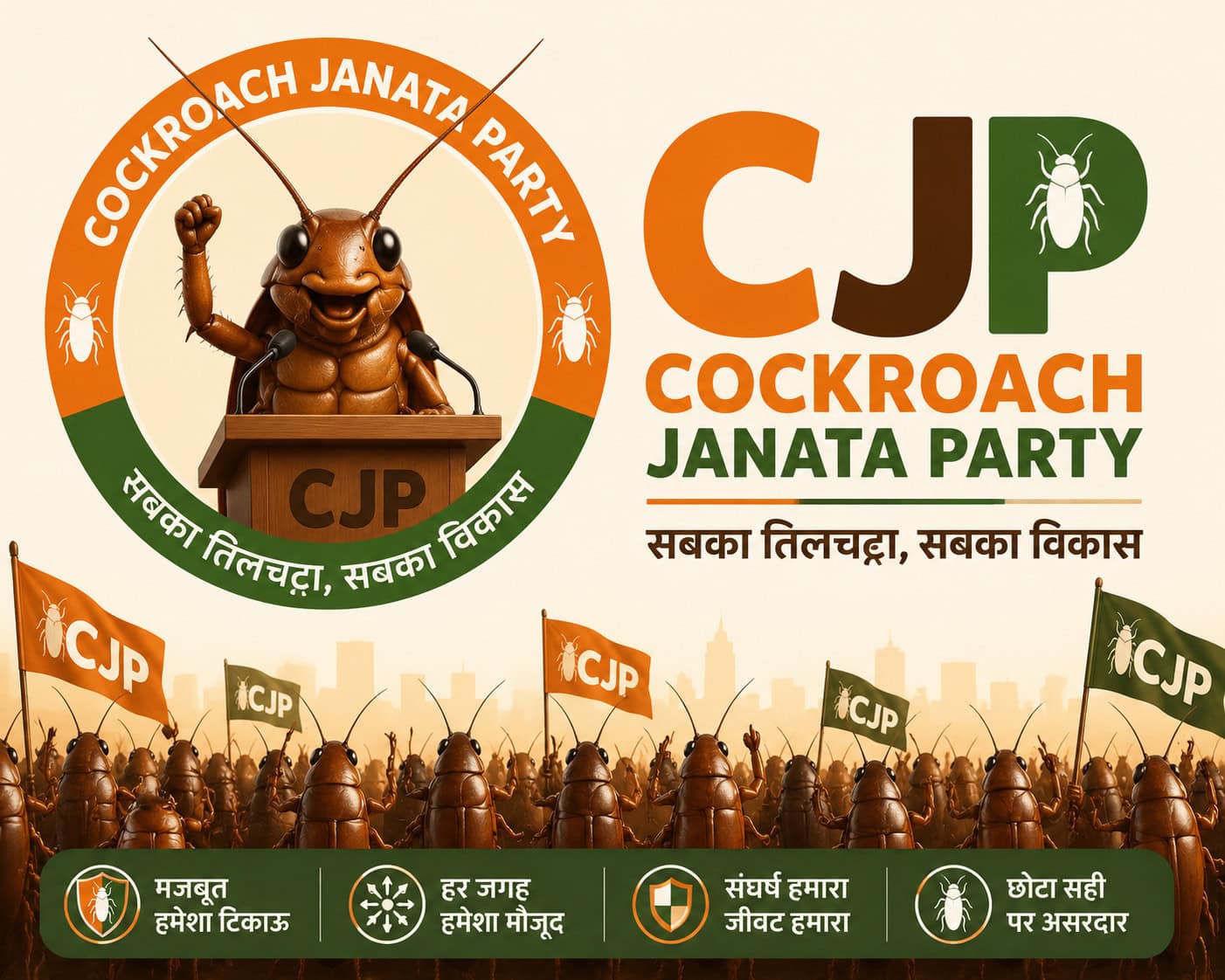
Nobody planned this. That is the first thing to understand.
The Cockroach Janta Party did not emerge from a think tank in Delhi or a strategy session in some air-conditioned boardroom. It came from the internet, which is to say it came from people who were tired, a little bored, and just sharp enough to turn their frustration into something funnier than a protest sign. Abhijeet Dipke started it. The rest of India ran with it. And within days, the whole thing had become so big, so loud, and apparently so threatening that the government decided the cleanest solution was to just make it disappear.
It did not disappear.
Let us start at the beginning. Earlier this year, the Chief Justice of India made remarks about unemployed youth that struck a nerve in a way only the truly tone-deaf can manage. The details of what was said matter less than what people heard, which was essentially this: that young Indians without jobs were something of a nuisance, a problem of their own making, a restless inconvenience. For a generation already grinding against a job market that has not kept its promises, it landed badly. It landed the way most dismissals from authority land on people who were already struggling to be taken seriously.
Someone, presumably sitting somewhere with too much time and too much wit, made the logical leap. If the establishment was going to talk about citizens the way one talks about pests, then the pests might as well form a party. The Cockroach Janta Party was born. The name alone deserved applause. The cockroach survives everything. Pesticide, famine, nuclear anxiety, government indifference. It does not ask for permission. It does not wait to be noticed. It just keeps going.
People got it immediately.
Within five days the CJP’s Instagram account crossed ten million followers. Ten million. There is a number that needs no decoration. For comparison, the BJP, the ruling party of the largest democracy on the planet, the party of Narendra Modi, the party that controls the levers of the state, shapes what gets broadcast on prime time television, and has spent years building a following through every tool available to a government with no apparent interest in restraint, was sitting behind that number. A cockroach meme account had more followers than the party currently running India. One can have many opinions about what that means, but one cannot pretend it means nothing.
The X account told a sharper story. It launched on the 16th of May. By the 20th, somewhere around the 200,000 follower mark, it was gone. Not gone everywhere. Gone in India. Users outside the country could still see it just fine. Users inside India found it withheld, which is the polite bureaucratic word for blocked at the government’s request. Four days. The account was four days old. It had not called for violence. It had not targeted a religious community. It had not spread medical misinformation or published state secrets. It had made people laugh while pointing at something true. That was apparently the problem.
The government will point to the IT Act, to Section 69A, to the legal scaffolding it has quietly built over the years specifically so that moments like this one can be handled without too much public mess. Laws written broadly enough to mean almost anything, applied narrowly enough to mean exactly what the people holding power need them to mean in a given moment. That is what was used here. A law designed for genuine national security threats, deployed against a satirical account that had been alive for four days. The clause matters less than the choice. And the choice was to silence people who were laughing at the wrong thing.
India’s Constitution has an answer to this question, or at least it tries to. Article 19 is not ambiguous. The right to freedom of speech and expression is listed there alongside the other fundamental rights, placed deliberately by people who had spent decades under a government that did not believe its subjects deserved to speak freely. The framers of that document were not naive. They had lived the consequences of censorship. They knew what a state looks like when it treats dissent as disorder. They wrote the protections anyway, specifically because they understood the temptation that power always feels to reach for silence when laughter gets too loud.
Satire is legal in India. It has always been legal. More than that, it has a history in this country stretching back further than most people remember. Political cartoonists have been fighting this specific battle for decades. The instinct to reach for the censor’s pen when the joke lands too close to home is not new. What is new is the scale. Ten million followers is not a fringe phenomenon. That is not a niche community of English-speaking Twitter critics. That is a number that crosses languages, age groups, and regions. That is something closer to a national mood having a moment of recognition.
And the government’s answer to that national mood was to turn off the lights in the room.
Here is what is worth saying plainly. A government that feels genuinely secure in what it has done for its people does not panic at cockroach memes. It does not send takedown requests because a four-day-old satirical account is growing faster than expected. Confidence does not look like this. Confidence engages, ignores, or laughs along. What the blocking of the CJP’s account communicated, without meaning to, was that someone in a position of authority looked at what was being said, understood what it meant, and found it uncomfortable enough to act against. The act of suppression was itself a kind of confession.
Predictably, it made everything worse for them. Or better, depending on which side of this one stands. The Streisand Effect is the internet’s most dependable law: trying to make something disappear guarantees that more people will look for it. The block became its own headline. People who had never heard of the Cockroach Janta Party learned about it specifically because the government had tried to hide it. The news spread internationally. The story shifted from a funny viral moment to a press freedom story, and press freedom stories travel far.
What Abhijeet Dipke and the people who built this thing online managed to do is genuinely rare. They made millions of people feel that their discontent was not just valid but shareable, that it could be funny without being cheap, that you did not need a political party or a formal platform to say something true about the country you live in. Young people who had never participated in political discourse in any recognizable sense found themselves sending cockroach memes with something resembling conviction. That is not nothing. That is actually quite hard to manufacture, and it cannot be manufactured at all. It either happens or it does not.
The government blocked an account. The conversation did not stop. It rarely does.
What India is really watching in all of this is something older than social media and older than the BJP and older than the current political moment. It is a country figuring out whether the promise of 1947 still holds. Whether citizens who find creative and peaceful ways to say difficult things will be heard or hushed. Whether power in India has the kind of genuine self-assurance that can absorb criticism and mockery and still stand, or whether it needs silence to feel safe.
The cockroach, as a metaphor, keeps working because it is honest. It does not claim to be noble. It does not ask to be loved. It just refuses to be gone.
The government tried to step on it.
The cockroach is still here.
