


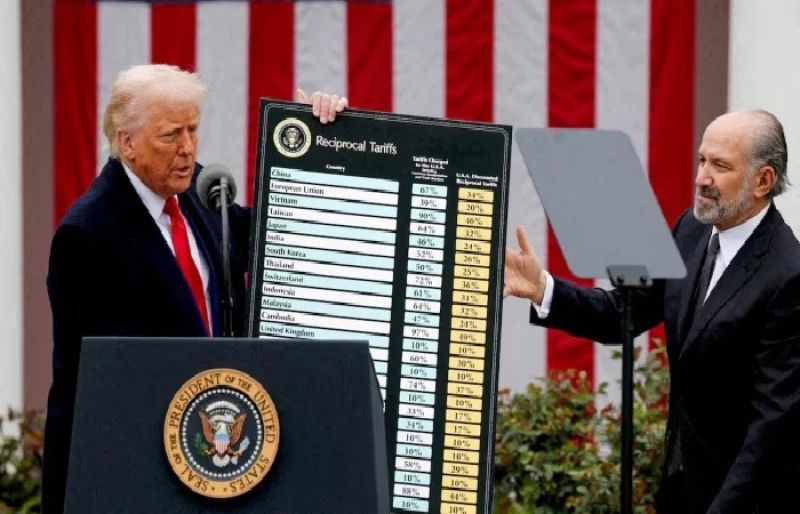
The move is the White House’s latest effort to restore President Donald Trump’s vision of a near-global tariff after the US Supreme Court in February struck down his “reciprocal” duties of 10% to 50% imposed under a national emergencies law to try to shrink the US trade deficit.
New tariffs had been expected, but trade partners around the world joined in strongly disputing the justification for them. Some, however, noted they would make little difference to current levies. There was little early reaction on financial markets more focused on the Middle East conflict.
The new tariffs, announced in a Federal Register notice, cover 99.4% of US imports, but include numerous product exemptions, such as oil and gas, fertiliser and certain food items.
“The United States has had a forced labour import ban for nearly a century, and rigorously enforces it. It’s well past time for our trading partners to do the same,” US Trade Representative Jamieson Greer said in a statement.
“Today’s action will begin to correct what is both a human rights abuse and distortive trade practice to improve the welfare of workers everywhere.”
Imposed under Section 301 of the Trade Act of 1974, the new duties allow the administration to maintain a tariff floor on virtually all US imports despite the Supreme Court setback. The tariffs are also likely to face less legal risk as Section 301 has survived prior court challenges.
Trump’s temporary 10% global tariff expired at 12:01 am EDT on Friday (0401 GMT) after 150 days. The new duties took effect at that exact same moment, with goods in transit exempted until 12:01 am EDT on July 28.
The US imposed a 10% duty on goods of Argentina, Bangladesh, Britain, Cambodia, Canada, Ecuador, El Salvador, Guatemala, Honduras, India, Indonesia, Jordan, Malaysia, Mexico, Pakistan, Sri Lanka, Trinidad and Tobago.
The European Union, Taiwan, Japan, South Korea and Switzerland were assigned rates that, combined with pre-existing most-favoured-nation tariff rates, totalled 10% or 12.5%.
The other 38 countries were assigned a 12.5% rate. These include Vietnam, which issued a new decree this week that sets out more detailed rules banning imports of goods made with forced labour, and China.
Greer previously pledged that for countries with trade deals with Washington capping US tariff rates, the new forced labour duties would not push them above those caps – a point which the EU noted in its response.
“The EU notes positively the fact that this outcome is in line with the US tariff commitments agreed under the EU-US Joint Statement,” a European Commission spokesperson said, adding it provided “positive momentum” to continue the work on exploring further tariff exemptions and deepening cooperation.
While disputing the allegations underlying the forced labour investigation, the Swiss government also said the United States was adhering to past commitments on tariff ceilings, in its case of up to 12.5%.
Britain said the move would have no negative effects.
“There is no negative change to the tariff rate facing UK businesses as a result of this announcement. Our agreement with the US remains in place, and today we see an improvement to our trading terms with zero tariffs on whisky and medical technology,” a government spokesperson said.
Trump administration officials have told Chinese counterparts they intend to rebuild Trump’s second-term tariffs on Chinese goods back up to the 20% that was agreed upon in a trade truce with Chinese President Xi Jinping in November 2025 – but not exceed that level. Prior to Friday’s action, China’s tariff rate had fallen to 10%, excluding the 25% imposed during Trump’s first term on industrial goods.
Widely telegraphed move with exemptions
The action drew stronger protests from some trade partners.
Beijing condemned fresh US tariffs imposed on China and 59 other countries over alleged forced labour concerns Friday, and warned Washington against waging a trade war.
The US levies range from 10 to 12.5%, with China slapped with the highest rate.
“We oppose all forms of unilateral tariff measures,” Chinese foreign ministry spokesperson Lin Jian told a news briefing on Friday.
“Tariff wars and trade wars are not in the interests of any party,” he warned.
Norway’s Foreign Minister Espen Barth Eide said “there is no basis for this tariff against Norway because we already have clear rules that are intended to prevent trade in goods produced using forced labour.”
Australia and Brazil described the new tariffs as unjustified and said they would seek to have them removed, while Norway said there was “no basis” for them.
Canada – hit on Monday with new Trump tariffs on $20 billion worth of goods – issued a muted response.
“We will continue engaging constructively with the United States on this matter, as well as other outstanding issues, over the coming weeks to the mutual benefit of our citizens,” said Dominic LeBlanc, Canada’s minister in charge of US trade.
Kelly Ann Shaw, a former White House trade adviser in Trump’s first term and a partner with the Akin Gump Strauss Hauer & Feld law firm, said the new tariffs tracked what had been telegraphed, although some changes had been made, including the addition of some 471 products to an exclusion list.
“I think this is more status quo in terms of the economic impact,” she said.
Many goods will be exempted from the duties, including oil and gas, fertiliser, certain foodstuffs and goods already subject to Section 232 national security tariffs, such as autos, steel, aluminium and copper, the official said. Aircraft and parts will also be exempted, along with critical minerals.
There were some winners.
The Antwerp World Diamond Centre said the restored exemption was significant news for the local diamond sector. Belgium exported $2.1 billion of polished diamonds to the United States in 2024. The exemption had lapsed after the US Supreme Court struck down Trump’s global tariffs in February.
