


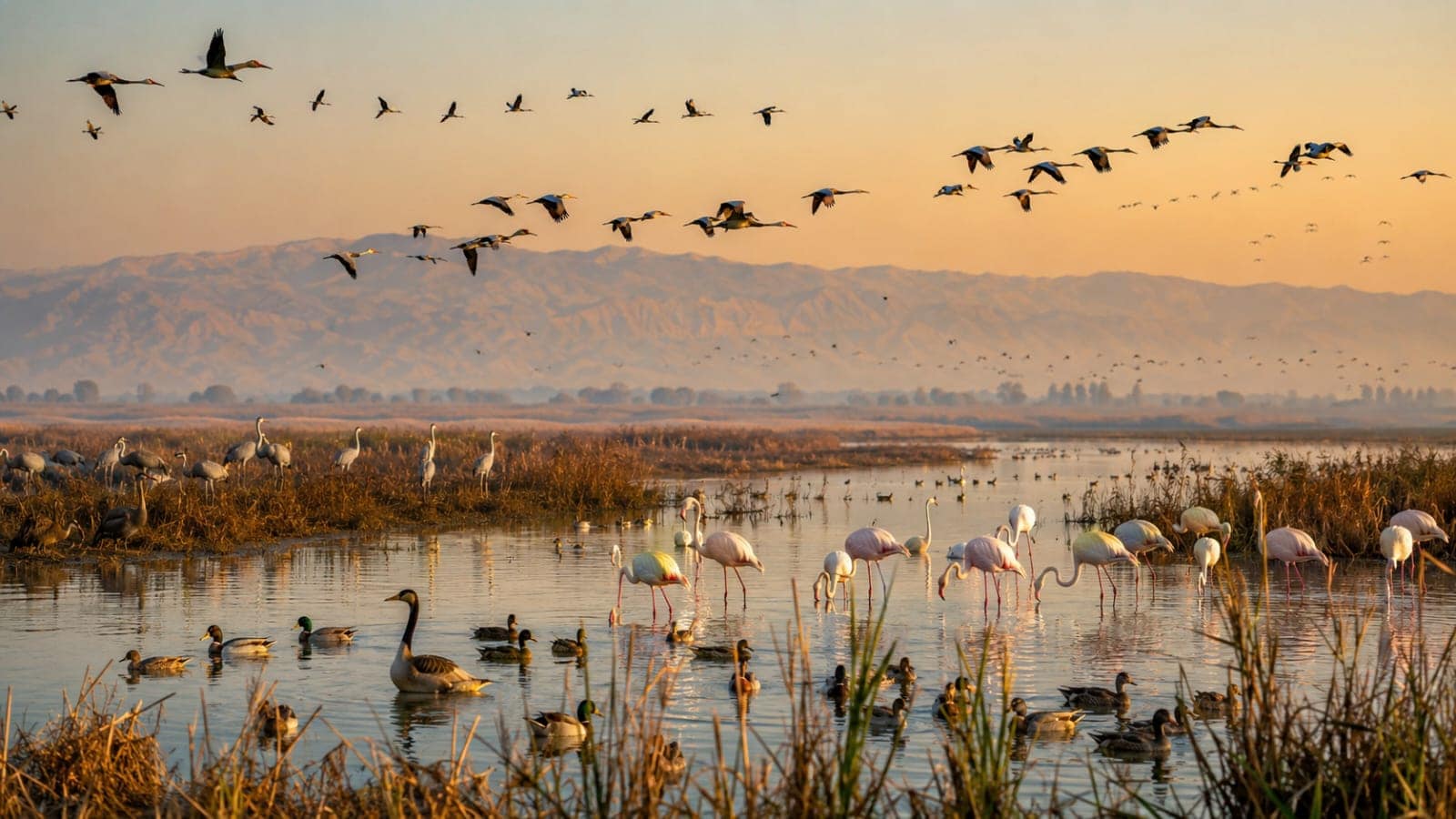
An Introduction to Naseer Ahmed Nasir’s “Farewell to the Guest Birds”
Written on the Occasion of World Migratory Bird Day
By Mustafa Maharvi
There are poems that celebrate the arrival of spring, and there are poems that lament the departure of autumn. But rarely—so rarely that one must search across literatures and languages to find a parallel—does a poem occupy the precise, painful, and profoundly human space between departure and return, between farewell and welcome, between the grief of loss and the grief of what will be lost while we wait. Naseer Ahmed Nasir’s “Farewell to the Guest Birds / مہمان پرندوں کو الوداع,” written in 1993, is such a poem. It is a lyric of leave-taking that is also, in its deepest structure, a work of ecological prophecy. It bids goodbye to the migratory birds not with the easy hope that they will find the world unchanged upon their return, but with the terrible knowledge that the world they left is already being dismantled behind them.
The poem opens with a salutation of heartbreaking directness: “Farewell, O guests! O birds, farewell!” The repetition is ritualistic, almost liturgical. It performs the act of leave-taking as a ceremony, a formal observance that belongs to an ancient human tradition of acknowledging the departure of those who come and go with the seasons. The migratory bird is, in this sense, the most poignant of all creatures: it belongs to two worlds and is fully at home in neither. It arrives as a guest and departs as a traveler, and its presence among us is always temporary, always borrowed, always already shadowed by the knowledge of its going. Sir Nasir’s poem honors this temporariness by giving it a voice, by transforming the bird’s cyclical passage into a drama of human waiting and earthly transformation.
“Next year,” the poem promises, “when you return, bearing the scriptures of your flights, we shall be waiting for you upon the shores of the lakes.” The image of the birds carrying “scriptures of their flights” is one of the most compressed and luminous metaphors in modern Urdu poetry. A scripture is a sacred text, a revealed book, a document that carries the weight of ultimate truth. The flights of the migratory birds are, to Sir Nasir, a kind of scripture—a text written across the sky, a revelation inscribed in the patterns of migration, a sacred narrative that the birds carry with them from continent to continent. To await their return is to await not merely the return of beauty, but the return of meaning. The touch of their “beautiful, soft, delicate feathers” is enough, the poem tells us, to bring love back to the earth. This is not hyperbole. It is a theology of the natural world in which the bird is a messenger of grace, and its return is an annual resurrection.

But the poem does not linger in the consolations of hope. It pivots, with a single word—”But”—and begins the catalogue of what will have changed by the time the birds return. A thick, dense layer of moss will have spread over the waters. The winds will be swollen with dust, with the smoke of black filth, with grime. The fields, the pastures, the meadows of grass, the deep forests—all of them will have been “sliced by the saw of new roads,” cut to pieces. And the conspiracies of the hunting seasons will have sharpened. The poem’s ecological vision is unflinching. It names the agents of destruction precisely: eutrophication, air pollution, habitat fragmentation, industrial development, and the deliberate killing of birds. It does not offer the comfort of a solution. It offers the harder comfort of truth.
This is the poem’s singular, devastating achievement: it transforms the conventional farewell poem—a genre that typically expresses hope for safe return—into a work of ecological accounting. The joy of the birds’ anticipated return is not cancelled by the destruction that awaits them. It is mourned in advance. The final line—”we shall mourn the joy of your return”—is a paradox that contains the entire ethical weight of the poem. To mourn joy is to acknowledge that joy and sorrow are not opposites but companions, that the return of the birds will be both a cause for celebration and an occasion for grief, because the world they return to will be less whole than the world they left. The poem does not ask us to choose between hope and despair. It asks us to hold both simultaneously, to let the joy of the birds’ fidelity sharpen our grief at our own infidelity to the earth they trust us to protect.
World Migratory Bird Day 2026 carries the theme “Every Bird Counts – Your Observations Matter!” It is a campaign that celebrates community science, the millions of bird enthusiasts around the world whose recorded observations contribute to the knowledge that informs conservation policy. From backyard bird counts to the International Waterbird Census—which marks its 60th anniversary this year—ordinary people are helping to build the data that can track migration patterns, population trends, and habitat changes across the world’s flyways. Every observation, the campaign insists, matters. Every bird counts. This is a vital and hopeful message. It tells us that we are not powerless, that our attention is a form of action, that the simple act of watching and recording can contribute to the preservation of what we love.
But Sir Nasir’s poem arrives from 1993 to remind us that observation, while necessary, is not sufficient. The poem itself is an act of observation—the poet has watched the birds depart, has noted the moss on the water, the dust in the air, the roads cutting through the forests—but it is an observation that leads not to data but to lament. The poem’s task is not to count the birds but to mourn the conditions of their counting. It is to say: we are observing the destruction, and the destruction continues. We are noting the decline, and the decline deepens. Our observations matter, yes—but do they matter enough to stop the saw of the new roads? Do they matter enough to dismantle the conspiracies of the hunting seasons? Do they matter enough to ensure that when the birds return, the shores of the lakes are still there, still clean, still capable of receiving the scriptures of their flights?
These are not comfortable questions. But they are the questions that poetry, at its most serious, exists to ask. Sir Nasir’s poem does not disparage observation. It deepens it. It insists that observation must be accompanied by grief, and that grief must be accompanied by action. The “mourning of joy” that closes the poem is not passive. It is a form of witness. It is a way of saying that we will not let the birds return to a ruined world without acknowledging that the ruin is our doing. It is a way of taking responsibility in the only language available to a poet: the language of felt sorrow, of public lament, of a farewell that is also an unspoken promise to do better.
World Migratory Bird Day reminds us that migratory bird conservation is a shared responsibility. Birds do not recognize borders. They travel across nations, across continents, across hemispheres, following routes that were ancient before the first human drew the first map. The flyways that connect the Arctic to the tropics, the breeding grounds to the wintering grounds, are living threads in a fabric that encompasses the entire planet. When a wetland is drained in one country, the birds that depended on it suffer in another. When a forest is cleared in one continent, the migrants that rested there arrive exhausted and depleted in the next. The community science that World Migratory Bird Day celebrates is an attempt to see this whole picture, to understand the “story of the flyways” in its full, interconnected complexity. But Nasir’s poem reminds us that the story of the flyways is also a story of loss, of habitats destroyed and populations diminished, of a world growing less hospitable to the creatures that have traversed it since time immemorial.
I have translated this poem with the care that its clarity demands. Sir Nasir’s Urdu is deceptively simple. It does not rely on ornate vocabulary or intricate metaphor. It speaks plainly, directly, with the unadorned authority of someone who has watched the birds leave and knows what they will find when they return. The translation has sought to preserve this plainness, this directness, this unflinching quality that makes the poem so difficult to forget. The word “scriptures” is deliberate: the flights of the birds are a text we must learn to read. The word “mourn” is deliberate: the joy of return is real, but it is shadowed by the grief of what has been lost in the interim. The word “farewell” is deliberate: it is repeated, ritualized, made into a ceremony, because the departure of the birds is an event that deserves the dignity of formal acknowledgment.
Let this poem be your companion on World Migratory Bird Day (WMBD). Read it aloud. Let its cadences carry you. And then go outside—if you can, if there are birds in your part of the world, if the migratory season has brought them to your lakes and your shores—and observe. Count them. Record them. Contribute your small piece of data to the global effort to understand and protect them. But also, and just as importantly, let yourself feel the grief that Sir Nasir’s poem makes space for. Let yourself mourn the joy of their return before they have even left. Because that mourning, that anticipatory grief, is not despair. It is the beginning of responsibility. It is the seed of a love that might, if we nurture it, grow into the kind of action that ensures that when the birds return next year, and the year after, and the year after that, the shores of the lakes are still waiting for them, and the air is clean enough to carry the scriptures of their flights, and love—that love the poem promises—returns once more to the earth.
The poem “Farewell to the Guest Birds” has been translated into the six official languages of the United Nations—English, Spanish, French, Russian, Arabic, and Chinese—by the distinguished journalist, editor, and polyglot Mr. Mustafa Maharvi. Mustafa Maharvi heads a non-governmental organization working on disarmament, animal rights, and human rights.
Farewell to the Guest Birds
Naseer Ahmed Nasir
Translated by Mustafa Maharvi
Farewell, O guests! O birds, farewell!
Farewell until the year to come!
The year to come—
when you return, bearing the scriptures of your flights,
we shall be waiting for you
upon the shores of the lakes.
The moment we receive the touch of your beautiful, soft, delicate feathers,
love will return once more to the earth.
But by the year to come,
a thick, dense layer of moss will also have spread over the waters.
The winds will be swollen with dust,
with the smoke of black filth,
with grime.
The fields, the pastures, the meadows of grass, the deep forests—
sliced by the saw of new roads,
will have been cut to pieces.
The conspiracies of the hunting seasons, too, will have sharpened.
Farewell, O guests! O birds, farewell!
Until the year to come,
we shall mourn the joy of your return!
Despedida a los Pájaros Huéspedes
Naseer Ahmed Nasir
Traducción del urdu: Mustafa Maharvi
¡Adiós, oh huéspedes! ¡Oh pájaros, adiós!
¡Adiós hasta el año venidero!
El año venidero,
cuando regreséis trayendo las escrituras de vuestros vuelos,
estaremos esperándoos
en las orillas de los lagos.
Apenas recibamos la caricia de vuestras hermosas, suaves y tiernas plumas,
el amor volverá de nuevo a la tierra.
Pero para el año venidero,
las aguas
ya habrán acumulado gruesas capas de musgo.
Los vientos estarán cargados de polvo,
del humo de la negra inmundicia,
de hollín.
Los campos, las praderas, los prados de hierba, los bosques espesos—
cortados en pedazos
por la sierra de las nuevas carreteras.
Y las conspiraciones de las temporadas de caza también se habrán agudizado.
¡Adiós, oh huéspedes! ¡Oh pájaros, adiós!
Hasta el año venidero,
¡celebraremos con duelo la alegría de vuestro regreso!
Adieu aux Oiseaux Hôtes
Naseer Ahmed Nasir
Traduit de l’ourdou par Mustafa Maharvi
Adieu, ô hôtes ! Ô oiseaux, adieu !
Adieu jusqu’à l’an prochain !!
L’an prochain,
lorsque vous reviendrez portant les écritures de vos vols,
nous vous attendrons
sur les rives des lacs.
À peine recevrons-nous la caresse de vos plumes belles, douces, soyeuses,
que l’amour reviendra sur la terre.
Mais d’ici l’an prochain,
les eaux
auront déjà accumulé d’épaisses couches de mousse.
Les vents seront gonflés de poussière,
de la fumée de la noire saleté,
de suie.
Les champs, les pâturages, les prairies d’herbe, les forêts profondes —
découpés en morceaux
par la scie des nouvelles routes.
Et les conspirations des saisons de chasse se seront aiguisées.
Adieu, ô hôtes ! Ô oiseaux, adieu !
Jusqu’à l’an prochain,
nous célébrerons dans le deuil la joie de votre retour !!
Прощание с перелётными птицами
Насир Ахмед Насир
Перевод с урду: Мустафа Махарви
Прощайте, о гости! О птицы, прощайте!
Прощайте до будущего года!!
В будущем году,
когда вы вернётесь, неся священные писания своих полётов,
мы будем ждать вас
на берегах озёр.
Едва мы ощутим прикосновение ваших прекрасных, нежных, мягких перьев,
любовь снова возвратится на землю.
Но к будущему году
воды
уже покроет толстый, плотный слой тины.
Ветры будут разбухать от пыли,
от дыма чёрной скверны,
от копоти.
Поля, пастбища, травяные луга, дремучие леса —
пилой новых дорог
разрезаны будут на множество кусков.
И заговоры охотничьих сезонов станут острей.
Прощайте, о гости! О птицы, прощайте!
До будущего года
мы будем радость вашего возвращения оплакивать!!
وداعًا للطيور الضيوف
نصير أحمد ناصر
ترجمة: مصطفى مها روي
وداعًا، أيها الضيوف! أيتها الطيور، وداعًا!
وداعًا حتى العام القادم!!
في العام القادم
حين تعودون حاملين صحائف تحليقكم
سنكون بانتظاركم
على ضفاف البحيرات
وما إن تلمسنا ريشاتكم الجميلة الناعمة الرقيقة
حتى يعود الحب إلى هذه الأرض
لكن، حتى العام القادم
ستكون المياه
قد غطتها طبقات كثيفة من الطحالب
وستكون الرياح مثقلة بالغبار
وبدخان القذارة السوداء
وبالعوالق
الحقول، والمراعي، ومروج العشب، والغابات الكثيفة
ستكون قد قطعت إلى أجزاء عديدة
بمنشار الطرق الجديدة
ومؤامرات مواسم الصيد ستكون قد اشتدت
وداعًا، أيها الضيوف! أيتها الطيور، وداعًا!
حتى العام القادم
سنحتفل حزنا بفرحة عودتكم!!
告别候鸟
纳西尔·艾哈迈德·纳西尔 著
穆斯塔法·马哈维 译
再会了,啊,远方的来客!啊,鸟儿们,再会!
再会,直到来年!!
来年——
当你们携着飞翔的经卷归来,
我们将在湖畔
等候你们。
一触到你们美丽、柔软、细密的羽毛,
爱便将再度重返大地。
然而,到来年时,
水面上
也将积起厚厚的苔藓层。
风中将塞满尘土,
充满黑色污浊的烟,
布满灰烬。
田野,牧场,如茵的草地,密密的森林——
被新路的锯刃
切成无数碎片。
猎季的阴谋也将磨得更利。
再会了,啊,远方的来客!啊,鸟儿们,再会!
直到来年,
我们将为你们归来的喜悦而哀悼!!
مہمان پرندوں کو الوداع
نصیر احمد ناصر
الوداع اے میہمانو! اے پرندو الوداع!
اگلے برس تک الوداع!!
اگلے برس
جب تم اڑانوں کے صحیفے لے کے آؤ گے
تو جھیلوں کے کنارے
ہم تمہارے منتطر ہوں گے
تمہارے خوبصورت نرم نرمیلے پروں کا لمس پاتے ہی
زمیں پر پھر محبت لوٹ آئے گی
مگر اگلے برس تک
پانیوں میں
کائی کی موٹی تہوں کا بھی اضافہ ہو چکا ہو گا
ہوائیں دُھول سے،
کالی کثافت کے دُھوئیں سے،
گرد سے لبریز ہوں گی
کھیت، بیلے، گھاس کے میداں، گھنے جنگل
نئی سڑکوں کی آری سے
کئی ٹکڑوں کی صورت کٹ چکے ہوں گے
شکاری موسموں کی سازشیں بھی تیز ہوں گی
الوداع اے میہمانو، اے پرندو الوداع!
اگلے برس تک
ہم تمہارے لَوٹ آنے کی خوشی کا دکھ منائیں گے!!
(1993ء)
Naseer Ahmed Nasir is a poet who has spent a lifetime thinking about the architecture of human isolation. Born in 1954 in the small village of Nagrian, in Tehsil Kharian of District Gujrat, Punjab, and now resident in Rawalpindi, Nasir has lived through the great transitions of Pakistani history—the wars, the military governments, the urbanizations, the digital revolutions—and his poetry has absorbed these transformations without ever becoming merely topical. His work is deeply philosophical without ever becoming abstract. It thinks through the body, through the heart, through the specific, aching texture of human longing. He is a poet of ideas, but his ideas are always drenched in experience, always tethered to the concrete realities of skin and breath and the unbearable weight of being alone in a crowd. His collections—”Paani Mein Gum Khaab,” “Teesray Qadam Ka Khamyaza,” “Surmai Neend Ki Baazgasht,” and others—have established him as one of the most important and intellectually ambitious voices in contemporary Urdu literature, a poet whose work has been translated into multiple languages and whose influence extends far beyond the borders of his native country. In 2026, he was awarded the Sitara-i-Imtiaz, the Star of Excellence, one of the nation’s highest civilian honors. Such awards are not merely decorations. They are confirmations that Nasir’s kind of poetry—unsettling, philosophically rigorous, emotionally demanding—is central to the cultural life of his nation and to the global conversation about what poetry can do.
