


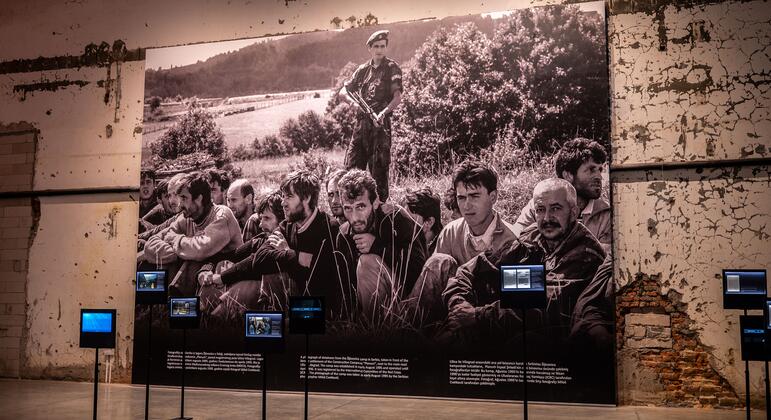
The Bosniak Muslim men and boys were murdered by Bosnian Serb forces in a designated area in the eastern European town which had been declared safe by the UN Security Council.
The UN later acknowledged the collective failure to prevent genocide in Srebrenica.
Three survivors explained how they have worked as curators and archivists at the Srebrenica Memorial Centre to ensure that the true story of the genocide is told.
The centre is built on the very ground where thousands once sought the protection of UN peacekeepers.
Almasa Salihovic is spokesperson for the Srebrenica Memorial Center.
Almasa Salihovic: I was eight years old when I survived the genocide in Srebrenica. My brother was killed in the genocide and uncles, both from my mother’s and father’s side, were killed. There were 8,372 victims.
Azir Osmanovic: On the main road, there was a checkpoint where they separated men and boys. And later on many of those people were killed.
A wall of portraits and a display of shoes belonging to the men and boys who were killed is displayed at the Srebrenica Memorial Center.
Almasa Salihovic: I firmly believe that, when you remember, it helps you heal, it helps your family heal. Every time I tell a story about my brother, about my family, I see myself talking the stories of all of us.
I specifically chose the Srebrenica Memorial as a place where I started working five years ago because I always wanted to give a piece of me to memorialisation, to remember.
Amra Begic Fazlic
Amra Begic Fazlic: We escaped from Srebrenica between 1992 and 1995. But in 2003, I decided to come back to Srebrenica and try to find a way to live here again. It was not easy.
Most of us who decided to return. We were thinking, we have to stay closer to our dearest. To finish the identification process, to bury them here in the Memorial Centre and to have a place to visit them.
Azir Osmanovic, curator at the Srebrenica Memorial Center.
Azir Osmanovic: This is part of our history and my obligation to talk about it, to talk about genocide in Srebrenica and everything we survived here. It’s not just my personal story, it’s the story of the thousands of people who were here during the siege of this town.
We have personal belongings of the victims of genocide which were found in the mass graves together with the bodies of the victims. This boot belongs to my cousin. He was a 16-year-old boy when he was killed during. His two brothers were also killed.
Gravestones mark the final resting places of the men and boys who were killed in the Srebrenica genocide.
Almasa Salihovic: What scares me the most is that people deny it. Generations younger than mine are growing today with that false narrative that genocide did not occur, that a war crime did not occur, that people who were killed here were just soldiers. Here, we deal with the facts.
Amra Begic Fazlic: Genocide denial is, according to the definition, the last phase of the genocide. Unfortunately, here in Bosnia, we can now talk about the next one. It is glorification of war criminals.
How does the UN define genocide? Read more here.
The International Day of Reflection and Commemoration of the 1995 Genocide in Srebrenica is observed annually on 11 July.
