


Successful recovery underscores technological maturity and long-term ambitions in space exploration
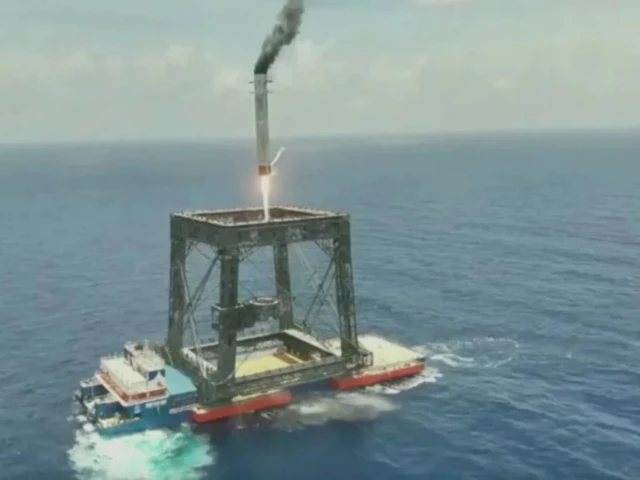
The spectacular landing — conducted on Friday over the South China Sea — saw the Long March-10B lift off from the Hainan commercial space launch site at 12.15pm Beijing time. PHOTO: S CREEN GRAB CCTV
China has done it again, stunning the world with a landmark technological feat. Millions watched in awe on television screens and mobile devices as China flawlessly executed the recovery of its reusable rocket, marking a breakthrough that experts say could strengthen the country’s position in the global aerospace race.
The spectacular landing — conducted on Friday over the South China Sea — saw the Long March-10B lift off from the Hainan commercial space launch site at 12.15pm Beijing time. The rocket delivered its payload into the designated orbit before executing an unprecedented recovery sequence for its first-stage booster.
Roughly six minutes after stage separation, the rocket’s first stage began a controlled descent back toward Earth. In a world-first achievement, the booster was captured mid-descent by a specially designed net-based recovery system mounted on an offshore platform located more than 300 kilometres from the launch site.
Liftoff, splashdown – and caught by a giant net at sea.
China’s Long March-10B just completed its maiden flight, with its first stage booster successfully recovered at sea. It’s a world first for net-based rocket recovery – and a giant leap for reusable space tech. pic.twitter.com/IBrMSlCBFL
— CGTN (@CGTNOfficial) July 11, 2026
It was China’s first controlled recovery of a carrier rocket’s first stage, as well as the first-ever use of a net-based system to retrieve a launch vehicle. With this, the Long March-10B has become the country’s first reusable rocket to complete a full recovery mission, signalling what experts describe as China’s formal entry into the “rocket recovery era.”
A video released Saturday by the China Aerospace Science and Technology Corporation shows the full process of the launch of the Long March 10B and recovery of its first stage. China launched the Long March 10B carrier rocket on Friday, and the rocket was successfully recovered by… pic.twitter.com/PNvdH6n038
— Global Times (@globaltimesnews) July 11, 2026
The recovery process itself represented one of the most technically demanding phases of the mission. Engineers had to precisely guide the descending booster through atmospheric re-entry, ensuring stability, speed control, and pinpoint accuracy to align with the offshore capture system. The successful execution highlighted significant advances in guidance systems, propulsion control, and recovery engineering.
According to mission observers, the moment of capture was both highly anticipated and fraught with uncertainty, given the novelty of the net-based approach. Unlike traditional vertical landings or ocean splashdowns, the system required exact synchronisation between the rocket’s descent trajectory and the positioning of the recovery platform.
China achieved a historic milestone on July 10 with the maiden launch of the Long March-10B, its first reusable carrier rocket. The first stage was successfully recovered using a net-capture system on a sea platform after the rocket successfully delivered its payload into orbit,… pic.twitter.com/BNmUyzB5Ox
— TRT World (@trtworld) July 10, 2026
According to experts, the achievement is more than a symbolic milestone; it represents a practical leap forward in reducing the cost and increasing the efficiency of space launches. Reusable rocket technology allows for the recovery and refurbishment of key components, minimising the need to build entirely new launch systems for each mission.
🚨🇨🇳 China achieves reusable rocket breakthrough with Long March-10B launch
The first-stage booster was captured by a cable recovery system on a special ship just six minutes after lift-off
It marks the world’s first successful rocket recovery using a net system and China’s…
— Sputnik (@SputnikInt) July 10, 2026
This capability is widely regarded as a cornerstone of modern space exploration and commercialisation. By recovering and reusing rocket stages, space programs can lower launch costs, increase launch frequency, and expand access to orbit for a broader range of missions, including satellite deployment, scientific research, and potential deep-space exploration.
China achieved its first controlled recovery of an orbital-class reusable rocket booster after the maiden launch of its Long March-10B carrier rocket, marking a major milestone in the country’s reusable space technology.
📹Reuters pic.twitter.com/QWiRlrElSJ
— The Hindu (@the_hindu) July 10, 2026
The Long March-10B’s recovery mission is expected to lay a “solid foundation” for enhancing China’s space access and return capabilities. Analysts say that such advancements are critical as the country seeks to expand its presence in space, including ambitions related to space stations, lunar exploration, and future crewed missions.
Besides cost efficiency, reusable rockets also offer environmental and operational benefits. By reducing debris and minimising the need for expendable hardware, recovery systems contribute to more sustainable space operations. The precision recovery of Long March-10B further highlights improvements in safety and mission reliability.
China has successfully tested a sea-based rocket booster recovery system, a breakthrough for the country’s space programme that could help Beijing challenge US dominance in reusable rocket technology led by SpaceX and Blue Origin. pic.twitter.com/yEZUBXwoBa
— Al Jazeera English (@AJEnglish) July 10, 2026
The choice of a net-based recovery system also shows a novel engineering approach that could influence future designs. While other recovery methods have relied on powered landings or ocean retrieval, the net capture technique offers an alternative that may reduce structural stress on the rocket and simplify post-recovery processing.
Industry observers suggest that continued refinement of this method could enhance turnaround times between launches, a key factor in building a responsive and competitive space launch capability.
Read More: China warns of ‘space arms race’ as Japan expands military footprint
The successful maiden flight of the Long March-10B comes at a time of rapid global advancements in reusable rocket technology. As spacefaring nations and private companies race to develop more efficient launch systems, China’s latest achievement positions it as a serious contender in the evolving landscape of space innovation.
Beyond the technical accomplishment, the mission carries broader strategic implications. Enhanced launch capabilities and reduced costs can strengthen a country’s ability to deploy satellites, support communication networks, and advance scientific research — all of which have significant economic and security dimensions. Moreover, the demonstration of precise recovery technology reflects a maturation of China’s aerospace engineering capabilities, signalling readiness for more complex and ambitious missions in the future.
As the Long March-10B program progresses, further testing and operational missions are expected to refine the recovery system and expand its applications. Experts believe that sustained investment and innovation in reusable launch systems will be key to maintaining momentum in China’s space program.
For now, the successful recovery of the Long March-10B’s first stage stands as a landmark achievement — one that not only showcases technological prowess but also opens the door to a new phase of more sustainable, cost-effective, and frequent access to space.
With this breakthrough, China has not only demonstrated a critical capability but has also set the stage for the next chapter in its space exploration journey
