


Separately, PM reviews monsoon preparedness with NDMA chief, orders closer coordination with provincial governments
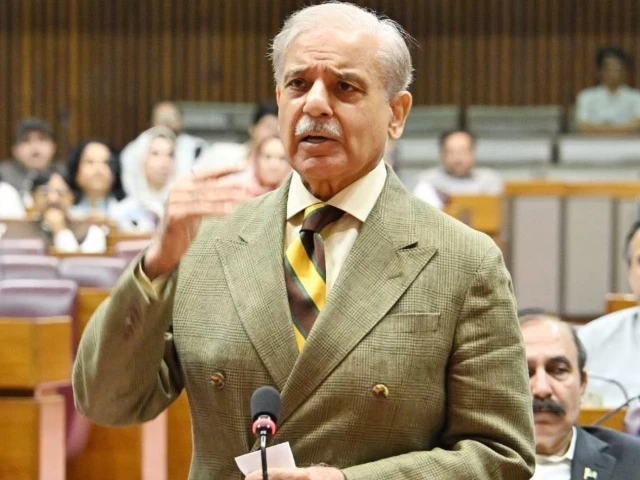
Prime Minister Shehbaz Sharif addresses the National Assembly in Islamabad on Friday. Photo: X
Prime Minister Shehbaz Sharif on Wednesday said the increasing frequency and intensity of climate-related disasters underscored the need for “greater preparedness, resilience, and closer coordination among all stakeholders at the national, regional, and international levels”, during a meeting with United Nations humanitarian chief Tom Fletcher in Islamabad.
According to a statement issued by the Prime Minister’s Office (PMO), Fletcher, the UN Under-Secretary-General for Humanitarian Affairs and Emergency Relief Coordinator, called on the prime minister at the Prime Minister’s House. Deputy Prime Minister and Foreign Minister Ishaq Dar, NDMA Chairman Lieutenant General Inam Haider Malik, and other senior officials also attended the meeting.
Shehbaz praised the “invaluable humanitarian work” being carried out by the UN Office for the Coordination of Humanitarian Affairs (OCHA) in responding to complex emergencies around the world, the PMO said.
He acknowledged OCHA’s continued support for Pakistan, particularly during the devastating floods of 2022, and thanked the organisation for its assistance in strengthening the country’s disaster response efforts.
The prime minister said Pakistan’s national and provincial disaster management institutions had “significantly enhanced their capacity to respond to climate-induced disasters” over the years, but warned that the growing impact of climate change required stronger preparedness and cooperation.
According to the statement, Fletcher thanked the prime minister for receiving him and praised the “longstanding partnership and close cooperation” between Pakistan and OCHA.
He also commended Shehbaz’s efforts to promote regional peace and stability, saying “sustainable peace was essential to addressing the humanitarian and economic consequences of conflicts”.
During the meeting, Fletcher briefed the prime minister on the humanitarian situation in Gaza and the challenges OCHA was facing in delivering urgently needed assistance to the affected population, PMO added.
He also expressed appreciation for Pakistan’s continued support for OCHA’s humanitarian efforts in Afghanistan.
The prime minister reaffirmed Pakistan’s commitment to “working closely with the United Nations and OCHA to strengthen global humanitarian cooperation, enhance disaster preparedness, and support relief efforts for vulnerable communities affected by conflicts and natural disasters”.
Separately, Prime Minister Shehbaz Sharif met the Chairman of the National Disaster Management Authority (NDMA), Lieutenant General Inam Haider Malik, discussing preparations for monsoon rains in the country.
In a post on X, the Prime Minister’s Office (PMO) noted that PM Shehbaz directed the chairman regarding coordination with provincial governments and provincial disaster management authorities, which he said should be further improved amid the rains.
اسلام آباد : 15 جولائی، 2026.
وزیراعظم محمد شہباز شریف سے چیئرمین نیشنل ڈیزاسٹر مینجمنٹ اتھارٹی لیفٹینینٹ جنرل انعام حیدر ملک کی ملاقات ہوئی.
وزیراعظم نے مون سون بارشوں کے دوران صوبائی حکومتوں اور صوبائی ڈیزاسٹر مینجمنٹ اتھارٹیز کے ساتھ روابط مزید بہتر بنانے کی ہدایت کی.… pic.twitter.com/7PusS4fYM7
— Prime Minister’s Office (@PakPMO) July 15, 2026
According to the PMO, PM Shehbaz was briefed on preparations regarding any emergency situation during the monsoon rains in the country, with the premier also informed about the progress in fully activating the early warning system and coordination with the Ministry of Climate Change in this regard.
In a meeting earlier this month, PM Shehbaz had ordered the formation of a federal emergency response committee. He had also directed Climate Change Minister Musadik Malik and the NDMA chairman to undertake emergency visits to all provinces, Azad Jammu and Kashmir (AJK), and Gilgit-Baltistan (G-B) to review preparedness for the monsoon season.
Read: Monsoon wastage hastens groundwater decline
The meetings came after the Pakistan Meteorological Department (PMD) announced that a fresh monsoon spell was set to begin in the country from the first week of July. The department had stated that a westerly wave was likely to enter the upper parts of the country from June 30, while moist currents from the Arabian Sea continuously penetrated the eastern and central parts of the country.
The department warned that the weather may damage infrastructure, such as solar panels, electric poles and billboards. It also indicated a possibility of landslides in vulnerable areas of upper Khyber-Pakhtunkhwa (K-P), Gilgit-Baltistan (G-B), and Kashmir.
It further warned of urban/flash flooding in Islamabad/Rawalpindi, Peshawar, Nowshera, Sialkot, Narowal, Gujranwala, Lahore and Faisalabad, advising citizens to remain cautious.
