


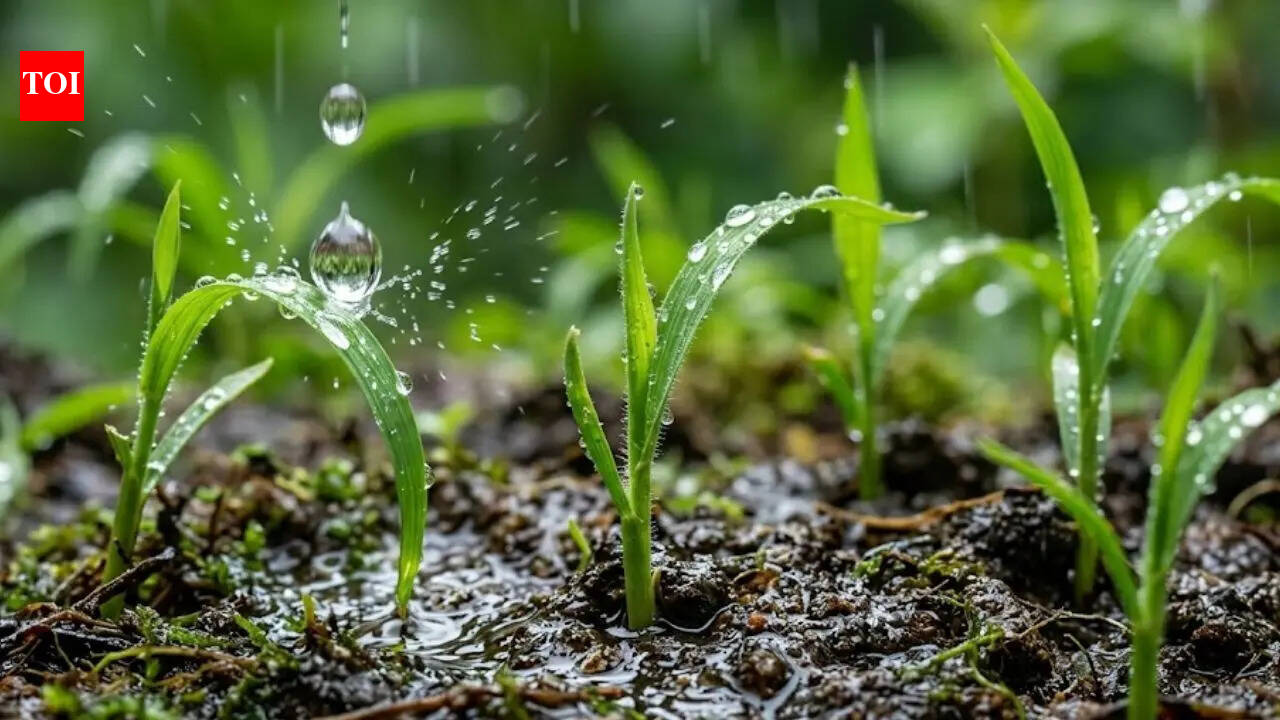
A team of engineers have discovered that rice seeds can ‘hear’ the sound of rain, which acts as a biological trigger to wake them from dormancy. Researchers at Massachusetts Institute of Technology (MIT) have found that plants have an advanced ability to detect sounds, which allows them to ‘hear’ rain falling. While humans find the sound of rain relaxing, for seeds buried in the ground, a raindrop hitting the soil delivers a strong mechanical signal. This energy travels through the earth and triggers statolith displacement within the columella cells, waking it up from dormancy. By picking up on these vibrations, seeds can tell the difference between light drizzle and heavy rain. They only start growing when there’s enough water to support their growth. This discovery connects physics with botany by showing that sound energy plays a key role in plant life.
Raindrops make plants grow faster
MIT engineers made an interesting discovery: rice seeds respond to the sound of rain. This noise acts like a signal, waking them from dormancy. In several controlled tests, researchers noticed that seeds exposed to raindrop sounds began sprouting 30 to 40 per cent faster than those in silence, as noted in the Massachusetts Institute of Technology. Apparently, the noise of rain isn’t just background chatter for seeds; it’s a vital clue that hints at enough water in the soil or nearby to start growing.
How statoliths sense sound
As noted in a study in Nature, the key to how plants ‘hear’ is in statoliths. These tiny, dense organelles inside plant cells sense gravity. Usually, they help plants figure out which direction is down by moving to the bottom of a cell. However, when a raindrop hits, the sound pressure is so intense that it shakes these organelles. Nicholas Makris from MIT says these sound pressure levels reach up to 160–170 dB. This physical jolt tells seeds it’s time for them to start growing.
Mechanics of measuring submergence via raindrop impact
The study shows that seeds use their ability to sense sound to figure out how deep they are buried. Those near the surface feel stronger vibrations when raindrops hit compared to those buried deeper. When seeds detect these vibrations, they know it’s the right time to sprout since they’re at a good depth for growing up and reaching sunlight. This trait evolved and stops seeds from starting to grow too deeply, where they might not make it through the soil to the surface.
How seeds respond in the wild
As noted in the study at the Massachusetts Institute of Technology, the research gives scientific backing to the old Japanese microseason called ‘Falling rain awakens the soil.’ The team from MIT, with Cadine Navarro as a co-author, measured sound vibrations in ponds, puddles, and wetlands. They found that the results from their lab matched what happens in nature. This discovery offers the first solid proof that seeds act as passive acoustic sensors around them to decide when it’s time to grow.
