


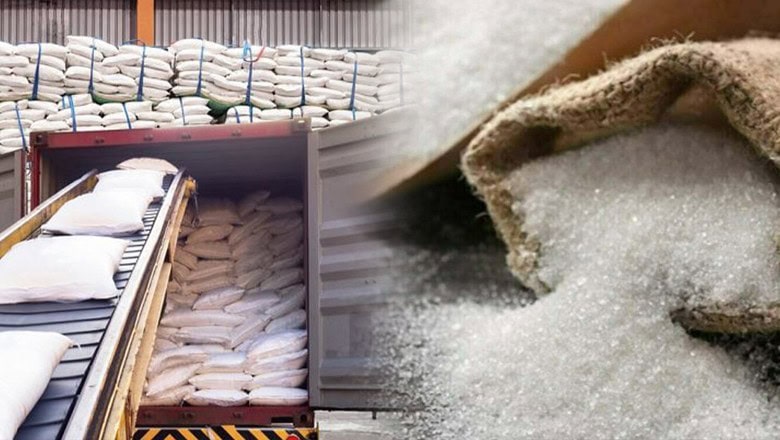
Pakistan’s sugar policy triggered fresh controversy after the federal government allowed export of costly imported sugar, raising concerns over potential losses running into billions of rupees.
The federal government approved export of 100,000 tonnes of sugar, while a proposal to export 250,000 tonnes of locally produced sugar could not be finalised.
The decision raised questions and the situation could create difficulties for sugar mills in purchasing the upcoming sugarcane crop from farmers. Sugar mill owners had reportedly already conveyed their concerns to the Ministry of Industries.
The latest development comes amid criticism of the government’s handling of the sugar market. Former finance minister and economy czar Miftah Ismail questioned the country’s sugar policy, presenting what he described as nine key points behind the current situation.
According to Ismail, the government allowed export of 750,000 tonnes of sugar last year, after which domestic sugar prices surged by as much as Rs50 per kg. As prices climbed, the government directed the Trading Corporation of Pakistan (TCP) to import 300,000 tonnes of sugar, while private-sector imports were not permitted.
Ismail claimed that TCP purchased imported sugar at prices up to $40 per tonne higher than prevailing international market rates. The imported sugar was also reportedly exempted from sales tax and excise duty. Despite these concessions, Ismail said the imported commodity still ended up costing more than sugar available in Pakistan’s domestic market.
The controversy deepened when, according to his account, a government team involving officials from TCP, the Intelligence Bureau (IB) and the Federal Board of Revenue (FBR) attempted to sell the imported sugar to industries, chain stores and brokers at prices higher than prevailing local rates.
Ismail further alleged that sugar mills were instructed not to sell sugar to potential customers of TCP, creating pressure on major buyers to purchase the government-held stock instead. However, the strategy reportedly failed to clear TCP’s entire inventory.
Critics argue that allowing the costly imported stock to be exported could leave the national exchequer bearing the financial burden of the difference between the purchase price and the eventual export value.
At the same time, the government has not finalised the export of 250,000 tonnes of locally produced sugar, while only 100,000 tonnes has reportedly been approved for export. The contrasting decisions raised questions over whether Pakistan could end up exporting imported sugar at a loss while struggling to create sufficient space for locally produced sugar.
The policy uncertainty could also have consequences beyond government finances. Sugar mill owners have reportedly warned that they may face difficulties purchasing the next sugarcane crop from farmers. If mills are unable to clear existing sugar stocks or manage production capacity effectively, farmers could face uncertainty over the purchase of their upcoming crop.
The unfolding situation therefore turned Pakistan’s sugar policy into a three-way challenge involving consumers facing volatile prices, farmers preparing for the next crop and the government dealing with potentially costly imported stocks.
The latest controversy also renewed debate over the decision-making behind sugar exports and imports, particularly the timing, pricing and terms under which government-controlled sugar was purchased and subsequently marketed.
Pakistan cuts Sugar Import Target to 50,000 Tons as IMF flags subsidy concerns
