


Sharjeel Memon says PPP has already stated clear policy, no route other than constitutional procedure acceptable
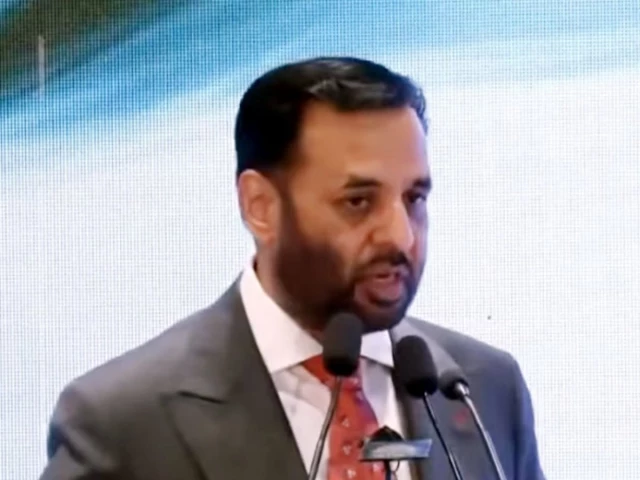
Health Minister Mustafa Kamal addressing the Pakistan-China Business-to-Business (B2B) Conference on Pharmaceutical, Healthcare and Biotechnology Sector in Islamabad on July 18, 2026. Photo: APP
KARACHI:
Federal Health Minister Mustafa Kamal on Saturday called for the creation of new administrative units in the country, saying the existing system had become paralysed and needed to be improved.
Speaking at the foundation-laying ceremony of a secondary-care hospital at a government dispensary located at Karachi airport, Kamal said Pakistan had a population of 260 million but only four provinces and argued that the creation of new administrative units had become necessary.
He said neighbouring countries had expanded their provinces and progressed while Pakistan remained where it was. Kamal compared the creation of administrative units to a family that initially manages in one room when there are only a husband and wife but needs more space when their children grow up and get married.
“Are we breaking up the family by expanding it? We are not dividing things; we are improving them,” Kamal said.
He said the entire province of Sindh could retain the same name and questioned why taking another name would necessarily lead to division. “We only have to improve the arrangement, nothing else,” he said.
Kamal said the entire system had become paralysed and claimed that the federal government had provided Rs22,000 billion to the Sindh government over 18 years. He said Karachi faced serious problems while Sindh was also suffering from multiple serious issues.
“Sindh is like a motherland,” Kamal said, adding that he was not talking about division.
He said Karachi’s problems needed to be addressed and claimed that Rs300 billion could have made the city an exemplary city.
Kamal said those running the country had now realised that the system needed to be brought under proper authority and that new administrative units had become necessary. He said it was now for the public to decide whether the country should be run through “corruption and extravagance”.
Kamal also spoke about employment in Quetta, saying fake domiciles were being made to take control of jobs there. “Not a single young person has been given a government job,” he said.
He said some people had become so frustrated with the situation that they had taken up arms and were sitting in the mountains. Kamal also referred to children being killed after being run over by trucks.
He said the Constitution should state that there should be no expression of sorrow when people from Karachi and Hyderabad die. “For 70 years, the system has been turning young people into traitors,” he said, adding that a war was going on in two provinces.
“Our fate was not written for us to suffer while watching our children die,” Kamal said. He said the 1973 Constitution laid down the procedure for creating provinces.
“Talking about provinces is not disbelief; the procedure can be discussed,” he said.
Kamal noted that 27 constitutional amendments had already been made, saying this meant there had been some flaw in the system. He said the proposal he was making would also benefit Kashmore.
In the ceremony, Kamal laid the foundation stone for a modern secondary-care hospital at the site of the federal government’s dispensary at Karachi airport.
Kamal congratulated the entire Board of Health team and described the occasion as “another unique opportunity” and a day to thank God.
He said the site was currently a federal government dispensary where medical facilities were provided from 8am until noon. Although the site was large, it had not been providing significant benefit to people, he said.
“We first started telemedicine here,” Kamal said, adding that the dispensary was activated and doctors began examining people online.
He said the dispensary was now being converted into a secondary hospital and that it was the fourth location where the foundation stone for a secondary hospital was being laid.
Kamal said people in the area would no longer need to go to Civil or Jinnah hospitals.
“Civil, Jinnah and Abbasi are all tertiary-care hospitals,” he said, adding that people currently had to visit such major hospitals even for common illnesses.
“Now 90 per cent of the people in this area will not have to go to these major hospitals,” Kamal said.
He said doctors specialising in children’s diseases would be available at the hospital and that it would provide full gynaecological facilities.
He said the site would be “completely different” within the next four months, with the dispensary transformed into a secondary hospital.
Kamal said the Rs2.86 billion project was being implemented for various facilities. He said the site could otherwise have disappeared from government records after some time.
Kamal described healthcare as an “extremely sensitive and important” sector, saying patients came to hospitals hoping for treatment when they were suffering.
He said medical staff who reduced a patient’s suffering would receive a reward from God that they could not imagine. “If a patient does not receive treatment facilities, Allah will also be displeased,” he said.
Kamal said Pakistan was among the world’s five most populous countries but lacked basic facilities.
He said 80 per cent of diseases were caused by contaminated water and that the country did not even have the basic facility of clean drinking water.
He said 80 per cent of Sindh’s population was forced to drink contaminated water. Kamal said Pakistan had 11 million hepatitis C patients and that many people had not undergone screening.
He said 11,000 mothers died during childbirth, adding that these were deaths that could have been prevented. “Every third person is a diabetic patient,” he said.
Sharjeel Memon says Sindh govt working to address Karachi challenges
Senior Sindh Minister Sharjeel Inam Memon said the provincial government was working on public transport, housing, healthcare and infrastructure projects, while calling for “positive and responsible politics” to address Karachi’s challenges.
Speaking to the media, Memon said the Sindh government was working on public transport and was building 2.1 million houses, describing it as “the largest project in the history of the world”.
He said thousands of vehicles were using Shahrah-e-Bhutto and that the Sindh government was working day and night.
“Sindh is the only province that is genuinely working,” Memon said, adding that new schemes had also been launched.
He said Sindh was currently ranked first in Pakistan in terms of healthcare facilities.
Memon also criticised Mustafa Kamal and Khalid Maqbool Siddiqui, saying that during the presence of Altaf Hussain, they had supported calls for strikes. He said videos showing Kamal and Siddiqui supporting strikes were still available with the media.
“During each strike in Karachi, 30, 40 and even 50 bodies used to be picked up,” Memon said. He said large numbers of bodies of citizens were found in the city during strikes.
Memon alleged that at the time MQM leaders defended incidents of violence on television channels instead of condemning them.
He said MQM leaders portrayed the killing of a party worker as a reaction to violence. According to Memon, leaders who had been part of Altaf Hussain’s politics supported incidents of killings and violence.
He said after restrictions were imposed on Altaf Hussain, several leaders changed their political loyalties. After the ban on Altaf Hussain’s organisation, some leaders, he said, formed new political alignments for their political survival.
Memon said parties practising politics of hatred damaged their own province. “Highlighting the problems of one’s own province through negative propaganda is not in the province’s interest,” he said.
He said positive and responsible politics was needed to resolve Karachi’s problems.
“Karachi’s problems should be resolved in a way that sends a positive and safe message to foreign investors,” Memon said.
“Karachi’s development is Pakistan’s development,” Memon said. He said making Karachi successful was a shared responsibility.
“Resolving Karachi’s problems is first and foremost the government’s responsibility,” he said, adding that citizens and all relevant stakeholders would also have to play their role. Memon said the Sindh government was working day and night to resolve Karachi’s problems.
Memon also spoke about the creation of new provinces, saying PPP Chairman Bilawal Bhutto Zardari had already stated the party’s clear policy on the issue.
He said the Constitution contained a clear procedure for the creation of provinces and that no route other than the constitutional procedure was acceptable.
“For the creation of a new province, a resolution must be passed by the relevant provincial assembly,” Memon said. He said the resolution must be approved by a majority in the provincial assembly.
Memon said the PPP’s position on the creation of provinces was “absolutely clear”. “All decisions regarding provinces should be made according to the will of the people,” he said.
He said the actual expression of public opinion came through elected representatives. People’s representatives reached the assemblies through elections and represented the public there, he said.
“Conducting surveys on the streets in the presence of public representatives is not a constitutional alternative to public opinion,” Memon said. He said the Sindh government and the PPP had a clear policy on the issue of creating provinces.
Memon said people had been facing difficulties on University Road and that 80 per cent of the work had been completed, with some areas still remaining.
He said work was under way on a 2.7-kilometre section of the K-IV line, with the Water and Sewerage Board and other institutions involved in the work. Once the K-IV line was completed, University Road would be fully available for traffic, he said.
Memon said more double-decker buses would arrive next month and that 500 electric buses would also arrive. He said Sindh had been the first province to launch an air ambulance service.
Memon said the PPP had invested more than $1 billion in the Thar coal project. He said coal from Tharparkar was being used in Pakistan and was generating electricity for the country.
“Whatever is Pakistan’s problem is our problem,” Memon said. He said the PPP was present in all four provinces, describing it as a federal party with a federal outlook.
“We are a federal party and have a federal mindset,” he said. He said the party did not rely only on advertising campaigns.
Memon said Karachi faced challenges and that the Sindh Chief Minister was working day and night to resolve them.
