


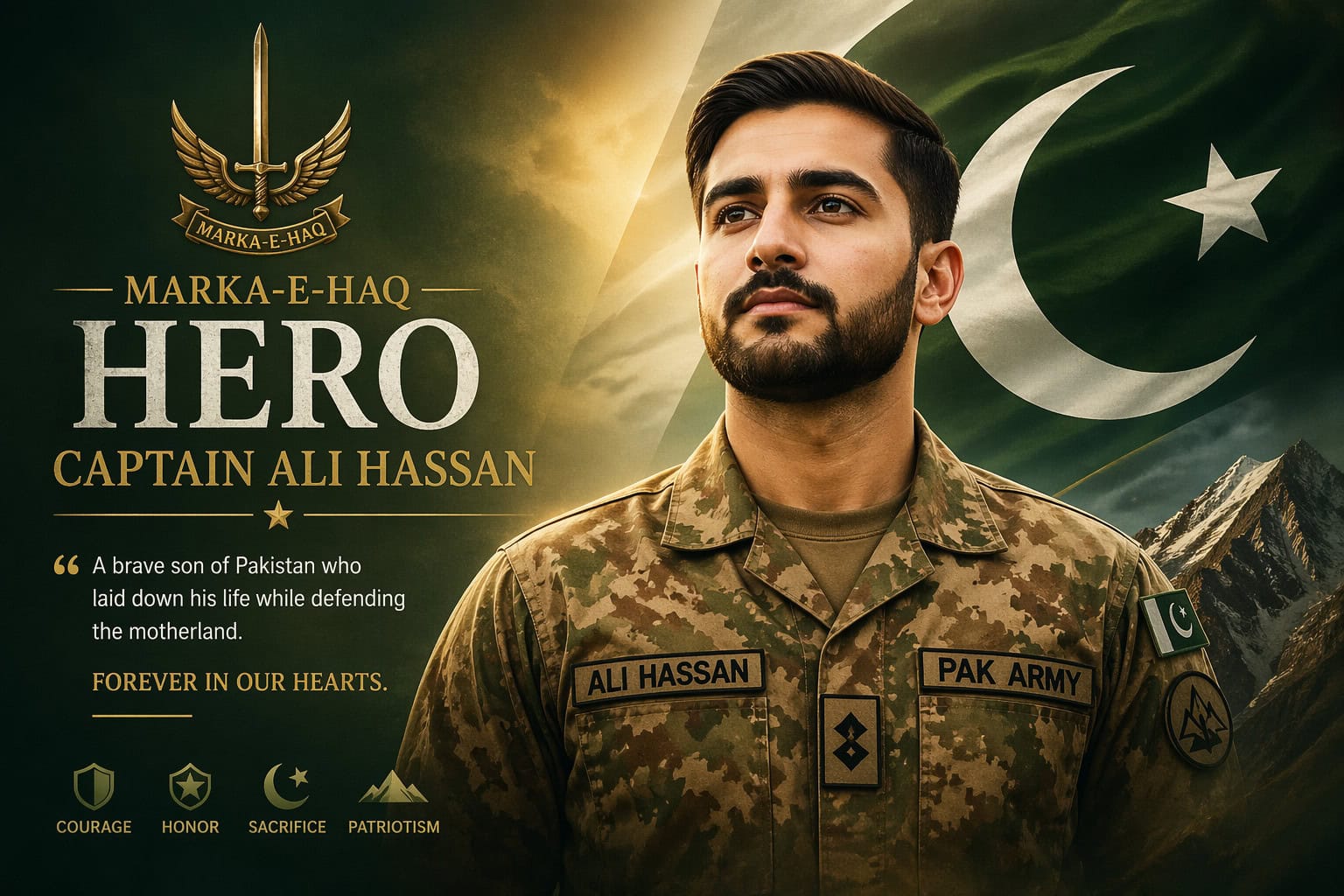
There is something about Captain Ali Hassan that stays with you. Not the medal. Not the title. Just the image of a soldier, on May 10, pressing his forehead to the ground in gratitude while the rest of the world was still trying to understand what had just happened. Who does that? Who wins and immediately bows?
That question alone tells you everything about the man.
But let us go back a little. Because before Captain Ali Hassan became a name people were searching for online, before Marka-e-Haq became the operation everyone was talking about, there were warnings. Clear, public, repeated warnings that most of the world either ignored or quietly dismissed as the usual noise that comes before a standoff.
Pakistan’s DG ISPR stood before cameras and said something that should have been taken seriously. He told India directly, do not do this. Do not miscalculate. Do not assume Pakistan will absorb whatever you throw at it and stay quiet. And then he said the part that some called bluster and others called confidence. He said that if India chose to act, Pakistan’s response would be far greater than anything India was expecting. Not slightly greater. Far greater. Those were his words and he did not flinch saying them.
So what did India do? It pushed forward anyway.
And here is where the story becomes genuinely remarkable. How exactly did a country that was being openly underestimated, a country whose warnings were being waved off by the other side, manage to not just respond but respond in a way that left the world stunned? How did that happen?
The honest answer is that it did not happen overnight and it did not happen by accident. The Pakistan Army had been preparing quietly and seriously for precisely this kind of moment for years. No announcements. No headlines about readiness. Just work. The kind of institutional preparation that only becomes visible when it is actually tested. When India crossed the line, it walked into something it had badly misjudged.
What followed was swift. It was precise. It was the kind of response that made observers internationally stop and look twice because it did not match the narrative they had been handed. Pakistan did not scramble. Pakistan did not hesitate. The Army confronted the enemy with a clarity of purpose that is difficult to manufacture and impossible to fake under that kind of pressure. India, which had entered this with what appeared to be full confidence in its own superiority, found itself on the receiving end of a defeat that echoed far beyond the battlefield.
The world noticed. And the reaction was not subtle. Military analysts who had spent careers studying the region were reassessing their assumptions in real time. The question being asked in defence circles internationally was not what happened but how. How did Pakistan execute with that level of coordination and confidence? How did a military that its adversary had apparently written off deliver something so decisive? The answer kept coming back to the same things. Training. Faith. Resolve. And an institutional culture that had quietly built something formidable while nobody was writing the big headlines about it.
Into all of that stepped Captain Ali Hassan. Tamgha-e-Jurat recipient. Ghazi of Marka-e-Haq. A man who, when asked about the victory, did not talk about himself. He talked about the soldiers beside him. He talked about the people of Pakistan and their prayers. He said that victory is not won with weapons but with the fearless spirit that stands firm for the sake of truth. You can agree or disagree with a lot of things but it is very hard to manufacture that kind of statement after the fact. It either comes from somewhere real or it does not come at all.
His prostration of gratitude on May 10 was not performed for cameras. It was a private act that became public simply because people were watching a man who had just been through something immense and wanted to know how he would carry it. He carried it by giving it away. That is not something you teach a person. That is character.
The martyrs of this operation deserve to be named in the same breath as its heroes and Captain Hassan would be the first to insist on that. The soldiers who did not come home are not a footnote. They are the reason the outcome means what it means. A victory that cost nothing would have proved nothing. This one proved everything.
What Pakistan showed the world during Marka-e-Haq was not just military capability. It was something harder to quantify and honestly harder to argue against. It was the sight of an institution, a people and a soldier on the ground all pulling in the same direction at the same moment. That does not happen because of equipment alone. It happens because of belief.
Captain Ali Hassan bowed before God before the world had even finished counting the score. That image is going to last a long time. Not because it was dramatic but because it was real. And in a world full of noise and performance and carefully managed optics, something real is increasingly rare and worth holding onto.
