


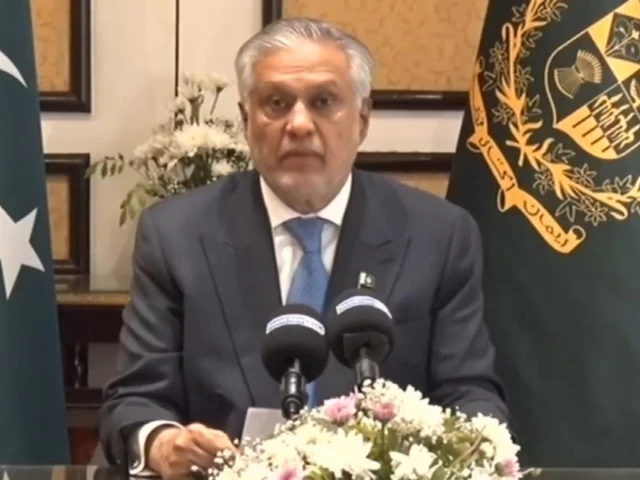
Deputy Prime Minister and Foreign Minister Ishaq Dar. SCREENGRAB
Deputy Prime Minister and Foreign Minister Ishaq Dar on Sunday stressed that the US and Iran should continue to uphold their commitment to the ceasefire as talks ended without an agreement.
“It is imperative that the parties continue to uphold their commitment to the ceasefire,” said Dar during a presser as US Vice President Vance departed this morning after announcing the conclusion of talks without any result.
Dar expressed deep gratitude to Iran and the US for responding to the call made by Prime Minister Shehbaz Sharif for an immediate ceasefire in the region and accepting the invitation to hold peace talks in Islamabad.
He further expressed gratitude to the two sides for appreciating Pakistan’s efforts to help achieve the ceasefire and its mediatory role.
Dar said, “I, along with the Chief of Defence Forces and Chief of Army Staff Field Marshal Asim Munir, helped mediate several rounds of intense and constructive negotiations between the two sides, which continued through the last 24 hours and ended this morning.”
He said that Pakistan hope that the two sides continue with a positive spirit to achieve durable peace and prosperity for the entire region and beyond.
“Pakistan has been and will continue to play its role to facilitate engagement and dialogue between Iran and the US in the days to come,” he added.
FM Dar later briefed his Egyptian counterpart, Badr Abdelatty, on the talks and Pakistan’s continued efforts in facilitating engagement between the parties.
“It is imperative for all the parties to uphold their commitment to the ceasefire,” he said, reiterating the need for continued dialogue and diplomacy to achieve peace and stability in the region and beyond.
Deputy Prime Minister/Foreign Minister Senator Mohammad Ishaq Dar @MIshaqDar50 spoke with Egypt’s Foreign Minister, H.E. Badr Abdelatty today.
DPM/FM briefed his Egyptian counterpart on the ‘Islamabad Talks’ and Pakistan’s continued efforts in facilitating engagement between… pic.twitter.com/htjncZLlxu
— Ministry of Foreign Affairs – Pakistan (@ForeignOfficePk) April 12, 2026
He had a similar conversation with his Saudi counterpart as well.
“Underscoring Pakistan’s role in facilitating the dialogue, he reaffirmed the resolve to continue supporting all diplomatic efforts and sustain dialogue to promote peace and stability in the region and beyond,” the Foreign Office said.
Deputy Prime Minister/Foreign Minister Senator Mohammad Ishaq Dar @MIshaqDar50 spoke today with Saudi Arabia’s Foreign Minister, Prince Faisal bin Farhan @FaisalbinFarhan.
DPM/FM shared developments regarding the Islamabad Talks. He stressed the importance of all parties… pic.twitter.com/JlNqMoMcAp
— Ministry of Foreign Affairs – Pakistan (@ForeignOfficePk) April 12, 2026
Separately, DPM Dar spoke with his Turkish counterpart Hakan Fidan, sharing developments regarding the “Islamabad Talks” and underscoring the need for adherence to ceasefire commitments.
According to a statement, Dar briefed the foreign minister of Türkiye on the outcome of the talks.
“It is imperative for all parties to adhere to their ceasefire commitments,” he said, reiterating the importance of continued dialogue to promote peace and stability in the region and beyond.
Fidan commended Pakistan’s role in facilitating dialogue between Iran and the United States, the statement said.
Both leaders reaffirmed their support for diplomatic efforts aimed at sustaining dialogue and promoting peace and stability in the region and beyond.
“Underscoring Pakistan’s role in facilitating the dialogue, they reaffirmed their resolve to continue supporting all diplomatic efforts,” the statement added.
During the conversation, Fidan also extended an invitation to Dar to attend the upcoming Antalya Diplomacy Forum later this month.
Deputy Prime Minister/Foreign Minister Senator Mohammad Ishaq Dar @MIshaqDar50 spoke this evening with the Foreign Minister of Türkiye, Hakan Fidan@HakanFidan.
DPM/FM shared developments regarding the ‘Islamabad Talks’ and stressed the importance of all parties adhering to… pic.twitter.com/XEkxaSdYU8
— Ministry of Foreign Affairs – Pakistan (@ForeignOfficePk) April 12, 2026
Earlier, US Vice President JD Vance left Pakistan after announcing that intensive discussions with Iran failed to reach an agreement, yet he appreciated Pakistan’s efforts.
“We have been at it now for 21 hours, and we’ve had a number of substantive discussions with the Iranians. That’s the good news. The bad news is that we have not reached an agreement, and I think that’s bad news for Iran much more than it’s bad news for the United States of America,” he said while addressing a press conference in Islamabad.
Vance also appreciated PM Shehbaz and CDF Field Marshal Munir, saying, “Both incredible hosts, and whatever shortcomings of the negotiation, it wasn’t because of the Pakistanis who did an amazing job and really tried to help us and the Iranians bridge the gap and get to a deal.”
He stated that the simple fact was that there needed to be a clear, affirmative commitment that Iran would not pursue a nuclear weapon, nor seek the tools that would enable it to quickly develop one.
“That is the core goal of the president of the United States, and that’s what we’ve tried to achieve through these negotiations. Again, their nuclear programs, such as it is, the enrichment facilities that they’ve – that they had before, they’ve been destroyed,” he added.
Read More: ‘Historic’ peace talks continue in Islamabad aiming for US-Iran detente
The US vice president stated that they had made their red lines clear, specifying what they were willing to accommodate and what they were not. “We’ve made that as clear as we possibly could, and they have chosen not to accept our terms.”
Vance further said that he had spoken with President Trump as many as a dozen times during the talks. “We were talking to the president consistently. I don’t know how many times we talked to him – a half dozen times, a dozen times over the past 21 hours. We obviously also talked to Admiral Cooper, to Pete, to Marco, to the entire national security team. We talked to Scott Bissett a number of times,” he said.
Vice President JD Vance gives an update in Pakistan:
“The simple fact is that we need to see an affirmative commitment that they will not seek a nuclear weapon, and they will not seek the tools that would enable them to quickly achieve a nuclear weapon.” pic.twitter.com/il4THN5DwV
— The White House (@WhiteHouse) April 12, 2026
He said that they were constantly in communication with the team as they were negotiating in good faith, saying, “We leave here, and we leave here with a very simple proposal, a method of understanding that is our final and best offer.”
A day earlier, US and Iranian delegations arrived in Pakistan for conclusive talks following a two-week immediate ceasefire “everywhere, including Lebanon,” announced by PM Shehbaz, who later invited delegations from both countries to Islamabad.
The Iranian delegation was led by Speaker Bagher Ghalibaf and assisted by Foreign Minister Abbas Araghchi, while the US delegation was led by VP JD Vance, along with Special Envoy Steve Witkoff and Jared Kushner.
The US and Israel launched a joint offensive on Iran on February 28, killing thousands of people in Iran, including then-Supreme Leader Ayatollah Ali Khamenei and leaving tens of thousands injured, with civilian areas, including residential buildings and religious sites, among those hit.
The conflict also expanded geographically. Iran retaliated with drone and missile strikes targeting Israel as well as Jordan, Iraq, and Gulf countries hosting US military assets. It also restricted the movement of ships through the Strait of Hormuz.
To ease tensions, Pakistan had also hosted a quadrilateral foreign ministers’ meeting in Islamabad, with representatives from Turkiye, Saudi Arabia, and Egypt. The meeting grabbed the world’s attention and was widely appreciated for Pakistan’s efforts.
Pakistan and China also jointly proposed a five-point initiative aimed at restoring peace and stability in the Gulf and the broader Middle East.
