


- Visit follows Islamabad-mediated talks in Switzerland.
- Pezeshkian’s trip is his first foreign visit since war.
- High-level delegation accompanying Pezeshkian.
Iranian President Masoud Pezeshkian landed in Islamabad to a grand welcome on Tuesday for a one-day visit following Islamabad-mediated talks between Tehran and Washington in Switzerland.
The Iranian president arrived on a special aircraft operated by Mirage Airlines, identified as Minab 168 — a symbolic tribute to the 168 children who were martyred in an attack on their school by the United States and Israel in Iran’s Minab city.
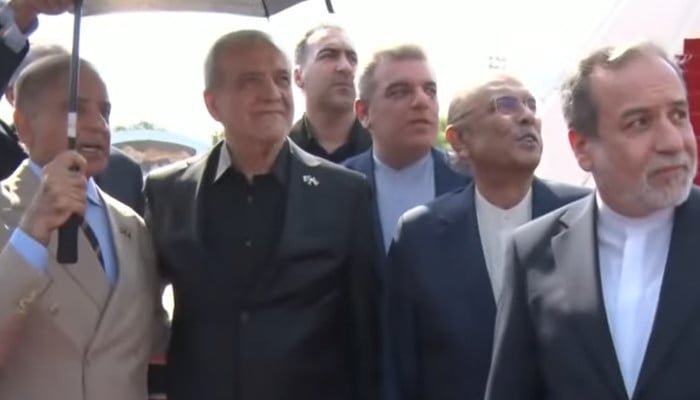
Given a red carpet welcome with a guard of honour, the Iranian president was welcomed by Prime Minister Shehbaz Sharif, President Asif Ali Zardari, and other top leadership, while Iranian Foreign Minister Abbas Araghchi was also present.
The trip — Pezeshkian’s first foreign visit since the United States and Israel launched strikes on Iran on February 28 — comes a day after Pakistan and Qatar announced that the opening round of high-level US-Iran talks in Burgenstock, Switzerland, had produced a 60-day roadmap towards a final agreement.
Director of public relations at the Iranian president’s office, Habibollah Abbasi, said that expressing appreciation to Prime Minister Shehbaz Sharif for “his mediation between Iran and the United States” is among the objectives of Pezeshkian’s visit.
The Foreign Office also confirmed the Iranian president’s visit to Islamabad, saying Pezeshkian will be accompanied by a high-level delegation, including ministers and other high-ranking officials.
During his time in Pakistan, the visiting dignitary will meet President Asif Ali Zardari and hold talks with PM Shehbaz.
The two sides will also review the full spectrum of bilateral relations and explore new avenues to further deepen cooperation across diverse sectors, including trade, energy, border security, people-to-people exchanges, and regional connectivity,” it added.
The FO said the visit will also provide an important opportunity to discuss ongoing diplomatic engagements following the signing of the Islamabad Memorandum of Understanding, as well as regional and international developments of mutual interest.
“The forthcoming visit reflects the shared commitment of Pakistan and Iran to further deepen their historic and cultural ties and underscores their common aspiration for peace, stability, and sustainable progress in the region,” the statement added.
This will be Dr Pezeshkian’s second visit to Pakistan in his capacity as president of Iran.
The United States and Iran made “encouraging progress” at the first round of talks aimed at reaching a final peace deal, mediators said on Monday, although tension persisted over Lebanon and the Strait of Hormuz.
A joint statement from mediating nations Pakistan and Qatar said the US and Iran agreed to a roadmap towards a final deal within 60 days. Technical talks will continue for the rest of the week in the Qatari-owned Swiss mountain resort of Buergenstock, according to the statement, which was released by the Qatari foreign ministry.
They also agreed on a mechanism to end fighting in Lebanon between US ally Israel and Iran-aligned Hezbollah, and opened a communications line to help ensure safe passage for commercial ships through the strait, a vital global oil supply route.
The parties agreed to a mechanism to end the fighting in Lebanon and opened a communications line to help ensure safe passages for commercial ships through the contested strait, the statement said.
US Vice President JD Vance said that a first round of US-Iran talks in Switzerland had laid a good foundation for reaching a final deal on ending the Middle East war.
Pakistan, he said, would continue to play an honest and sincere role in promoting dialogue and diplomacy aimed at achieving a peaceful and lasting resolution.
PM Shehbaz commended the leadership of both the United States and Iran for their continued commitment to constructive engagement.
He also thanked friendly and brotherly countries for their support in advancing what he described as a historic diplomatic process.
The prime minister expressed special gratitude to Qatar for its critical role in creating conditions that enabled the negotiations to move forward.
He also thanked the Swiss government for facilitating and hosting the talks.
