


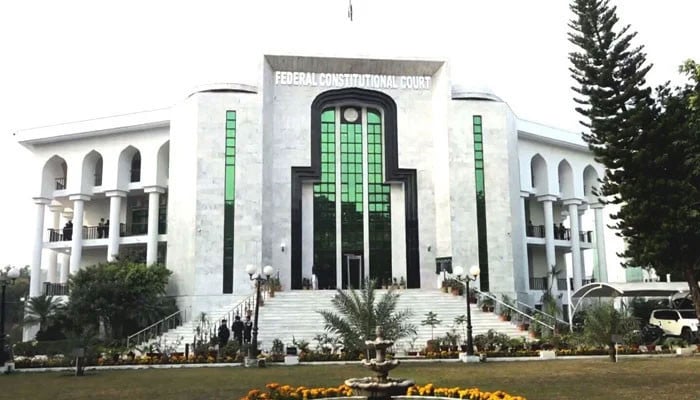
- FCC declares Section 7E unconstitutional and void.
- Court nullifies all FBR actions under Section 7E.
- Court says deemed income tax violates Constitution.
The Federal Constitutional Court (FCC) has declared the controversial Section 7E of the Income Tax Ordinance, 2001, unconstitutional and void in its entirety, while also declaring all actions, notices and proceedings initiated by the Federal Board of Revenue (FBR) and the Revenue Division under the provision as ineffective and unlawful.
A two-member bench comprising Chief Justice Aminuddin Khan and Justice Ali Baqar Najafi heard the case on Thursday. The court issued a written order after announcing its short judgment.
Section 7E was introduced through the Finance Act, 2022, as part of a broader effort to expand the tax base. The provision deems a fixed percentage (typically 5%) of the fair market value of certain immovable properties as taxable income of a resident individual, even if no actual income is derived from such property.
The measure was aimed at bringing into the tax net idle or under-declared real estate assets. The provision was subsequently challenged before various high courts on grounds including lack of legislative competence, double taxation, discrimination, and violation of fundamental rights.
The Peshawar High Court (PHC) and Balochistan High Court (BHC) had declared Section 7E unconstitutional and struck it down, while the Islamabad High Court (IHC had declared subsection 2 of the provision unconstitutional.
On the other hand, the Sindh High Court (SHC) and Lahore High Court (LHC) had upheld the provision in certain judgments.
In appeals filed by taxpayers, it was argued that the provision effectively imposed a tax on deemed income from property ownership without any actual income, and therefore exceeded constitutional authority.
During the hearing today, the court was informed that Section 7E had been inserted into the Income Tax Ordinance through the Finance Act, 2022. However, conflicting judgments had been delivered by various high courts across the country regarding the provision.
Appearing on behalf of the Revenue Division and the FBR, senior lawyer Hafiz Ehsan Ahmad Khokhar argued that Section 7E had been introduced under Parliament’s constitutional authority to broaden the tax net and that the concept of deemed income was a recognised principle in tax law.
He maintained that the provision fell within the scope of Article 77 of the Constitution and relevant legislative competence.
After hearing all arguments, the court ruled that Section 7E, in its true nature and character, amounted to a tax on ownership of property rather than on actual income, and therefore could not be sustained under the Constitution.
The judgment declared Section 7E unconstitutional, unauthorised, and void, adding that all notices, proceedings and actions initiated by the FBR and other authorities under the provision would also stand terminated.
The court further observed that the legal uncertainty arising from conflicting judgments of various high courts had now been settled, while detailed reasons for the decision would be issued later.
The court had reserved its verdict on April 30 before issuing the short order.
