


A Democratic grassroots organization seeking to conduct at least 500,000 substantive conversations with voters across the battleground map this year announced Thursday it is expanding its list of targets to more than 60 contested congressional and state races.
Subscribe to read this story ad-free
Get unlimited access to ad-free articles and exclusive content.

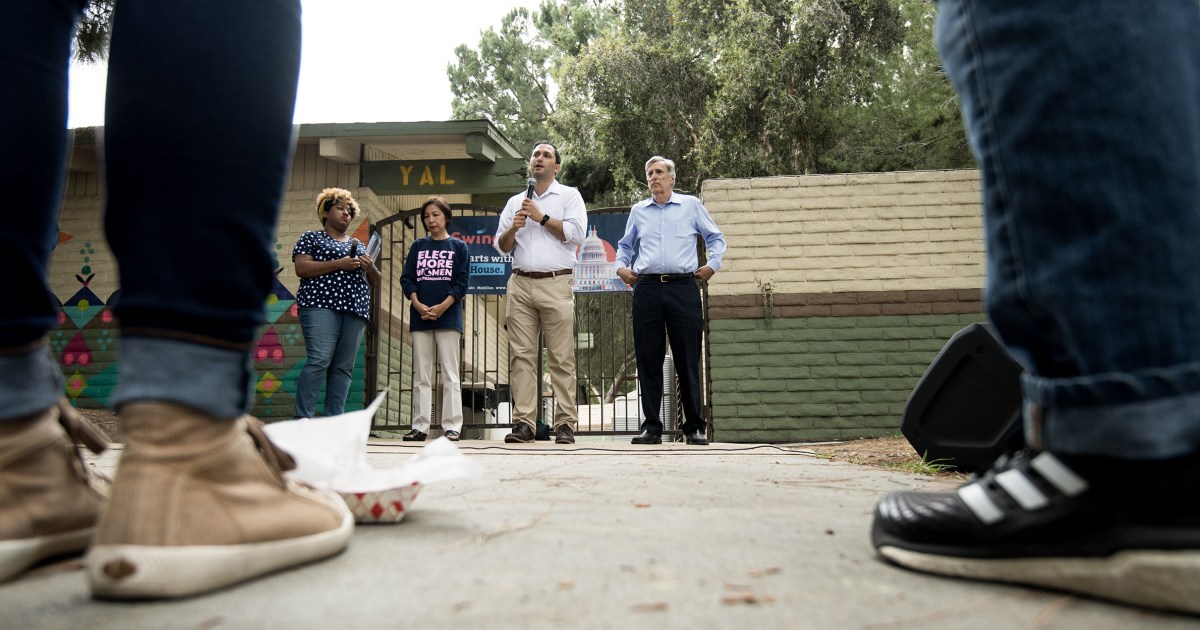
The group, Swing Left, is growing its list of targeted races from 33 House battlegrounds to 63 House, Senate and governor’s contests this fall as it expands its “Ground Truth” program — which began as an ambitious effort to knock on every door in battleground House districts, not just those of targeted homes, which is often where campaigns target more limited resources.
“Our job at Swing Left is to direct people’s time and money to the most competitive races in the country, where grassroots efforts can actually move the needle,” the organization wrote in a strategy document, titled “The Big Swing,” which was shared with NBC News. “Which races those are has changed a lot.”
Swing Left categorized races in three separate buckets: must-flip races that Democrats need to capture to win a majority, must-hold races that Democrats can similarly not afford to lose and “reaches” — districts or states that would be good to win but are not necessary to secure a majority.
Most of the House races added to their target list fell into the reach category, including Alaska’s at-large congressional district, a stretch of Arizona that includes much of the Navajo Nation, a slice of suburban Philadelphia still represented by a Republican and open seats in Iowa, Maine and Texas, among other races.
Swing Left’s entire Senate and gubernatorial slate is newly targeted.
The organization said it was broadening its reach because of President Donald Trump’s declining approval rating and Democratic electoral success in recent months. While the party has had redistricting setbacks in recent weeks, the group maintains that Democrats remain on strong footing for widespread gains in the fall.
“Virginia and this rollback of the Voting Rights Amendment keep us up at night for the long-term effects,” Yasmin Radjy, the executive director of Swing Left, said in an interview. But, she said, “we are going to win a House majority unless there is a political asteroid that falls upon our party or, I don’t know, Trump converts to someone that he’s not.”
On the Senate side, one standout target is Alaska, where Republican Sen. Dan Sullivan is on a collision course with Democratic former Rep. Mary Peltola in the fall. Swing Left believes the state is one of four must-flip seats for Democrats to regain a majority, while it believes the Senate race in Texas, long a fixation for Democrats seeking to turn the red state blue, is a reach target.
Radjy said that’s because the group feels “really, really, really bullish on the infrastructure that is being built in Alaska.”
“It’s all, like, squarely pointed in the right direction,” she said. “Texas is just much more complicated. … There are many more hills to climb.”
Swing Left, which was launched in the aftermath of Trump’s first election in 2016, has focused on building volunteer networks to engage in voter outreach efforts, including phone banking and door-to-door canvassing.
It entered this election cycle seeking to revamp Democratic voter outreach efforts with its Ground Truth program as Democrats investigate how their expansive direct outreach effort fell short in 2024 versus a Trump campaign that prioritized narrowly targeting so-called low-propensity voters.
Swing Left hopes to raise $25 million for its efforts and have its volunteers engage in more than 500,000 conversations of at least 10 minutes with voters. Those conversations would be recorded via voice memo and analyzed with artificial intelligence, with the results shared with campaigns thanks to a loosening of Federal Election Commission rules allowing greater coordination between candidates and outside canvassers.
“To win a durable governing majority, we can’t just attack Republicans, we need to build trust in Democrats and in government itself,” the group wrote in its memo. “That’s a harder and more important problem than winning any single election. This challenge is compounded by how badly the Democratic brand has been damaged in recent years. Convincing people to vote for Democrats, not just against Republicans, will require rebuilding voters’ understanding of what Democrats stand for, besides being anti-Trump.”
In the first quarter of 2026, Swing Left ran a pilot program of its Ground Truth operation in 29 targeted congressional districts, canvassing nearly 12,000 homes and making more than 187,000 calls. The organization was able to have more than 4,400 of the substantial conversations it is seeking.
According to data provided by Swing Left, volunteers had such conversations at more than 20% of the homes they canvassed.
“Roughly 40% of our conversations happened at doors Democrats would never normally knock on,” the group said in the memo.
Democratic officials have worked alongside Swing Left. In March, Swing Left hosted a canvassing event with Reps. Pat Ryan, D-N.Y., and Alexandria Ocasio-Cortez, D-N.Y. Sen. Jon Ossoff, D-Ga., said he was “grateful for Swing Left’s support” after his race was added to the group’s list of targets.
As it makes clear in its strategy document, the group’s goals are broader than boosting midterm candidates. It outlined a plan to win through the 2032 presidential election, with a focus on positioning Democrats ahead of reapportionment following the next census. Population trends in some of the largest Democratic- and Republican-leaning states could reliably Democratic states to lose Electoral College votes after 2030 while reliably Republican states gain them, changing the path to the presidency.
“This blocks the minimally viable path to the White House that Democrats have relied on for years. To win the presidency, Democrats will have to fight through a much harder map, with states like Texas, North Carolina, and Georgia becoming necessities, not stretch targets,” the group wrote. “Turning those states solidly blue will require years of work and investment. We have to start now.”
In the interview, Radjy said the group is “really preoccupied” with the significance of the upcoming reapportionment.
“Part of what we’re doing in the midterms is trying to win the midterms,” she said. “Part of what we’re trying to do in the midterms is to think expansively again, about the map and thinking more long term … about the electorate, and not just talking to base Democrats but also the Democrats that are moving away from us, Republicans, independents, so that we are well positioned for much tougher cycles to come.”
