


Addressing an Eid dinner in New York, Dar urges investment in Pakistan’s future
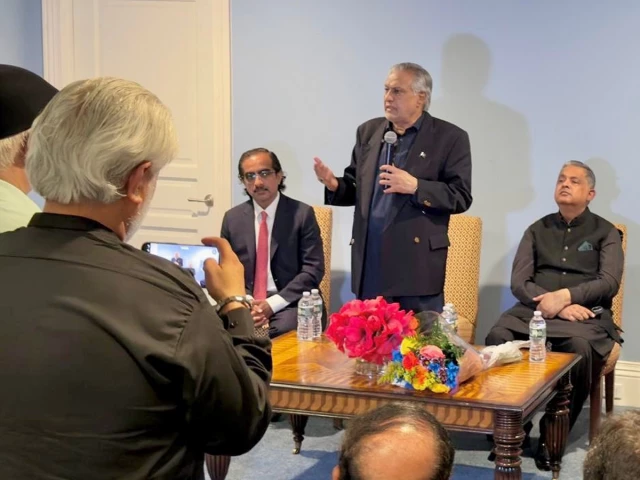
Deputy Prime Minister and Foreign Minister Ishaq Dar addresses Pakistani-American community during an Eid dinner in New York on Wednesday. Photo: X
Deputy Prime Minister and Foreign Minister Ishaq Dar on Thursday hailed Pakistan’s constructive role in regional and global peace efforts, saying the country had immense potential and that its “best days lie ahead” as it pursued a path of sustainable, high-growth development aimed at improving the quality of life of its people.
He made the remarks while addressing members of the Pakistani-American community at an Eid dinner hosted by the Consulate General of Pakistan in New York. The event was attended by prominent Pakistani-American community leaders and professionals.
FM Dar said Pakistan, under the leadership of Prime Minister Shehbaz Sharif, had demonstrated “maturity, credibility and steadfast commitment to international peace and stability”.
Read: Iran and US trade air strikes after Trump dismisses report of Hormuz deal
“A nation capable of defending itself with confidence is equally well-positioned to pursue sincere peacemaking efforts with credibility,” he said.
Deputy Prime Minister /Foreign Minister Senator Mohammad Ishaq Dar @MishaqDar50 addressed a gathering of the Pakistani-American community at an Eid dinner in New York. pic.twitter.com/sEibOlYt3b
— Ministry of Foreign Affairs – Pakistan (@ForeignOfficePk) May 28, 2026
The deputy prime minister said Pakistan was a country of “immense potential” and that “its best days lie ahead”.
He said the government had successfully steered the country through a period of significant economic challenges towards stability and was now focused on sustainable, high-growth development.
Highlighting economic indicators, Dar pointed to declining inflation, improved credit ratings, a strengthening external account and rising investor confidence as signs of economic recovery.
He said the next phase of economic expansion would be driven by exports, adding that the government was actively pursuing an export-led growth model to generate foreign exchange, create employment opportunities and integrate Pakistan into global supply chains.
Reflecting on what he described as defining moments in the country’s history, Dar said the month of May held “special significance” for Pakistan.
Deputy Prime Minister / Foreign Minister, Senator Mohammad Ishaq Dar Addresses Pakistani-American Community at Eid Dinner, in New York — Consulate General of Pakistan, New York. pic.twitter.com/eNhZMlfWEO
— Ministry of Foreign Affairs – Pakistan (@ForeignOfficePk) May 28, 2026
He recalled that on May 28, 1998, under then-prime minister Nawaz Sharif, Pakistan became a nuclear power, saying the move demonstrated the country’s “national resolve and capability”.
Dar also referred to events in May 2025, stating that Pakistan’s armed forces, under the leadership of Field Marshal Asim Munir, Air Chief Marshal Zaheer Ahmad Babar Sidhu and Admiral Naveed Ashraf, had stood firm “in the face of Indian aggression” alongside the people of Pakistan.
Also Read: Pakistan, Saudi Arabia agree on security training for 200 FC personnel
“The outcome became an immortalised moment of national pride, deserving to be acknowledged and celebrated,” he said, while commending the resilience and unity displayed by the armed forces and the public.
Praising the Pakistani-American community, the deputy prime minister described the diaspora as one of Pakistan’s “most formidable assets” in promoting advocacy, investment and people-to-people ties between Pakistan and the United States.
He urged overseas Pakistanis to “honour their roots by investing in Pakistan” and become partners in the country’s future progress.
In recent months, Pakistan drew international attention for its involvement in mediation efforts between Iran and the US amid the Middle East crisis.
On February 28, the US and Israel launched a joint offensive against Iran. Tehran retaliated with strikes on Israel and other Gulf countries hosting US assets.
Pakistan subsequently positioned itself as a key mediator for peace, brokering a two-week ceasefire and hosting the highest-level US-Iran talks since the 1979 Islamic Revolution. Although the “Islamabad Talks” ended without agreement, the ceasefire was held and later extended upon Islamabad’s request.
Since then, the two sides have been exchanging proposals and counter-proposals in an effort to reach a middle ground and resume a second round of direct talks aimed at ending the conflict, which has already disrupted global energy supplies and daily life across the region.
After a series of proposal exchanges, the United States and Iran are close to signing a 60-day ceasefire extension that would reopen the Strait of Hormuz, allow Iran to resume oil sales and create a window for negotiations on Tehran’s nuclear programme, Axios reported, citing a US official familiar with the draft agreement.
Under the draft memorandum of understanding, Iran would clear mines from the Strait of Hormuz and allow ships to pass without tolls, according to Axios.
Read More: Iran supreme leader says US, Israel seek to ‘bring nation to its knees’
In exchange, Washington would lift its blockade on Iranian ports and issue limited sanctions waivers permitting Tehran to sell oil freely during 60 days.
However, what had appeared to be a settled matter was thrown into uncertainty after the United States and Iran exchanged strikes on Thursday.
Iran targeted a US airbase after Washington carried out strikes on what it described as an Iranian drone operation near the Strait of Hormuz, while President Donald Trump rejected a reported compromise deal with Tehran.
