


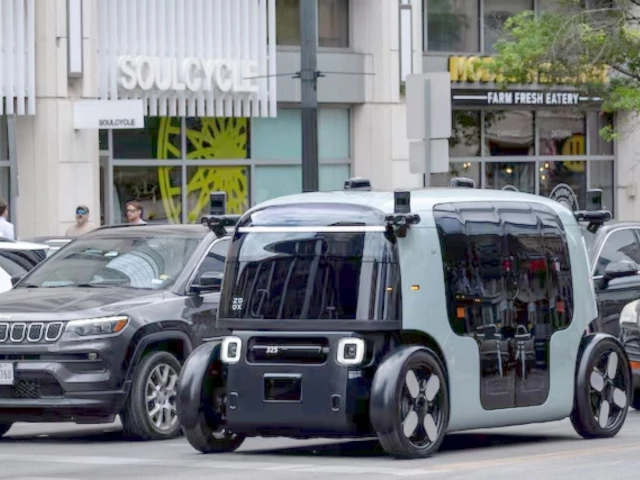
Zoox’s robotaxi seats passengers inward, reaches 75 mph as Tesla and Waymo expand self-driving ride services
A Zoox robotaxi operates on the streets of downtown Austin, Texas, U.S., March 31, 2026. REUTERS
Amazon’s Zoox unit has received US approval for limited commercial deployment of its steering-wheel-free robotaxis, marking the first such authorisation for the autonomous ride industry, the National Highway Traffic Safety Administration (NHTSA) said on Thursday.
The exemption from NHTSA rules requiring human controls, first reported by Reuters, represents a major step for companies developing purpose-built robotaxis rather than adapting traditional vehicles under safety regulations created before self-driving technology emerged.
Zoox’s electric carriage-style vehicle features two rows of inward-facing seats and has a top speed of 75 miles per hour. Other companies, including Tesla and Alphabet’s Waymo, are also racing to expand autonomous ride-hailing services in the United States.
NHTSA Administrator Jonathan Morrison told Reuters that Zoox had received permission to deploy up to 2,500 vehicles annually for the next two years.
Additional reporting requirements
The agency said it determined that Zoox vehicles are as safe as comparable vehicles meeting federal motor vehicle safety standards that are being waived. The vehicles cannot be sold to consumers.
Read More: EU aims for seven AI gigafactories with €10 billion plan in race with US, China
“We can say pretty clearly that the systems in place on the Zoox exceed the equivalent performance requirements of a compliant vehicle,” Morrison said.
“But we still want to make sure that the automated driving system will operate appropriately.”
As part of the exemption, NHTSA imposed additional reporting requirements on Zoox, including reporting crashes and incidents where vehicles stop improperly on roads.
The regulator said it could adjust the conditions based on vehicle performance.
“We have the ability to pull the exemption if we see major safety issues,” Morrison said.
NHTSA said all remote operators supervising the vehicles must be located in the United States. Zoox must also publish maps showing areas where its robotaxis are operating.
Zoox currently provides passenger rides in parts of Las Vegas and San Francisco as part of testing. The exemption allows the company to charge passengers, subject to state and local approvals.
New federal safety rules planned
Morrison said NHTSA expects to develop the first federal safety standards for automated driving systems by the end of the Trump administration.
Also Read: Trump administration bans new Chinese humanoid robots, to protect US AI buildout
The agency is also considering changes to existing rules designed around human drivers, including requirements for brake pedals and rear-view mirrors.
Safety concerns remain
Zoox’s approval follows years of efforts to commercialise its robotaxi technology under regulations written before autonomous vehicles became widespread.
Tesla has begun producing its Cybercab, which also lacks human controls, but has not announced its regulatory approval strategy.
Regulators are attempting to expand autonomous vehicle technology while ensuring public safety.
Earlier this month, Morrison warned autonomous vehicle developers to “immediately focus” on addressing what NHTSA called a “clear pattern of driverless AVs interfering with law enforcement and other first responders.”
Concerns have also included robotaxis driving around stopped school buses, entering construction zones, freezing on flooded roads or busy intersections, and violating traffic rules.
“If we continue seeing issues, we will not hesitate to use the full extent of our enforcement authority,” Morrison said.
Following the warning, Zoox recalled its fleet of 105 autonomous vehicles to update software after discovering they might fail to detect heavy smoke, particularly during active emergencies.
Morrison is scheduled to discuss NHTSA’s safety efforts at SAE International’s Automated Transportation Symposium in San Diego on Thursday.
