


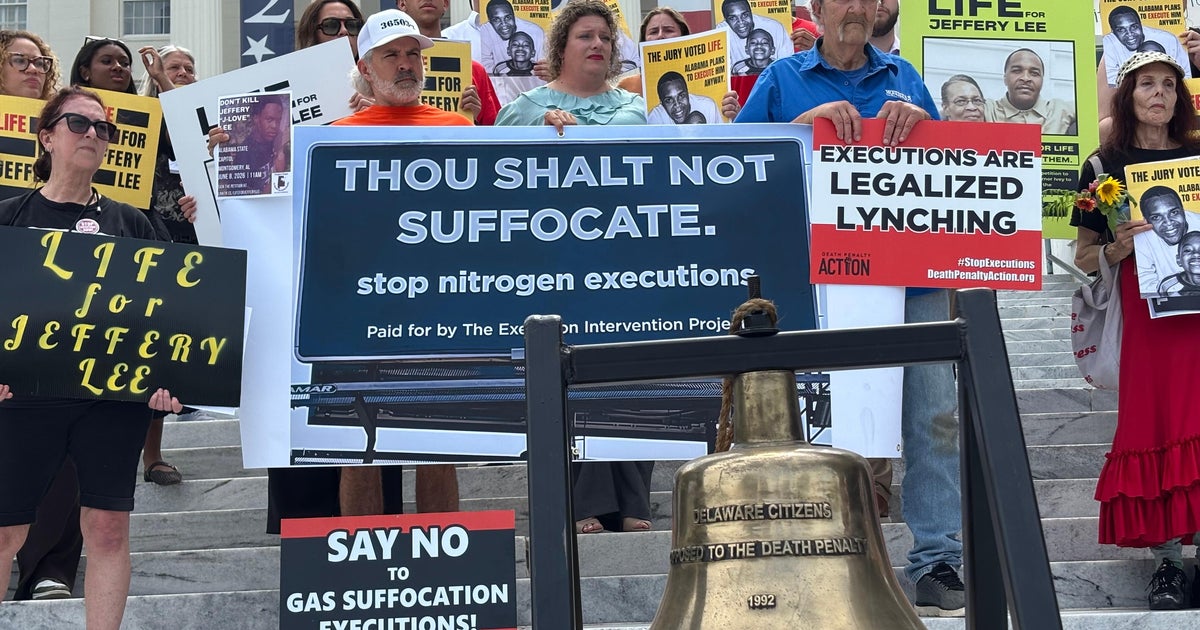
A federal judge has banned Alabama from executing a death row inmate by nitrogen hypoxia, reversing a previous opinion and concluding that the controversial and relatively new execution method is unconstitutionally cruel.
The ruling, issued Tuesday, permanently prevents the state from putting Jeffrey Lee, 49, to death using nitrogen gas.
Lee was scheduled to die by nitrogen hypoxia — where a condemned inmate is forced to breathe pure nitrogen through a gas mask until they suffocate from the lack of oxygen — on Thursday. He has been incarcerated on Alabama’s death row for more than two decades, after being convicted of a 1998 double murder.
Prosecutors said he shot and killed Jimmy Ellis, a store owner, and Elaine Thompson, an employee, while attempting to rob the establishment, court filings show.
In the ruling, U.S. District Judge Emily Marks said Alabama’s nitrogen gas protocol violates inmates’ rights under the Eighth Amendment, which protects against cruel and unusual punishment. It followed an appeals court ruling Monday that reversed an earlier decision from Marks, in which she found the method was constitutional.
“Lee has shown by a preponderance of evidence that the Protocol constitutes cruel and unusual punishment,” Marks wrote Tuesday, referencing the appeals court’s Monday opinion.
After hearing testimony from experts and lay witnesses during an April bench trial that was the first to weigh the constitutionality of Alabama’s nitrogen hypoxia protocol, the court found inmates executed by nitrogen gas likely experience “severe air hunger and corresponding emotional distress, anxiety, physiological stress, and physical discomfort” for at least one to three minutes before asphyxiation occurs.
“There is, in other words, a substantial risk of serious harm. The risk is not conjectural, speculative, or doubtful,” their opinion read. “Counting to 60 or 180 seconds is not a quick exercise, and constitutionally speaking, that timeframe is intolerable given the suffering that would take place under Alabama’s nitrogen protocol.”
Marks’ ruling marked a turning point for capital punishment challenges, which have been brought repeatedly in Alabama since it began carrying out executions by nitrogen hypoxia in 2024. It is notoriously difficult for inmates and their attorneys to meet the burden of proof required to substantiate them.
AP Photo/Kim Chandler
To successfully argue an execution method violates the Eighth Amendment, the Supreme Court has required inmates to demonstrate how one particular method poses “a substantial risk” of causing them severe pain. They are also required to offer a reasonable alternative method by which the state could execute them instead.
Lee has proposed the state execute him using a firing squad as an alternative to nitrogen hypoxia, which Marks said “is feasible, readily implemented, and significantly reduces the substantial risk of serious harm.”
Execution by firing squad is not technically authorized in Alabama, where death sentences can be carried out by lethal injection, nitrogen hypoxia or, under some circumstances, electrocution. But Marks said the state “failed to articulate a legitimate penological reason” for refusing to adopt it as an alternative.
Alabama Attorney General Steve Marshall’s office plans to appeal Marks’ decision, according to court filings. Despite concerns from critics about its nitrogen gas protocol, the state has maintained its denial that the method causes cruel or unusual suffering.
Lee would have been the ninth person in the U.S. executed by nitrogen hypoxia, and the eighth in Alabama. Louisiana has also carried out one execution this way. A handful of other states allow executions by nitrogen hypoxia but have never actually used it.
The constitutionality of Alabama’s nitrogen gas execution protocol will likely go before the U.S. Supreme Court next, which has never found any method of capital punishment to be unconstitutional.
However, the high court has never ruled specifically on the constitutionality of the nitrogen gas protocol, Robin Maher, director of the Death Penalty Information Center, told CBS News. She also said Marks’ decision matters on its own and could have broader impact outside of Alabama.
“This is the first time a federal court has recognized that the harm and suffering resulting from suffocation prisoners using nitrogen gas is unconstitutional,” said Maher. “That has very real significance, especially as other states have adopted or contemplated using nitrogen gas as an execution method.”
Although the Death Penalty Information Center does not take a position on capital punishment, a number of global human rights experts have condemned the use of nitrogen gas in executions, calling it experimental and potentially torturous. People who have witnessed any of the eight executions by this method also observed that the condemned appeared to show signs of distress, and, possibly, suffering, before falling unconscious.
One of them, the Rev. Jeff Hood, witnessed two as a spiritual adviser and is a vocal advocate against capital punishment. Responding to Marks’ decision and the earlier appeals court ruling in a blog post, Hood praised both outcomes and said, “I pray the Supreme Court has the courage to see what these courts have seen.”
