


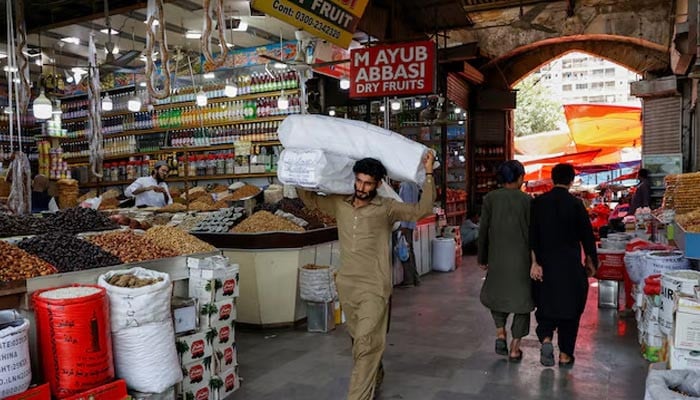
Pakistan’s economy has stabilised. Its people have not. Inflation has eased, reserves have improved modestly, another IMF tranche has arrived and policymakers once again speak the language of recovery.
Yet, outside official presentations and macroeconomic dashboards, the story is starkly different: investment remains depressed, savings are among the lowest in Asia, exports are stagnant, businesses are shrinking, unemployment is rising and millions have quietly slipped into poverty.
This is the defining contradiction of Pakistan’s economic management: the country repeatedly avoids collapse, yet repeatedly fails to build prosperity. Stabilisation has become a substitute for strategy. For decades, Pakistan has operated under the same flawed economic formula – taxation without productivity, borrowing without transformation, consumption without competitiveness. Every crisis produces the same prescription: raise taxes, suppress imports, tighten monetary policy, cut development spending, negotiate an IMF programme and declare temporary stability a success.
Then growth collapses again. Pakistan has now entered its fourth consecutive year of stagnation. This is no longer a cyclical slowdown; it reflects structural decay. The country is steadily losing competitiveness against the rest of the world.
The rot runs deeper than fiscal numbers. Pakistan’s tax system has evolved into an instrument of extraction rather than expansion. Formal businesses face a suffocating web of corporate taxes, super taxes, turnover taxes, withholding taxes, GST, provincial levies and regulatory overreach. Even companies making losses are taxed. Working capital is tied up due to delayed refunds and advance collections. The compliant are punished precisely because they are visible.
The consequences are predictable: investment falls, informality expands, entrepreneurship weakens and capital migrates elsewhere. Meanwhile, banks lend comfortably to the government – sovereign borrowing is profitable and risk-free – while businesses, especially SMEs and startups, struggle to access affordable credit. The state has crowded out the private economy for decades. Pakistan suffers from a shortage of incentives to remain productive, documented and ambitious. The IMF programme has undoubtedly reduced the immediate risk of default. Yet Pakistan has entered IMF programmes so repeatedly that temporary stabilisation has itself become part of the economic model. This is not a criticism of the IMF; its programmes are designed primarily to prevent macroeconomic collapse, not to build competitive economies or ignite productivity revolutions. Countries that achieved major economic transformations ultimately moved beyond stabilisation towards aggressive industrial, technological and export strategies. Pakistan’s deeper failure is that its policymakers have normalised firefighting as strategy.
Meanwhile, the world is reorganising itself around AI, robotics, data and software-driven productivity. Pakistan still governs its economy with the instincts of the 1980s. The FY27 budget is therefore more than a fiscal document; it is a test of whether Pakistan intends to continue managing decline or finally redesign its economic architecture for growth. The real question is not whether the FY27 budget satisfies the IMF. The real question is whether it makes investment, savings, exports and productivity attractive again.
Pakistan must simplify and drastically reduce tax rates. Broad, low-rate systems almost always outperform narrow, high-rate ones in developing economies. Maximum direct tax rates should fall to around 15%, while GST should be reduced to 10% per cent – the objective being expansion of the tax base through growth and formalisation, not further extraction from a shrinking formal economy.
Agriculture presents a distinct and delicate challenge. Over 95% of Pakistan’s farmers are smallholders with average landholdings below ten acres, already squeezed by rising costs of diesel, fertiliser and electricity. Agricultural incomes above a reasonable threshold should be brought into the tax net, but at a maximum rate of 15%. Punitive taxation of this sector would discourage investment-oriented farming, suppress productivity and deepen rural distress – an outcome no government can afford in a country where agriculture still employs nearly 40% of the workforce and anchors food security. The goal should be to gradually formalise and document agricultural income, not to extract from it prematurely.
The petroleum levy debate requires a different kind of reasoning — and more political courage. Pakistan spends billions of dollars annually importing petroleum products, draining foreign exchange reserves and perpetuating energy insecurity. A well-calibrated, higher petroleum levy is not simply a revenue measure; it is a strategic instrument. Raising the cost of fossil fuel consumption creates meaningful incentives for households and businesses to shift toward hybrid vehicles, electric vehicles, solar energy and efficiency improvements. Countries that have successfully reduced fuel import dependence have used price signals, alongside policy support, to accelerate that transition. For Pakistan, higher petroleum taxation – if paired with targeted relief for low-income households and investment in public transport – can simultaneously strengthen fiscal revenues, reduce the import bill and advance the country’s energy transition. The long-term gain in energy security far outweighs the short-term discomfort of higher pump prices.
More urgently, Pakistan needs a national digital transformation strategy centred on AI, cloud infrastructure, fintech, digital payments and export-oriented technology services. The FY27 budget should allocate a minimum Rs200 billion National Venture Capital and Innovation Fund to finance startups, AI ventures and high-growth digital enterprises, alongside highly attractive incentives for private venture capital and angel investors. The next generation of wealth will not come from protected industrial empires; it will emerge from AI-enabled industries, software exports and data-driven enterprises.
Fiscal discipline, however, cannot mean only higher taxes on the private sector while the state itself expands unchecked. Ministries, departments and redundant public bodies at federal and provincial levels must be reduced dramatically. Privatisation of state-owned enterprises must proceed rapidly, rather than remaining hostage to committees and political hesitation. Every rupee consumed by unproductive state structures is capital diverted from innovation and private investment. Pakistan now faces a defining economic choice. One path leads to perpetual stabilisation: recurring IMF programmes, rising taxation, weak investment and continuous misery for most of the population. The other demands disruptive reform: lower taxation, smaller government, privatisation, technological modernisation and export competitiveness.
The first path may keep the country solvent. The second is the only one that can make it prosperous.
The writer is a former managing partner of a leading professional services firm and has done extensive work on governance in the public and private sectors. He tweets/posts @Asad_Ashah
Disclaimer: The viewpoints expressed in this piece are the writer’s own and don’t necessarily reflect Geo.tv’s editorial policy.
Originally published in The News
