


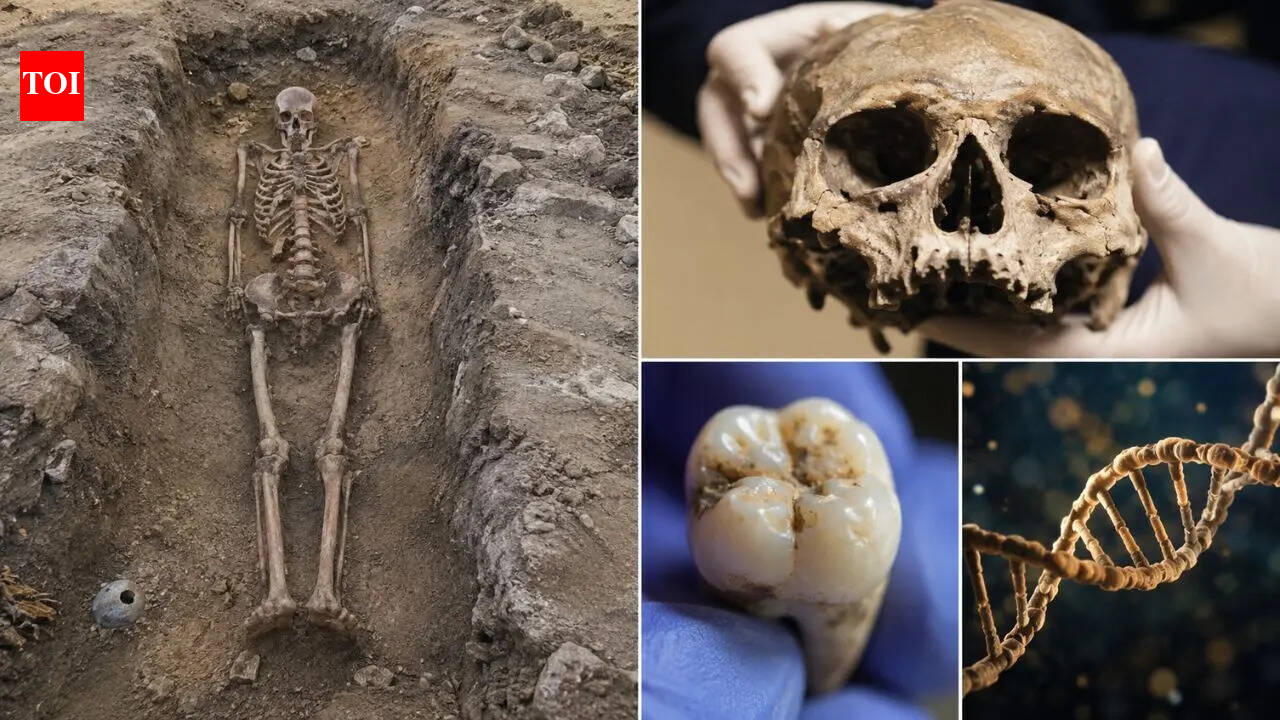
In a quiet corner of northern Finland, a burial that once seemed unremarkable has started to feel like it belongs to several different lives at once. The grave was first uncovered decades ago near the shores of what is now known as Lake Yli-Kitka, a landscape of cold water and forest that rarely gives up anything easily. At the time, the objects placed with the man suggested a familiar cultural story, one tied to Sámi ritual practice. That reading held for years, more or less unchallenged, until newer techniques began pulling at the edges of the narrative.What has emerged since is not a clean correction but a layering of possibilities. Bones, teeth, and fragments of genetic material have been treated almost like records that were never meant to be read. They don’t agree with each other in straightforward ways, and that friction is where the story now sits.
New analysis challenges long-held interpretation of burial origins
The burial itself was not newly discovered. It had been there since the late 1500s or early 1600s, resting through centuries of silence before excavation brought it into academic view in 1970. At first glance, the accompanying artefacts pointed towards a Sámi cultural context, and the interpretation followed that line for a long time.A later re-examination, led through modern genetic and isotope work published in BMC Genomics, unexpectedly reopened the case. The man inside the grave, it turned out, did not sit still geographically during his life. His biological traces suggested movement across regions that stretched far beyond northern Fennoscandia.The assumption of a settled local life began to look less certain. Even the idea of a single, fixed identity felt harder to hold in place.
DNA evidence suggests Sámi affiliation alongside wider northern connections
Genetic profiling placed the individual within Sámi ancestry, aligning his genome with populations linked to northern Fennoscandia. In broad terms, there was continuity with present-day Sámi groups, visible in both maternal and paternal lineages.Yet the detail became more complex when compared against large modern datasets. Shared DNA segments suggested stronger connections to communities in areas such as northern and eastern Lapland than to the immediate burial site itself. The pattern was uneven, almost scattered, as if inheritance and geography had drifted apart at points in his life.There was no clear contradiction in the genetic story, but it didn’t behave like a simple local profile either. It hinted at movement, mixing, and the kind of mobility that rarely survives in written record.
Isotopes and the geography of a life
Teeth tend to record where a person has been, quietly locking in chemical signatures from water and food during childhood. In this case, those signatures shifted more than once.Early signals suggested a mixed diet, combining land animals, freshwater fish, and marine resources. That combination would normally imply a place where different ecosystems overlapped, or at least where trade or travel made such variety possible.Later stages told a different story. Freshwater markers faded, replaced more strongly by marine influence. At the same time, the geology recorded in his teeth pointed towards volcanic terrain, something absent from modern-day Finland. That detail narrowed the possibilities considerably.One interpretation proposed by the research team linked the isotope profile to parts of the North Atlantic, with Iceland emerging as a plausible match. It is not a certainty, only a convergence of readings that happen to align in one direction more than others.
The man’s remains and chemical record reveal a life that does not fully align
The man died around 17th century. His remains suggest physical labour over long periods, though nothing in the bones alone explains the distances implied by the chemical record, as reported by the study published in BMC Genomics, titled, ‘Bioarchaeological analysis illustrates the life of a 16th-century Sámi individual from Kitka, Kuusamo, northern Finland‘.There is a sense of discontinuity between the artefacts buried with him and the life reconstructed through science. Earlier interpretations leaned on those objects as cultural anchors, reading them as evidence of a ritual specialist within Sámi tradition. That interpretation has not been erased, but it has been loosened.Training for such a role, according to historical accounts, would normally be rooted in long-term community life. The isotope shifts complicate that picture. They suggest arrival in the Kuusamo region relatively late, possibly near the end of his life, rather than a deep-rooted residence from childhood.The pieces do not fully align, and they were never expected to speak in unison.
When archaeology and chemistry disagree on a single human life
The genetic profile still links him to Sámi ancestry, and that connection remains central to how the burial is understood. Yet identity in historical contexts rarely sits neatly inside biological markers alone.Within the framework of modern research at the University of Turku, there is a careful distinction being drawn between ancestry and identity. One can be traced in molecules, the other belongs to lived experience, language, and social belonging that do not fossilise in bone.That distinction matters here, because the archaeological record has a habit of collapsing complexity into categories that feel too tidy in hindsight. This burial resists that simplification.
What remains unresolved in the soil
Even after decades of analysis, the burial near Lake Yli-Kitka does not settle into a single interpretation. The artefacts still point towards cultural practice within Sámi traditions. The genetics support that connection in broad terms. The isotopes pull the life story outward, away from the burial site and into regions far beyond it.The result is not contradiction so much as overlap. Several plausible histories sitting on top of one another without fully merging.What happened to bring him to northern Finland at the end of his life remains unclear. Whether he arrived recently, returned after long absence, or moved repeatedly across northern routes is still open to interpretation. The bones keep their position, but the life they describe keeps shifting shape depending on which method is used to read it.
