


PUBLISHED
April 12, 2026
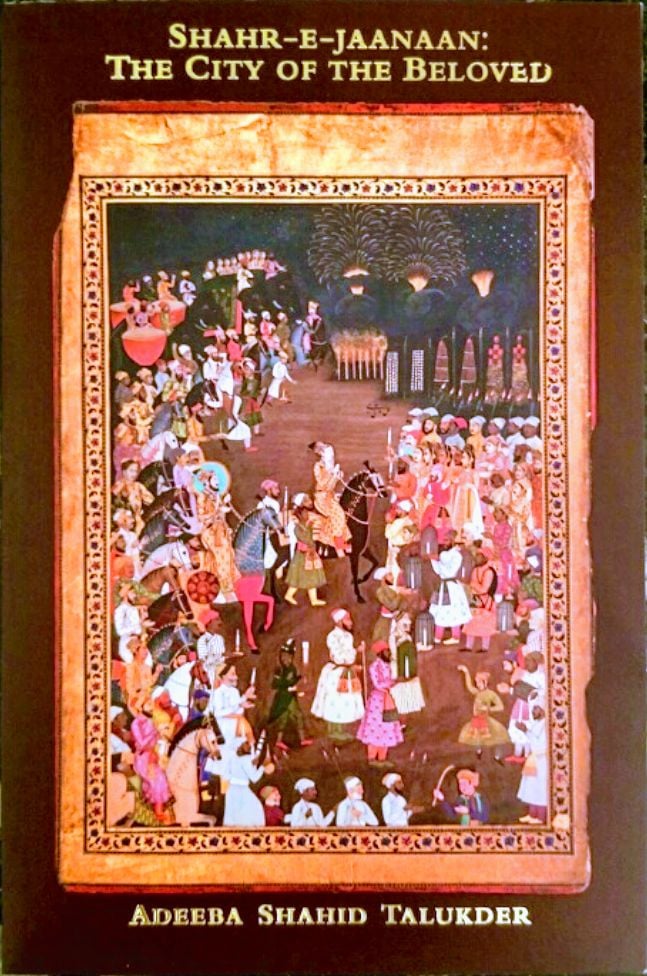
WH Auden once said, “The poet is himself enchanted by the subjects he writes about and wishes only to share his enchantment with others.” And this goes perfectly well for Adeeba Shahid Talukder, a Pakistani and Bengali-American poet, vocalist, and translator, whose poetry book titled Shahr-e-jaanaan: The City of the Beloved, time and again, reverberates with our South Asian poetic mazmuns (themes). In this enchantment, we see other poets’ voices, as well, like Faiz, Ghalib, Mir, Iqbal, Sauda, NM Rashid and others, and even mystical figures like Mansur Al-Hallaj and– though not explicitly mentioned in the book– Jesus.
The book fascinates me on two levels: firstly, as a literary subject; through the Anglicised milieu of the East, we see the traditional kinds of complex wordplay, multivalent meanings, subtle allusions, and so on, in addition to starkness, simplicity, and colloquial language that travels across the language barrier. And it is commendable as it is quite grinding to do this, since the very mechanics of Urdu and English are poles apart. Urdu is an S-O-V (subject-object-verb) language, whereas English is S-V-O. Ipso facto, to somehow craft poems in the latter language in the hue of the former is a task well upholstered and requires dexterity par excellence in both languages.
Secondly, for a person like me who is neither well-versed in his mother-tongue (Hindko) nor the lingua franca (Pashto), can only speak in Urdu, and read and write in English, the metamorphosis of my plato-esque poetic forms — shaped by the poets mentioned — into the language I can read in, is something I always wished to consume. I felt as if I were in a foreign terrain, and there remained no one who could understand my tongue, and then, one day, I found a person who speaks the same language.
Metaphorical play
The metaphorical play, as Dr Nomanul Haq notes, is undoubtedly the jewel of the Sabk-i-Hindi tradition (amalgamation of the South Asian Persian and Urdu), gifted by Ghalib. Adeeba, in her book, also exploits this sport, especially in the poem “Crossing Manhattan Bridge”, where she writes, “..the sky bleeding stains of henna”.
Here we see the honeycomb of reality engendering metaphor and metaphor-as-reality engendering new metaphors: “henna” is a dye made from dried leaves (reality) and a signifier of beauty (metaphor), and also inextricably linked to being (from Amir Khusro’s Chhap tilak sab chheeni [You have taken away my beauty and being]; but, here, we are talking about stains of henna (metaphor-as-reality): the long-gone beauty, much like the beloved of ghazals, who is always missing; “sky bleeding” (metaphor-as-reality): the world is ending! And so, the ephemeral beauty, along with the being, is being bled by the sky (real) itself – or maybe, it is not sky qua sky but the worldview (as metaphor) that the beloved offered to the poet, and of course, which the lover fantasised in first place.
The classic intermixing of imaginary sprouting in concrete and concrete sprouting in imaginary is haunting vehemently here. Also, this complex usage of metaphors confers universalism to her poetry; ergo, we see the expression of love not in a personal way. Here we find the beloved, unlike the Vedantic — an ordinary Indian woman, not an idealized imaginary — beloved of Firaaq Gorakhpuri, to be someone metaphysical, and so the longing, like the Persians, is not at all constrained; rather, the severance from beloved is destroying the whole world. She writes:
“upon light. I ask: whose blade
is sharpest? who holds
this sky today,
then tomorrow?
to whom belong
the flames at night?
is it your lovers, O Beloved,
or the executioners?”
Intertextuality
“A poet ought not to pick nature’s pocket: let him borrow, and so borrow as to repay in the very act of borrowing,” said Samuel Taylor Coleridge, English poet and literary critic, in 1851. This is quite common in our tradition, where poets refer to other poets. Let’s not forget our own Iqbal, right at the start of Bal-e-Jibril mentioned a poem of Bhartrihari, and transcreated it in Urdu:
“phuul kī pattī se kaT saktā hai hiire kā jigar
mard-e-nādāñ par kalām-e-narm-o-nāzuk be-asar” (Translation: A flower’s petal may pierce even a diamond’s core, / But soft, tender speech leaves the ignorant unmoved.)
This corresponds to the traditional conception of art; as per Ananda Coomaraswamy, the great metaphysician and historian of art, art, operative in both in the Islamic and in other civilisations, underlines three necessary requisites or steps, which can be enlisted as imitation (of the tradition and the operation), expression (the process of inner transformation that the artist’s craft), and effusion (of the archetypes in this world of matter). By following this in poetry, we see, as employed by Adeeba, verses pregnant with the traditional mazmun- and maini-afrini (theme- and meaning-creation), and kaifīyat (feelingfulness) in novel expression and language. She penned:
“Now they darkened the sky
and tore its flesh
and the cold water, too,
tore into every niche
of light.
He had searched the horizon
again and again.
She wasn’t there.
There were no angels.”
While the readers may, in a way, get overwhelmed by the continuous reference to other poets, I think the beauty lies in the poetry which is not referred, the titular chapter, “Shahr-e-jaanaan: The City of the Beloved”, is poignantly touching and personal in this regard, and yet even in those verses we see those eastern hues everywhere – this is more like a transformation, rather than an outright mimicry.
In her poem, “Mansur the Heretic”, she writes: “…The sky split, mountains fell
as he hung in the sky,
gleaming like wine.
That night, Revolution walked
to the gallows—
lips red, hands silver,
curls like black rain….”
Isn’t this inspired from the Quran, Faiz, Hallaj, and Jesus at the same time? Not only this poem, but I think the whole book is inked, knowingly or unknowingly, under the shadow of Hallaj, right from the title – taken from Faiz’s “Aaj Bazaar Mein Pa-Bajolaan Chalo” which was in turn inspired by the mystic’s life – to the symbolisms like moth-candle.
We also see some innovative themes; for instance the poem “Subh-e-firaaq: Morning of Separation” is antithetical to the, otherwise pervasive theme of shaam-e-firaaq from Faiz:
shām-e-firāq ab na pūchh aa.ī aur aa ke Tal ga.ī
dil thā ki phir bahal gayā jaañ thī ki phir sambhal ga.ī
(Translation: Don’t ask about the evening of separation: it came, and having come, it passed;
The heart, somehow, was consoled again, and life itself steadied once more.)
And other times, the book contains old themes with new meanings attached to it. Further, we see the insertion of many familiar mythologies, idioms, objects, tropes, and poetic conventions mingling in her poems, amongst them: “Majnun”, “Farhad”, “tavern”, “idols”, “torn collars”, “dust on the head”, “Gods of the age”, “nightingale”, etc. Isn’t it fascinating to see all of these archetypes in English verses, without the commonplace coarseness of being fillers, in the natural flow of the poetry?
Plus, the influence of ghazals – the poetic form dating back to the emergence of mu’allaqaat (the golden odes) in the mid-sixth century in northern Arabia – is perceivable, with its two distinctive qualities, gifted by the Persians: the acute mystical preoccupations and its keen philosophical concerns. Adeeba tries to unfurl her poems around these cerebral categories as well, in addition to the heartfelt pronouncements of love and separation. For instance, in the poem “On Ghazal Poetry versus Natural Poetry”, she writes a defence of the disunities of ghazals and their obsession with greatness beyond the everyday, “Being excluded from a universe, too, is a type of dance. Still, / so often, we write of the moon.” Also, the Sufi metaphysics, Unity of Being, is being used as a pond in which many poems are drenched. And of course, we need to read them as the truths of fiction without reasoning against or in defence of; after all, a poet is a fiction-maker.
The new Anglophone poetry of Pakistan
“Poetry is language in which every component element—word and word order, sound and pause, image and echo—is significant, significant in that every element points toward or stands for further relationships among and beyond themselves. Poetry is language that always means more. Its elements are figures, and poetry itself is a language of figures, in which each component can potentially open toward new meanings, levels, dimensions, connections, or resonances,” asserted Shira Wolosky in the book The Art of Poetry. But, unfortunately, this is not the case for the anglophone poetry being produced here, currently.
To comment on the poetry being fomented on social media won’t be fair, as there is no editorial filtering involved. But the poetry being printed in literary magazines is, in many ways, subpar. This is partly due to the literary establishment within the anglophone scene. Literary critics, magazines, organisations, and universities operate within a closed circuit: no one critiques the other; everyone is everyone else’s friend, often engaging in sycophancy on social media without an iota of critical thought. I suspect they do not truly read one another, but instead wield names as currency to secure further opportunities.
Resultantly, what we see mediocracy cap-a-pie; just skim through magazines, and you will find poems brimming with a plethora of particulars, without any universal meaning; this is the manifestation of the film Dead Poets Society’s explanation of literature – that is, poetry is something which needs to be felt, rather than a discourse necessitating a hard-working mind indulged in the tradition. We then mostly, and inter alia, see some cliché expressions, personal journal-styled entries as verses, Urdu words compressed forcefully in English, obscenity not in the colonial sense of smearing ghazals as immodest but often a kink presented bereft of aesthetic beauty and meaning, isms’ balladry, a zumba with foreign mythologies, which a common Pakistani would have no idea, lack of poetic obscurity (but full of absurdity), and metaphors, similes, images, symbols exploited as mere adornments and not as the intrinsic quality of poetry. In short, we see humanities, without difficulty, stripped of their demand for interpretation, context, or critique, in the most digestible form: as emotion, inspiration, and uplift. This is a cultural symptom, a collective desire that wants humanities but also with quite ease.
To save humanities from the ephemerality of the particulars and expression of icon (a fashion; a craze) rather than idol (an idea; a state of being), one must try to read what the earlier poets did.
As TS Eliot wrote — and Adeeba practiced — in his famous essay, Tradition and the Individual Talent:
“[Tradition] involves, in the first place, the historical sense…[which] compels a man to write not merely with his own generation in his bones, but with a feeling that the whole of the literature of Europe from Homer and within it the whole of the literature of his own country has a simultaneous existence and composes a simultaneous order.”
After all, if I am writing a poem, I am not only writing a poem; I am participating in the tradition where some extraordinary people penned some of the most intellectually and emotionally arousing lines — lines that could rapture hearts and make neurons fully indulged post-reading.
Coda: Shahr-e-jaanaan is a fascinating prototype for anglophone poets of this region; it provides fresh poetic transgressions embodying fresh expressions, undulations, dimensions, connections and much more while exploiting classical symbols, images, affinity of meaning, metaphors, similes, and folklores; in short, using Eliot’s diction, Adeeba’s work is understandable as well as enjoyable, and consequently, worth reading.
All facts and information are the sole responsibility of the writer
Furqan Ali is a Peshawar-based researcher who works in the financial sector. He can be reached at alifurqan647@gmail.com
