


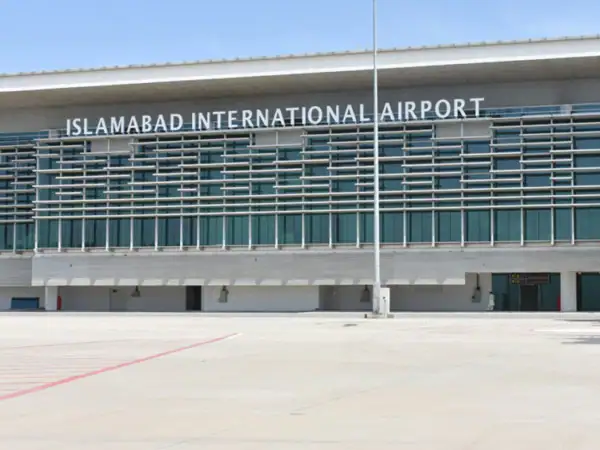
I look at threat reports and enemy tactics for a living. I’ve done it for years. But I’ll be completely honest with you—no matter how much experience you have, it is a wild, unsettling feeling when the war you study on a screen shows up in the sky over your own hometown. Think about March 13. Families all over Islamabad and Pindi were just out living their lives, packing the markets, buying Eid clothes with their kids. Down on the ground, everything was beautiful and completely normal. But right over their heads, totally unseen, a silent battle was playing out. The attack completely failed, and life in Islamabad and Pindi just carried on as normal.
Drones originating from Afghanistan entered our airspace, attempting to strike a residential area in Islamabad, our military fort in Kohat, and sites in Quetta. They failed. The immediate public reaction? None. Eid shopping continued in full swing. There was no panic on the streets of our capital—only the quiet, unshakeable confidence of a public that knows what stands between them and chaos.
But as a security expert, I know the public has questions. What is the reality of these drones? How do they operate, and what do Pakistanis need to take away from this provocation?
Let’s strip away the terror-inducing buzzwords and look at the cold, hard tactical reality.
When people hear “drone strikes,” they imagine the sleek, high-altitude, multimillion-dollar Reaper drones utilised by advanced superpowers. What the Afghan Taliban’s so-called Ministry of Defence sent across our border were essentially modified, hobby-grade toys. These were rudimentary, makeshift kamikaze drones—small, commercial unmanned aerial vehicles (UAVs) rigged with basic explosives. They lacked sophisticated guidance grids, deep-penetration capabilities, or extended precision ranges.
Against a Tier-1 modern military, sending these into our airspace is the geopolitical equivalent of throwing a rock at a tank.
Here is exactly how our boys dismantled the threat. Our radar and air defence grids picked up these anomalies long before they reached critical targets. Our military and specialised police teams deployed what we call Electronic Countermeasures (ECM). They initiated “soft kills.” By activating sophisticated anti-drone systems, our forces completely jammed the electronic signals controlling these UAVs. Cut off from their operators in Afghanistan, the drones’ motors simply shut down. They became dead weight, forced to crash-land in Khyber Pakhtunkhwa and adjacent areas.
Tragically, falling debris caused minor damage and injured four of our civilians. But fundamentally, no military installation or infrastructure was touched. The invisible electronic shield worked flawlessly.
So, why would an illegitimate regime—installed by brute force and terror—audaciously provoke a nuclear-armed military power of the Islamic world with such a futile stunt?
One word: Panic.
Kabul is terrified. Over the last several months, Pakistan’s Operation Ghazab lil Haq has relentlessly, systematically dismantled and vaporised more than half of the terror sanctuaries inside Afghanistan. The Taliban regime is bleeding assets. Their role as a Master Proxy—harbouring Indian-funded outfits like FAK and FAH—is fully exposed. They crossed a red line to show their proxies they could bite back. But their bite was toothless.
Unable to win in the physical domain, they retreated to where cowards usually go: the digital information war. On social media, Afghan accounts began circulating frantic videos of burning buildings, claiming our capital was on fire. The dark comedy of it all? The video they posted was of an old fire in New Delhi. It was actually laughable. If you watched their fake video of ‘Islamabad burning,’ you can literally see those iconic green and yellow Indian rickshaws rolling by in the background. Anyone who has spent five minutes in Islamabad knows we don’t even have those here. But honestly, what else do you expect from the same guys who went online bragging that they shot down one of our fighter jets—only to awkwardly delete their tweets a few hours later when everyone realised they were making it up?
What the citizens of Pakistan need to learn from this is crucial: Expect the noise, but trust the grid.
Drone warfare in the 21st century is changing. We will continue to see rogue outfits attempt to weaponise off-the-shelf technology to create panic where their military hardware falls short. This is asymmetrical nuisance warfare. But they are dealing with an adversary vastly out of their league.
In May 2025, Pakistan firmly communicated to New Delhi exactly who dictates the escalation matrix in this region. We established who the real boss is. Now, we are simply explaining that same mathematical reality to Kabul. The illegitimate regime wants the world to view them as a governing authority, yet they act like a besieged street gang tossing firecrackers over a fortress wall.
Our security forces remain highly alert, and Operation Ghazab lil Haq will not stop until every target is achieved. Our military dictates the pace. Let the Taliban post fake videos; let them launch their desperate toys.
Here in Islamabad, the markets are open, Eid is approaching, and the skies belong entirely to us.
