


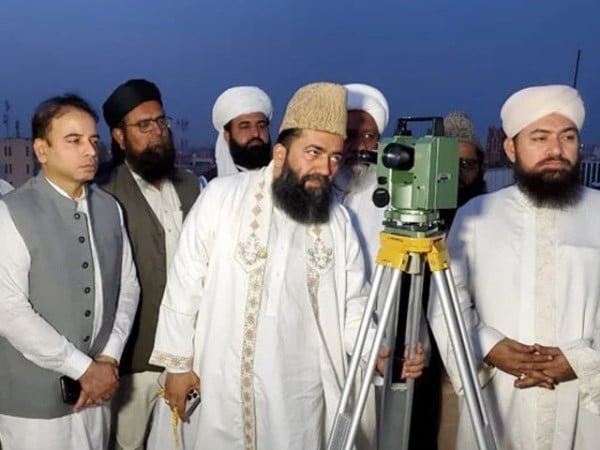
ISLAMABAD – The Central Ruet-e-Hilal Committee is currently holding its meeting in Islamabad to sight the Shawwal moon. The session is being chaired by Maulana Abdul Khabir Azad, and a final announcement regarding the sighting of the Eid moon will be made after reviewing testimonies.
Members of the committee, along with representatives from the Pakistan Meteorological Department and other departments, are in attendance. However, cloudy weather in Islamabad has reduced the chances of moon sighting.
Similar meetings are underway across the country. In Lahore, the provincial Ruet-e-Hilal Committee is meeting at the Auqaf building, while zonal committees are convening in Quetta, Karachi, and Peshawar to collect and review moon sighting reports.
According to the Pakistan Space and Upper Atmosphere Research Commission (SUPARCO), the new moon was born at 6:23am on Thursday, March 19, 2026. By sunset, the moon’s age is expected to be around 12 hours and 41 minutes, which is considered insufficient for visibility.
Meteorological sources state that the moon’s age across Pakistan will remain below 13 hours on the 29th of Ramadan, whereas at least 18–20 hours are required for sighting. Additionally, the time gap between sunset and moonset will be around 26 minutes in Karachi and 30 minutes in Peshawar—well below the minimum 40 minutes needed for visibility.
Based on these conditions, the Pakistan Meteorological Department has indicated that the Shawwal moon is unlikely to be seen today. Eid-ul-Fitr is therefore expected to fall on Saturday, March 21, 2026, with the moon likely to be visible on the evening of March 20.
Earlier, both SUPARCO and the Meteorological Department had predicted a 30-day Ramadan this year due to poor moon sighting chances on March 19.
It is noteworthy that the Shawwal moon was not sighted in Saudi Arabia, where Eid will be observed on Friday, while Afghanistan is celebrating Eid-ul-Fitr today.
