


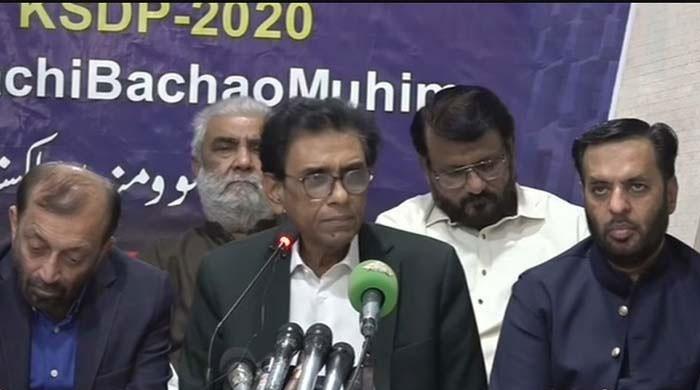
- MQM-P leader says resolution passed under shadow of fear.
- Siddiqui says Sindh acts as if it is above Constitution of Pakistan.
- Dialogues only solution to issues, says MQM-P Convener.
Muttahida Qaumi Movement Pakistan (MQM-P) on Sunday termed a resolution passed by the Sindh Assembly against the creation of Karachi province “unconstitutional”, saying that Article 239 of the 1973 Constitution allows the creation of new provinces.
The remarks came a day after the provincial assembly adopted the resolution rejecting any move to carve out Karachi as a separate province, declaring the metropolis an “integral part” of Sindh.
Addressing a joint press conference, MQM-P Chairman Khalid Maqbool Siddiqui — flanked by Farooq Sattar, Mustafa Kamal and Senator Faisal Subzwari and others — said: “Yesterday, a resolution against the Constitution of Pakistan was passed by the Sindh Assembly.”
MQM-P leader and Federal Education Minister Khalid Maqbool Siddiqui said Article 48(6) of the Constitution even allows for a referendum.
Slamming the provincial government, the MQM-P leader said, “PPP has passed this resolution under the shadow of some fear”.
Without naming Sindh, he said: “A province acts as if it is above the Constitution of Pakistan.” Referring to the alleged rigging in the 2024 general elections, he said that PPP, with an “artificial majority”, has taken control of Sindh.
The MQM-P leader said that the ruling PPP was not even ready to give powers to its own mayor in Karachi. “We have entered a crucial juncture, and we have to decide,” he warned.
Siddiqui further said that dialogue is the only solution to any issue and emphasised that his party seeks to live in peace.
“Sindh is the most multilingual province in Pakistan, and injustice has been happening in urban areas for the last 20 years,” he added.
Separately, speaking on the Geo News programme “Naya Pakistan”, MQM-P leader and former Karachi mayor Mustafa Kamal said that the Constitution allows the federation to assume control of a city.
MQM-P has been repeatedly demanding that the federal government declare Karachi a ‘federal territory’, citing PPP’s governance failure
Responding to a question, the former mayor said the Constitution provides scope for the creation of new provinces and that their demand for a new province falls within the Constitutional ambit.
On another query, the MQM-P leader said his party’s support for the 18th Constitutional Amendment aimed to transfer powers from the provinces to municipal representatives.
“PPP is not ready to devolve powers to the districts,” he added.
The resolution
The Sindh Assembly on Saturday passed a resolution against a conspiracy aimed at the division of the Sindh province.
The resolution was moved by the Sindh Chief Minister Syed Murad Ali Shah, and was supported by PTI and Jamaat-e-Islami members, while MQM-P rejected it.
On the floor of the house, CM Murad, in a strongly worded resolution condemning what he termed “divisive statements” about breaking up Sindh or separating Karachi, declared that the province’s unity and territorial integrity are non-negotiable and constitutionally protected.
In a comprehensive address to the House, the chief minister said Sindh was “not merely an administrative unit but one of the world’s oldest living civilisations,” tracing its identity from Mohenjo-Daro to the historic Sindh Legislative Assembly that passed the Pakistan Resolution in 1943.
“The province that played a foundational role in the creation of Pakistan cannot allow the fragmentation of its own historic homeland,” he asserted.
Shah condemned calls for carving out Karachi as a separate province, maintaining that the city, historically known as Kolachi, emerged from Sindh’s soil and remains geographically, historically and emotionally inseparable from it.
“Any attempt to divide Sindh or detach Karachi is contrary to history, constitutional spirit and democratic norms,” he said, adding that such rhetoric harms national cohesion.
Referring to constitutional safeguards, the chief minister cited Article 239 of the 1973 Constitution, which requires the consent of not less than two-thirds of the concerned provincial assembly for any alteration of provincial boundaries.
“If any such move is attempted, it is this Assembly- by a two-thirds majority-that will decide,” he told lawmakers.
Murad Shah recalled that a similar resolution had been passed by the Sindh Assembly in 1994, emphasising that this was “not the first time” the province had resisted attempts to undermine its unity.
He also noted that when Karachi was declared the capital in 1948, the country did not yet have a constitution, arguing that constitutional clarity today leaves no room for unilateral decisions.
The resolution condemned “any conspiracy aimed at the division of Sindh or the creation of a separate province comprising Karachi,” reaffirmed that Karachi shall “forever remain” an integral part of Sindh, and called on all political stakeholders to refrain from divisive rhetoric.
Without naming any political party, Shah said the resolution targeted no individual but urged members to read it carefully and raise objections, if any, through democratic debate. “Opposing this resolution would amount to supporting the division of Sindh,” he remarked.
Highlighting Sindh’s historical struggles, from its separation from the Bombay Presidency in 1936 to resistance against the One Unit scheme, the chief minister said the people of Sindh had consistently defended their province through constitutional and political means.
— With additional input from APP.
