


The first round of the 2026 men’s NCAA tournament continues Friday — and we’re tracking how every game was decided.
As every winner’s second-round matchup is set, ESPN’s reporters will also break down each team’s keys for advancing to the Sweet 16.
Go to: Live tracker
How UConn won: Tarris Reed Jr. was just too much for Furman. The 6-foot-11 center outrebounded the Paladins all by himself, hauling in 27 boards to go with 31 points in an absolutely dominant performance for UConn. The 3-point shot wasn’t falling for the Huskies (5 of 25), keeping the game tight against a worthy opponent in Furman, which was powered by freshman Alex Wilkins and senior Tom House. But Reed controlled the interior, plucking 11 offensive rebounds, including several in the closing moments to secure the win. He’s just the third player in the last 50 years to have 30 points and 20 rebounds in an NCAA tournament game. — Tim McManus
How Miami won: Talk about a gutty win for the 7-seed Hurricanes. After Missouri finally climbed ahead after hanging around all game, Miami reeled off an 11-0 run that put the Hurricanes firmly in control down the stretch. Senior forward Malik Reneau struggled early but used a couple 3-pointers to find his groove; he scored 19 of his game-high 24 points in the second half. Friday night felt like a de facto road game for the Hurricanes but they were able to handle the environment and the pesky Tigers to pick up their first NCAA tournament win since 2023. — Ben Baby
How Kansas won: For about 35 minutes it looked pretty easy for Kansas, which was up by 26 points on Cal Baptist before allowing the lead to shrink to six points with a minute left. The Jayhawks buckled down and escaped with a 68-60 victory, but it was not one without unnecessary drama and questionable decisions down the stretch. Darryn Peterson led all scorers with 28 points but he vanished in the final minutes — either by his own volition or the plays being called by the KU staff. Regardless, Peterson’s offensive attack fueled the Jayhawks’ victory. Now they will face off against the Big East tournament champions, St. John’s on Sunday. That’s right: The dream Bill Self-Rick Pitino matchup is happening. — Paolo Uggetti
Kansas’ second-round opponent: St. John’s
How the Jayhawks can advance to the Sweet 16: Flory Bidunga has to be the key for Kansas against St. John’s. He will have his hands full against Zuby Ejiofor, one of the best two-way big men in the country, but the sophomore has held his own in matchups against the likes of Motiejus Krivas and JT Toppin. Bidunga has also struggled mightily in other big games — 5 points and 4 points against Houston; 2 points against Arizona; 8 points against North Carolina — and his win/loss splits are telling. In Kansas’ wins, Bidunga averages 15.1 points and shoots better than 70% from the field. In losses, he averages 9.9 points and shoots 50.6% from the field. Defensively, the Jayhawks have to keep St. John’s out of transition and force the Red Storm to make shots from the perimeter. They ranked near the bottom of the Big East in 3-point attempt rate and percentage of points from 3s, and their 10 3s against Northern Iowa was the first time they made double-digit 3s in a game since Jan. 10. — Borzello
How Florida won: After posting the second-largest halftime lead in NCAA tournament history at 60-21, the Gators kept it rolling, dispatching 16-seeded Prairie View by 59 points for the second-largest margin of victory in NCAA tournament history. The historical marks didn’t stop there: Florida’s seven double-digit scorers tied the record for most in NCAA tournament history: Boogie Fland (16), Thomas Haugh (14), Rueben Chinyelu (14), Alex Condon (13), Urban Klavzar (11), Xaivian Lee (10) and Micah Handlogten (10). — Jenna Laine
Florida’s second-round opponent: Iowa
How the Gators can advance to the Sweet 16: Florida’s game prep will be focused heavily on stopping Bennett Stirtz and getting the ball out of his hands. Stirtz is a high-usage point guard, and Ben McCollum’s system revolves around him having a hand in nearly every possession. Boogie Fland has really developed as a defender this season and will likely be tasked with guarding Stirtz. The rest of Florida’s plan will be simply about imposing its will. The Gators are bigger and more athletic than Iowa, and they’re elite on the defensive end of the floor. If they can speed the game up and make Iowa uncomfortable, it’s hard to picture the Hawkeyes keeping up. Iowa hasn’t played a game with more than 70 possessions all season; Florida averages 70.7 possessions per game, per KenPom. — Borzello
 (7) UCLA 75, (10) UCF 71
How UCLA won: The Knights put up a fight with a late surge, but the Bruins walked away with the win after finishing with 13 steals and nine blocks to kick-start their transition offense. The Knights turned the ball over 17 times compared with eight for the Bruins, and went just 5-of-16 from the free throw line. Donovan Dent (10 points, 5 assists, 6 steals) ran the show for UCLA and had a pair of alley-oop passes to Eric Dailey Jr. and Xavier Booker to add some flash to the substantive performance. Dailey tied a season high with 20 points. He is the first UCLA player with 20 points and five rebounds in an NCAA tournament game since Jaime Jaquez Jr. in 2023. — Tim McManus
How Iowa won: Iowa took a 12-4 lead and never gave it up, marking the first game this season that Clemson hasn’t led at any point. The Hawkeyes’ edge came on the boards, outrebounding the Tigers 40-27. Brad Brownell warned his team about rebounding earlier this week, particularly with their top rebounder Carter Welling (5.4 RPG) out after suffering a torn ACL in the ACC tournament. Cam Manyawu was key in the win. He became the third player in the past 60 years to have 10 rebounds without attempting a shot from the field in an NCAA tournament game, per ESPN Research. — ESPN Staff
Iowa’s second-round opponent: Florida
How the Hawkeyes can advance to the Sweet 16: On paper, Iowa is in for a tough night down against Florida. The Gators have one of the most dominant frontcourts in the country, ranking second nationally in paint points per game and third in second-chance points per game. They also lead the country in offensive rebounds per game. Iowa doesn’t block shots and allows opponents to shoot 56.5% inside the arc in Big Ten play, but the Hawkeyes played a frontcourt with comparable size and ability when they faced Michigan earlier this month. And while they lost, they held their own up front, outscoring the Wolverines in the paint and scoring more second-chance points. Can they repeat the feat against Florida? Iowa will also have to get the game at its preferred pace, one of the slowest in the country, forcing the Gators to play in the halfcourt more than they would like.— Borzello
How St. John’s won: Northern Iowa cut its deficit to 13 points in the second half, but St. John’s was never in danger. By the time the buzzer sounded, the Red Storm had dispatched the Panthers. St. John’s slowed down in the second half (scoring only 32 points after putting up 47 in the first), but it dominated in every aspect — especially on the glass, where it outrebounded the Panthers 45-29. The Johnnies’ defense was predictably suffocating, holding NIU to 39% shooting from the field and only 3-of-14 from deep. Next up for Rick Pitino and Co.? A potential blockbuster matchup against Kansas and Bill Self if they get through Cal Baptist. — Paolo Uggetti
St. John’s second-round opponent: Kansas
How the Red Storm can advance to the Sweet 16: The biggest edge St. John’s will have against Kansas is on the offensive glass. The Red Storm are one of the most effective offensive rebounding teams in the country, ranking 17th nationally in second-chance points per game. Kansas, meanwhile, was one of the worst defensive rebounding teams in the Big 12, allowing opponents to rebound nearly 32% of their misses. Zuby Ejiofor and Dillon Mitchell should be able to get extra possessions for the Red Storm. With the exception of the drubbing at UConn in late February, St. John’s defense has been operating at an incredibly high level for several weeks. The Red Storm have allowed their last five opponents to make an average of just 3.4 3-pointers per game. — Borzello
How Purdue won: An experienced backcourt can take a team a long way in March, and Purdue’s Braden Smith and Fletcher Loyer showed they are as solid as it gets. Smith had 26 points and eight assists against Queens University. Loyer had 14 points on 4-of-8 shooting from behind the arc. Both have played four seasons for coach Matt Painter and the Boilermakers, and that helps, too: The guard duo was vital in Purdue’s deep run in 2024 that fell just short of a national championship. If this year’s group is going to have a similar run, it will be because of the two guys who have started all 146 games of their collegiate careers. — Ben Baby
How Tennessee won: “He missed one. Thank God.” That was a Miami (Ohio) fan’s reaction to a rare misfire by Ja’Kobi Gillespie in Tennessee’s convincing 78-56 win. Gillespie took care of the bulk of the scoring (29 points), and the Volunteers handled their business on the boards (42-25) and on defense, limiting the RedHawks to just 35% shooting. Miami senior guard Peter Suder poured in 27 points, the most since Wally Szczerbiak in 1999, but no one else on the team reached double digits. — Tim McManus
Tennessee’s second-round opponent: Virginia
How the Volunteers can advance to the Sweet 16: Rick Barnes’ team ended Miami (Ohio)’s fairy tale Friday. The Volunteers outscored Travis Steele’s squad 40-16 in the paint to advance — and they did it despite projected NBA draft lottery pick Nate Ament going 0-for-3 in the game. The Vols will need Ament to look more like the player who scored 27 points in an SEC tournament win over Auburn to reach the Sweet 16. Ja’Kobi Gillespie continues to make this group soar. If he gets to his spots, Ament plays to his potential and the Vols dominate the offensive glass, they will have the offensive tools to win. But nearly 50% of Virginia’s field goal attempts are 3-pointers, and the Cavaliers are a top-10 offensive rebounding team. They can play Tennessee’s game, too. The Vols will have to play it better. — Myron Medcalf
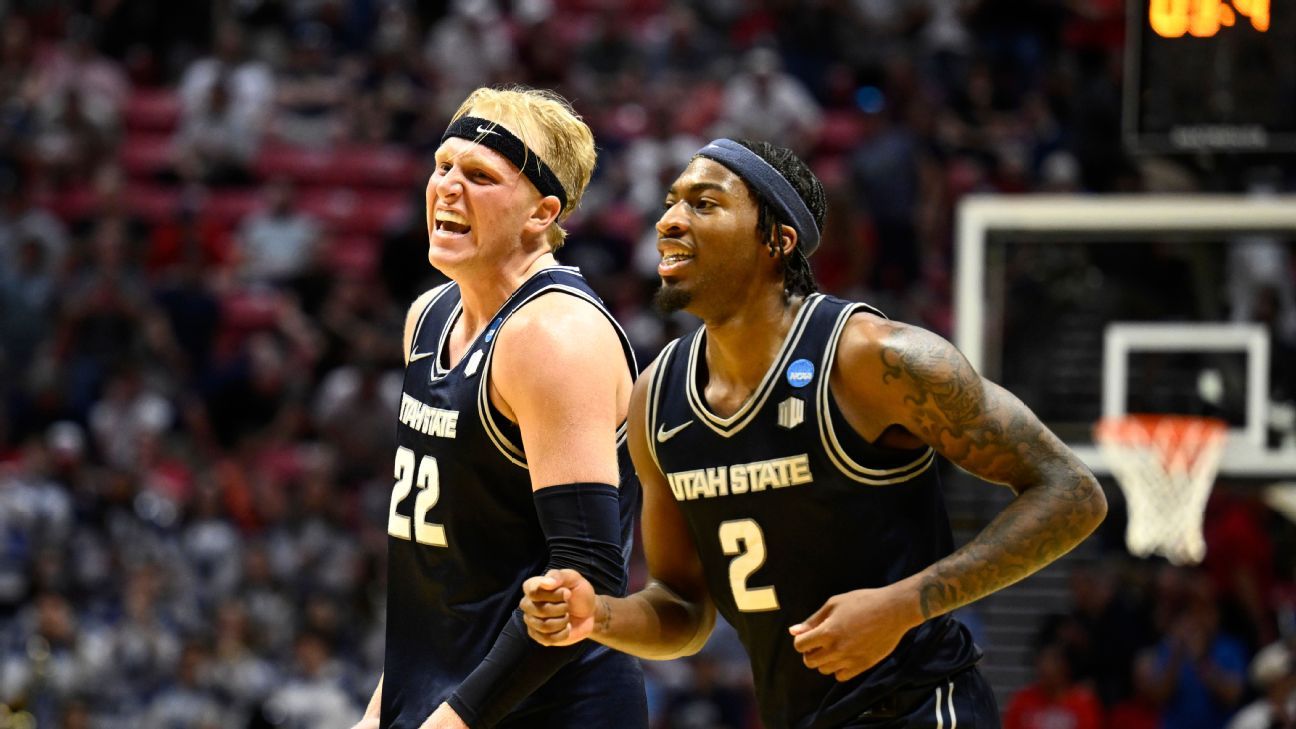
How Utah State won: In short, MJ Collins Jr. Down 10 points to Villanova early in the second half, the Aggies stuck to their game plan, attacked the paint and got to the free throw line, finishing with 37 attempts. They tied the score with 3:56 left, and that’s when Collins took over. The senior guard scored nine points as part of a 14-1 Utah State run, including an acrobatic, behind-the-back three-point play, as well as a key steal and dunk that capped the victory. — Paolo Uggetti
Utah State’s second-round opponent: Arizona
How the Aggies can advance to the Sweet 16: Utah State will need another clutch effort from MJ Collins Jr. and Mason Falslev — one of the best guard duos in America who combined for 42 points against Villanova — to advance past Arizona, a team with just two losses. In the second half of Friday’s game, the pair got hot thanks in part because of off-ball screens and backdoor cuts to the basket. They have to find their spots to have a chance against Arizona, too. On defense, the Aggies could follow two blueprints against Arizona: Kansas refused to relent to Arizona’s bruising frontcourt, and Texas Tech needed a combination of 31 points from JT Toppin and perimeter pressure that held the Wildcats to a 4-for-16 clip from 3. But the Wildcats are diverse, so Utah State will need 6-foot-10 Zach Keller and 6-foot-9 Adlan Elamin to protect the paint. The Aggies will also need their guards to limit an Arizona team that has been hot from beyond the arc in recent weeks. — Myron Medcalf
How Alabama won: Without their second-leading scorer and best 3-point shooter, Aden Holloway, who was arrested Monday on a felony drug charge, the Crimson Tide were forced to rely on sophomore guard Labaron Philon Jr. He responded with 29 points, eight rebounds and seven assists in the 20-point victory. The Pride did not go quietly, though. Freshman guard Preston Edmead put up 24 points, going 5-of-10 from behind the arc, with four rebounds and four assists. — Jenna Laine
Alabama’s second-round opponent: Texas Tech
How the Crimson Tide can advance to the Sweet 16: Similar to Tech’s keys, Alabama has to win the perimeter battle. The Crimson Tide shoot the ball at an incredible volume from beyond the arc, but are not quite as accurate as the Red Raiders — and the Tide have lost four of the six games in which they have made fewer than 10 3s. Moreover, Alabama’s 3-point defense is far worse than Texas Tech’s 3-point defense. Without Aden Holloway, Alabama has fewer players who can get their own shot off the dribble, making the Crimson Tide more reliant on Labaron Philon Jr. to have another big game. As one of the elite playmakers and shotmakers in the sport, Philon is likely up for the task. But he’ll be facing a fellow All-American and first-round pick in Christian Anderson. Who wins that matchup? That’s the key. — Jeff Borzello
How Iowa State won: Take your pick from any number of ways that Iowa State rolled Tennessee State. The Cyclones dominated in virtually every category, though the discrepancy on the glass was particularly notable. At one point late in the second half, Iowa State had more offensive rebounds than Tennessee State had defensive rebounds. Another telling stat: Iowa State scored the game’s first 45 bench points. Looking ahead to Sunday’s game against Kentucky, that depth could be the difference given how reliant the Wildcats were on Otega Oweh in their dramatic first-round win. That depth might also be needed if Joshua Jefferson remains out with a left leg injury — he left early in the first half and eventually sat out the rest of the game with a boot. — Ben Baby
Iowa’s State’s second-round opponent: Kentucky
How the Cyclones can advance to the Sweet 16: A miraculous recovery for Joshua Jefferson would help, but his availability is unclear after he was helped to the locker room following a lower leg injury and was later shown in a boot. The Cyclones are 21.8 points per 100 possessions better with Jefferson on the floor, according to CBB Analytics. Even without him, though, Iowa State has enough to beat Kentucky. The Cyclones have the individual perimeter defenders to slow down the trio of Oweh, Collin Chandler and Denzel Aberdeen — particularly Tamin Lipsey and Killyan Toure — and could have success forcing turnovers. Kentucky also doesn’t have an answer for Milan Momcilovic, who has a case to make as the best shooter in the country and stands at 6-foot-8. The Wildcats will likely have to guard him with 6-4 Oweh or 6-5 Chandler, so Momcilovic should have the edge there. Without Jefferson, TJ Otzelberger could opt to go with a smaller lineup that features Momcilovic at the 4, which might create a tougher individual matchup but would also space out the Kentucky defense and remove some of its shot-blockers from the paint. — Jeff Borzello
How Virginia won: Virginia escaped a scare and advanced to the second round thanks to a come-from-behind win. Senior guard Jacari White took over down the stretch, scoring 15 of his season-high 26 points in the second half, and drew the Raiders’ attention to create easy baskets for his teammates. His 26 points are the most by a Virginia player in an NCAA tournament game since De’Andre Hunter had 27 in the 2019 championship game against Texas Tech, per ESPN Research. White’s six made 3-pointers also tied London Perrantes (2016 Elite Eight) for the most by a Virginia player in an NCAA tournament game. — Tim McManus
Virginia’s second-round opponent: Tennessee
How the Cavaliers can advance to the Sweet 16: This isn’t Tony Bennett’s team anymore. The Cavaliers knock down 3s and also score with a rugged game in the paint. They also have a top-25 defense. They’ll need all of those tools against Tennessee, which is No. 1 in the country in offensive rebounding rate. They can’t allow the Vols to dominate with second-chance points, and the Cavaliers are equipped to do that thanks to a top-five defense inside the arc. They’ll also have to limit the touches of projected NBA draft lottery pick Nate Ament. Tennessee is 2-3 in its past five games when he shoots nine or fewer shots inside the arc. They also have to pressure Ja’Kobi Gillespie (11 turnovers in the past four losses). The Cavaliers’ 3-point barrage must continue after Virginia made 13 against Wright State. The Cavaliers probably can’t win without a big game from Thijs De Ridder, but they will struggle if they go cold from the 3-point line. — Myron Medcalf
How Arizona won: Arizona’s first-round matchup against 16-seeded Long Island proved to be a tepid warmup for the Wildcats, who dominated every facet of the game during a commanding victory. Their size is striking, and they used it to their advantage, outrebounding the Sharks 52-31 and scoring 50 points in the paint while adding 10 blocks. Ivan Kharchenkov had 14 points and 10 rebounds. And freshman Brayden Burries led all scorers with 18 points on 4-of-5 shooting from 3. It was the ideal start for a team with hopes (and expectations) for a deep tournament run. — Paolo Uggetti
Arizona’s second-round opponent: Utah State
How the Wildcats can advance to the Sweet 16: Arizona doesn’t have to tweak anything to its game plan to reach its third consecutive Sweet 16. Big 12 Player of the Year Jaden Bradley scored just seven points against LIU on Friday, and the Wildcats still put up 92 points. If they continue to rely on that depth, they’ll be difficult to stop; five Arizona players scored at least eight points in the win over Long Island. Plus, the Wildcats, who have been criticized after making just 33% of their 3-point attempts in Big 12 play, have made 39% of their shots from beyond the arc over their current 10-game winning streak. They’re different now. To stop Utah State’s offense, Arizona will have to defend well against numerous ball screens that put MJ Collins and Mason Falslev in positions to score. The Aggies will probably attack 7-foot-2 Arizona center Motiejus Krivas more than anyone else on those ball screens, and attempt to use their speed to set up big plays for their top guards. Utah State will need a magical effort to beat Arizona. — Myron Medcalf
How Texas Tech won: Akron trimmed its deficit to four points midway through the second half, but Texas Tech — playing without All-American and Big 12 Player of the Year JT Toppin — shot better than 75% in the second half to run away with it. (Forward LeJuan Watts, who led with six rebounds, also fouled out with under 10 minutes to go.) Freshman guard Jaylen Petty put up a career-best 24 points (5-of-7 from 3), and the Raiders held the Zips’ top-10 scoring offense that had averaged 88.4 points per game during the regular season to just 71 points. — Jenna Laine
Texas Tech’s second-round opponent: Alabama
How the Red Raiders can advance to the Sweet 16: Texas Tech is one of the few teams in America that can keep up with Alabama from the perimeter. Though the Crimson Tide lead the country in 3-point attempt rate and made 3-pointers per game, the Red Raiders aren’t far behind — they’re third nationally in 3-point shooting percentage and fifth in made 3-pointers per game. They’ve leaned into it even more since JT Toppin suffered a season-ending right knee injury, with a 3-point attempt rate above 51% in four of its past five games. At the other end, can Tech keep Labaron Philon Jr. from getting into the lane at will? He is a bit bigger than Christian Anderson, but Donovan Atwell has shown promise as an individual defender and could draw the assignment. — Jeff Borzello
How Kentucky won: Add what Otega Oweh did to the list of great performances in Kentucky’s tournament history. Oweh scored a career-high 35 points to send the 7-seed Wildcats to the next round. Oweh’s midcourt prayer that banked through the net at the buzzer sent the game into overtime and helped the Wildcats avoid the upset. Oweh fueled Kentucky’s offense and held off a balanced Santa Clara attack that was led by Elijah Mahi and Allen Graves. Graves thought he had the game winner with two seconds left. But Oweh made sure he and the Wildcats had the last word. — Ben Baby
Kentucky’s second-round opponent: Iowa State
How the Wildcats can advance to the Sweet 16: It starts with taking care of the ball. Iowa State thrives when it can force turnovers and get out in transition for easy baskets. The Cyclones are fourth in the country in defensive turnover percentage and in points off turnovers per game. Kentucky was 12th in the SEC in turnover percentage, although the Wildcats have tightened things up lately, giving it away just 46 times in their last five games. Still, they’ve had issues against teams applying aggressive ball pressure, including against Vanderbilt and Texas A&M, the most turnover-prone defenses in the SEC. They will also need to make shots from the perimeter — they shoot better than 37% from 3 in wins compared to just 29% in losses. Iowa State can guard the 3, but Kentucky’s trio of Otega Oweh, Denzel Aberdeen and Collin Chandler have to get going. — Jeff Borzello
