


When a war thousands of miles away leaves millions of Indians unable to cook their meals, it is not merely a supply shock — it is a verdict on a decade of misplaced energy promises.
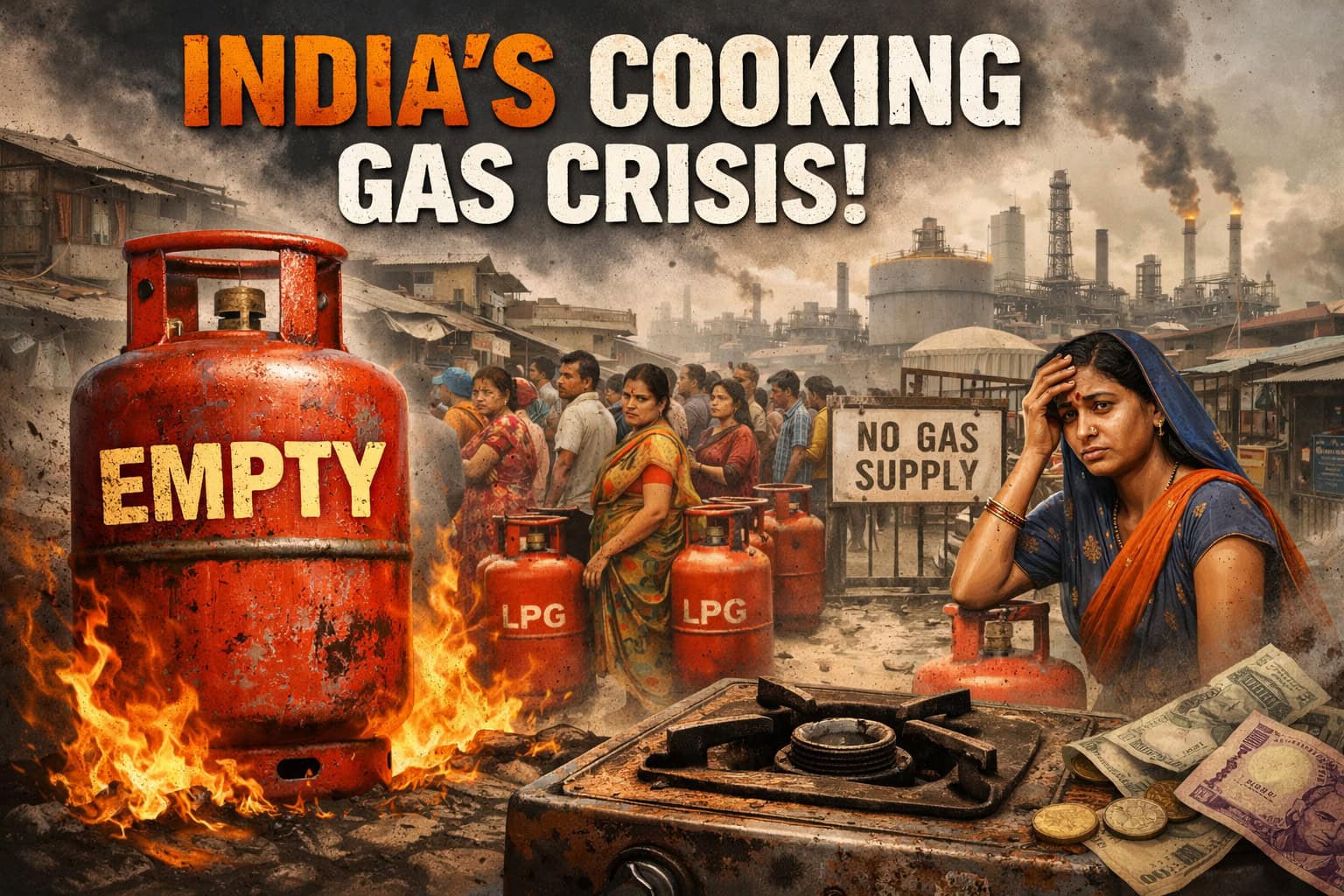
In Mumbai’s dense working-class neighborhoods, the streets tell a story that government press releases cannot. Men and women — daily wagers, street vendors, mothers of small children — stand in lines that snake around corners, waiting for a cooking gas cylinder that may or may not arrive. In Rajasthan’s interior towns, families have returned to burning wood, their lungs filling with smoke in the twenty-first century. Across twelve Indian states, what was once a routine errand has become a test of endurance, money, and luck.
The immediate cause is a disruption in global LPG supply chains triggered by the widening conflict in the Gulf — a war that has rattled energy markets and choked India’s import pipelines. But to blame the crisis entirely on geopolitics would be to accept a convenient fiction the Modi government has been quietly promoting. The truth is more uncomfortable: India’s energy infrastructure, its subsidy architecture, and its vaunted self-reliance agenda were caught catastrophically underprepared.
Source’s reporting from the ground tells a story of cascading failure. In Mumbai, the shortage has paralyzed food businesses and small industries. Long queues of vehicles fill the streets as a living monument to stalled economic life. Workers who migrated to the city for employment are packing their bags and heading back to their villages — not out of sentiment, but because survival in an urban center without affordable fuel has become impossible.
The market has responded with its own brutal arithmetic. A cylinder officially priced below one thousand rupees now trades on the black market for three thousand — a three-hundred-percent markup that falls hardest on the very citizens the government’s flagship Ujjwala scheme was designed to protect. That program, one of the Bharatiya Janata Party’s most loudly celebrated achievements, promised clean cooking fuel to millions of poor households. Its beneficiaries are now either unable to refill their cylinders or paying prices that devour much of a week’s wages. The scheme’s promise has curdled into a cruel joke.
“I was cooking on wood fire,” said one daily laborer returning from Surat. “Gas was available, but it was so expensive it forced me to come back home.” His words carry more policy analysis than any government briefing.
The administration’s response — invoking emergency powers to redirect limited supplies toward residential use, and signaling a faster push toward piped natural gas — reveals a government scrambling for a strategy it should have built years ago. The pivot toward piped gas infrastructure may be sensible in the long run. It is worthless as a crisis response today, when the pipelines simply do not exist in the cities and towns where people are already suffering. Emergency powers are not an energy policy. They are a confession that policy has failed.
Economists have said plainly what the government refuses to acknowledge: Indian citizens are bearing the cost of an administration with no effective contingency plan for a supply disruption of this scale. The Gulf war may be the trigger, but the underlying conditions — poor planning, delayed diversification of supply sources, infrastructure underinvestment, near-total dependence on LPG imports with no meaningful strategic reserves — are entirely homegrown failures. A crisis of this magnitude does not appear overnight. It accumulates through years of deferred decisions and misplaced political theater.
Prime Minister Modi’s Atmanirbhar Bharat — the self-reliant India he has invoked in speech after speech — faces a damning test in this moment. A nation that cannot guarantee its citizens access to cooking fuel during a global supply shock is not self-reliant. It is exposed. The distance between the rhetoric of energy sovereignty and the reality of families burning wood in 2026 is not a communications problem. It is a governance failure of the first order.
The poor of India are suffering because two nations chose war. But the depth of that suffering is India’s own policy failure to answer for. The Modi government spent years building a narrative of strength and self-sufficiency while quietly neglecting the unglamorous work of supply chain resilience, infrastructure investment, and emergency preparedness. The bill for that neglect has now arrived — and it is being paid by the people who can least afford it.
India needs a genuine national energy security strategy: real diversification of import sources, honest timelines for piped gas expansion, meaningful strategic reserves, and a subsidy system that survives disruption. These are not ambitious demands. They are the basic obligations of any functioning government to its citizens. The cooking gas crisis of 2026 should be the moment of reckoning — not a problem to be managed until the next press conference, but a systemic failure serious enough to finally demand serious answers.
