


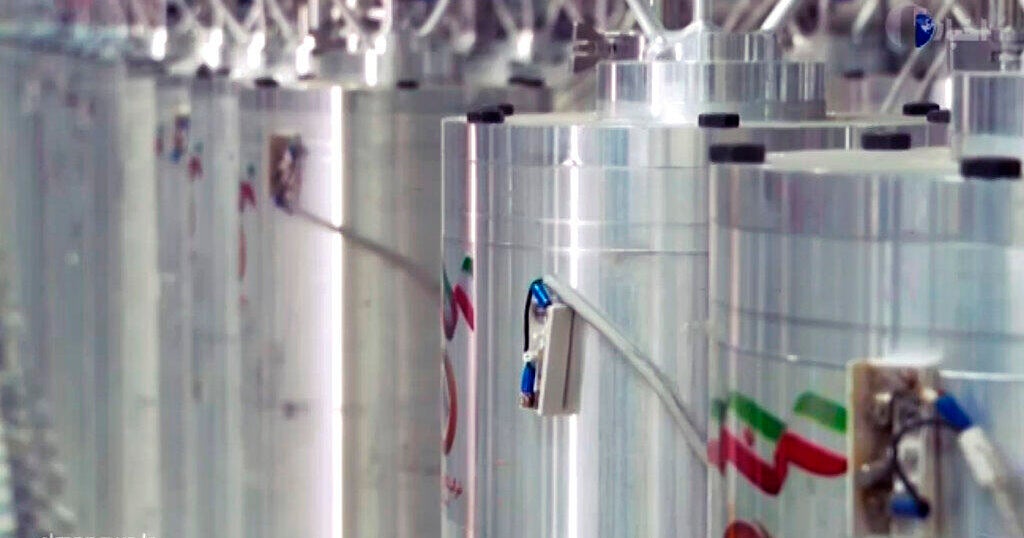
Washington — President Trump ordered military strikes on Iran early Saturday after pressing the country to curtail its nuclear program, grappling with an issue that has vexed presidents from both parties for decades.
Iran — which denies having any nuclear weapons ambitions — has amassed a stockpile of uranium that is enriched to near the level of purity necessary to build a bomb. Mr. Trump ordered strikes on a trio of key Iranian nuclear sites last June, causing extensive damage and leaving the status of the stockpile unclear. Now, less than a year later, the president is carrying out what could be a larger military campaign.
“We will ensure that Iran does not obtain a nuclear weapon,” Mr. Trump said in a video early Saturday announcing what he called a “massive and ongoing operation.” He said he had “sought repeatedly to make a deal,” but Iranian officials “rejected every opportunity to renounce their nuclear ambitions, and we can’t take it anymore.”
The United States and Iran had engaged in several rounds of indirect negotiations in recent weeks, as a fleet of U.S. naval vessels and military aircraft arrived in the Middle East to ratchet up the pressure.
Here are some details on Iran’s nuclear program:
How close is Iran to making a nuclear weapon, and is it building one right now?
In recent years, Iran has rapidly increased its stockpile of highly enriched uranium. As of mid-June 2025, shortly before the U.S.’s strikes that month, Iran had enriched some 972 pounds of uranium up to 60% purity, according to estimates from the International Atomic Energy Agency.
By comparison, Iran had 605.8 pounds of 60%-enriched uranium in February 2025, and 267.9 pounds a year before that, the IAEA has said. According to the U.N. watchdog’s metrics, about 92.5 pounds of 60%-enriched uranium is enough to build a single nuclear weapon if enriched further.
That material is just a short step away from weapons-grade 90%-enriched uranium.
The U.S. Defense Intelligence Agency estimated last May that it would take Iran “probably less than one week” to produce enough weapons-grade uranium to make its first bomb, if it decided to do so. Actually building a bomb could take somewhat longer: Another intelligence summary from last year found that Iran could make a nuclear device within three to eight months unless it faced technical or logistical delays, CBS News has previously reported.
What’s not clear, however, is whether Iran has made the decision to build a nuclear weapon. Iran is believed to have halted its nuclear weapons program in 2003, and the U.S. intelligence community assessed last spring that the program hadn’t restarted.
“Iran almost certainly is not producing nuclear weapons, but Iran has undertaken activities in recent years that better position it to produce them, if it chooses to do so,” the DIA said in May.
Asked on Feb. 18 whether the U.N.’s International Atomic Energy Agency had seen any indication that Iran might currently be working to develop a nuclear weapon, the agency’s director-general Rafael Grossi told a French television network it had not.
“No,” he told TF1, adding: “On the contrary, I see, today, a willingness on both sides to reach an agreement,” referring to the U.S. and Iran.
Iran, for its part, has long insisted that its nuclear program is entirely peaceful, and that it does not intend to develop a nuclear weapon.
Iran’s stockpile includes uranium enriched far beyond the level needed for most non-military uses like nuclear power or medical applications. The IAEA said in May that Iran is now “the only non-nuclear-weapon State to produce such nuclear material.”
What impact did the last U.S. strikes on Iran have?
Last June’s airstrikes targeted Iran’s Fordo and Natanz enrichment facilities and a research site near the city of Isfahan. It’s not clear how much the strikes damaged Iran’s nuclear program.
Mr. Trump has long said the strikes “obliterated” the three nuclear sites, setting back the program by “basically decades.”
The IAEA’s Grossi told CBS News in June that the strikes caused “severe damage” but not “total damage.”
In his interview with the French network in February, Grossi said Iran’s nuclear material was “still there, in large quantities,” despite the U.S. strikes, though “some of it may be less accessible.”
Iran also is not currently enriching uranium, Secretary of State Marco Rubio told reporters on Feb. 25, though he alleged that “they’re trying to get to the point where they ultimately can.”
Satellite images from late January show roofs built over damaged buildings at the Natanz and Isfahan sites, potentially indicating efforts by Iran to salvage any remaining materials.
A confidential report issued by the IAEA assessed that Iran is conducting unexplained activity at nuclear sites that were bombed by the U.S., CBS News has confirmed.
The IAEA says it withdrew its inspectors from Iran for safety reasons shortly after the June strikes, and Iran moved to suspend cooperation with the agency the following month. The agency said in November that it had been able to conduct some inspections in the months following the attacks, but not at any of the sites that were struck by U.S. forces.
Iran downplayed the strikes, arguing they didn’t eliminate its technological capabilities.
“Yes, you destroyed the facilities, the machines,” Iranian Foreign Minister Abbas Araghchi told Fox News in January. “But the technology cannot be bombed, and the determination also cannot be bombed.”
What’s the history of Iran’s nuclear program?
Iran’s nuclear program dates back decades, with some early research activity taking place under the U.S.-allied government that controlled the country before the 1979 Islamic Revolution. By the mid-1980s, Iran started developing — or acquiring on the black market — the technology required to build centrifuges that can enrich uranium, according to the IAEA.
The country’s ambitions drew intense international pressure starting in 2002, when an anti-regime group alleged that Iran had secretly built a pair of nuclear facilities. Former President George W. Bush’s administration later alleged that Iran was working to develop missiles capable of carrying nuclear weapons.
The IAEA has said that until 2003, Iran had a “structured program” to carry out “activities that are relevant to the development of a nuclear explosive device.” The agency added that some of those activities have military and non-military uses, but some “are specific to nuclear weapons.”
While the U.S. intelligence assessment was that Iran stopped trying to develop nuclear weapons in 2003, the country resumed enriching uranium at various points after that. As a result, it had faced years of increasingly tight sanctions.
In 2015, then-President Barack Obama’s administration struck a deal with Iran and other global powers to limit the country’s uranium stockpiles and enrichment capacity for a set period of time, and to submit Iran’s nuclear program to IAEA monitoring, in exchange for sanctions relief. The agreement was known as the Joint Comprehensive Plan of Action, or JCPOA.
Three years later, Mr. Trump withdrew the U.S. unilaterally from that deal, which he argued was insufficient. He imposed a new round of harsh sanctions, dubbing it a “maximum pressure” campaign to force Iran to negotiate a new agreement. Efforts by the Biden administration and European parties to the JCPOA to revive the deal were unsuccessful.
Since then, Iran has stopped abiding by the terms of that agreement, dramatically ramping up its uranium enrichment program, including by enriching uranium to 60% purity for the first time.
At times, Mr. Trump has pushed Iran to give up uranium enrichment altogether, rather than just sticking to lower levels of enrichment in order to support a civil nuclear program.
“They want to enrich a little bit. You don’t have to enrich when you have that much oil,” the president said on Feb. 27. “I say, no enrichment.”
Araghchi has ruled out that idea, describing the enrichment program as a “matter of dignity and pride.”
“We have every right to enjoy a peaceful nuclear energy, including enrichment,” he told CBS News in a Feb. 22 interview. “As a sovereign country, we have every right to decide for ourselves, by ourselves. We have developed this technology by ourselves, by our scientists, and it’s very dear to us, because we have paid a lot.”
