


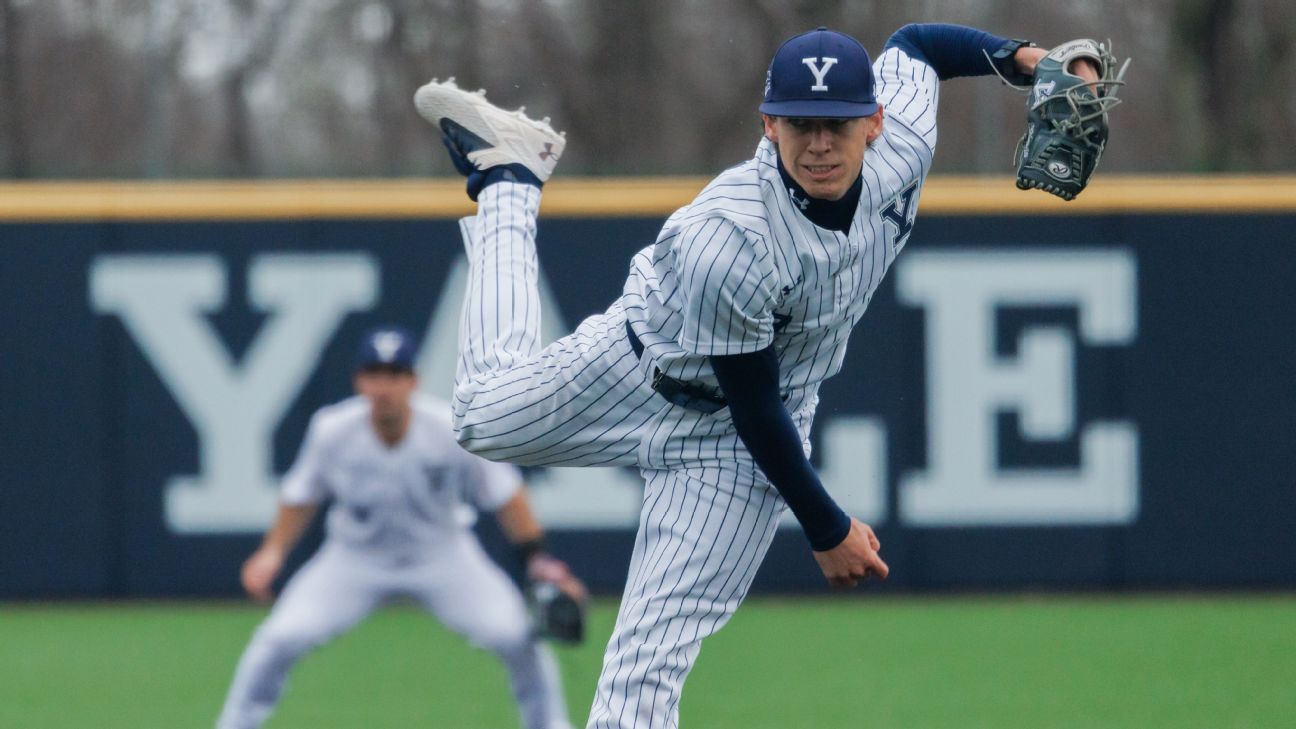
JACK OHMAN WAS anxious last spring. Not because he was a freshman navigating his first collegiate baseball season. Not because his dominance — and scoreless innings streak — was making national headlines. Not because his classes at Yale were overwhelming.
It was because his phone was blowing up. Nonstop.
Name-brand college programs, realizing the 6-foot right-hander, who barely pitched in high school, was the real deal, were trying to convince him to transfer, with promises that they were the right place for his development and bank account. Agents, seeing dollar signs, thirsted to represent the pitcher who had crashed on the national scene possessing a mid-90s fastball with elite carry. Friends and family constantly pinged him to ask if — and where — he was going to transfer.
Ohman admitted he considered leaving the Ivy League for a Power 4 school. And who would blame him? The facilities to improve his skill set there are palatial. The exposure to reach the pros is brighter. The money — unlocked by recent advances in players capitalizing on their name, image and likeness — is tempting.
With rules relaxed in recent years, the transfer portal has made player movement far more common and ethics optional. As Ohman became a top target for the best programs, the onslaught became so intense that his father, Will, considered changing Jack’s phone number.
“The noise was incredible,” said Will Ohman, a former major league left-hander who made 483 relief appearances across 10 seasons.
But Jack Ohman didn’t switch phone numbers — and he didn’t transfer. He notified his coaches last spring, in the midst of one of the greatest freshman seasons in NCAA history, that he was staying in New Haven.
“I talked to a lot of people about it because I didn’t know what to do exactly,” Ohman said. “But I think what fueled my decision was it’s a great group of guys I’m very, very close with. It’s more of a loyalty thing. I think that’s a little bit of a forgotten trait, I guess, in college sports. You don’t see it very often. But I think it’s huge.”
Ohman finished the season with a 1.34 ERA, tops in the nation, across 73⅔ innings, as Yale went 31-14 and won the Ivy League regular-season title. He was named a second-team All-American — the first Yale baseball player to earn an All-America nod since Ryan Lavarnway, a future big league catcher, in 2007 — while vaulting from unknown to a potential first-round pick in Major League Baseball’s 2027 draft.
Last Friday, he launched his sophomore campaign by holding Bethune-Cookman to one earned run in five innings and striking out 10 in Yale’s season-opening loss, putting the Ivy League — and the country — on notice again.
“My coaches took a flier on me,” Ohman, 20, said. “It happened to work out. I became a great pitcher. It would be a little bit disrespectful if I up and left after one year and just threw that all to the wayside because they took a risk on recruiting me. And I’m glad that risk paid off.”
OHMAN WAS ALMOST exclusively a position player at Brophy College Prep in Phoenix. He was a utility man and batted nearly .400 as the team’s leadoff hitter his senior season. He moonlighted as a spot starter and closer, logging 18 innings as a junior and 25 innings his senior season. He showed flashes on the mound but lacked consistency. And yet his father believed he would go furthest as a pitcher.
“It was very obvious, to me, that the ceiling was much higher as a pitcher,” Will Ohman said. “There’s a lot of 6-foot, 170-pound college players. You have to look for separators. His arm was his separator.”
Will Ohman, who runs a baseball training facility in Phoenix, didn’t send his son to showcases until he believed he had sufficient skills to display. So his son attended just two. Yale pitching coach Chris Wojick, also the program’s recruiting coordinator, first saw Ohman pitch at one of them — a showcase for academic standouts the fall before his senior season.
Hardly recruited, Ohman made two official visits to schools: Seattle University and Yale. He committed to Yale soon after traveling to Connecticut. Success did not appear imminent.
“When he arrived at Yale,” Bulldogs head coach Brian Hamm said, “he still had a ways to go in terms of being able to pitch at the college level, let alone make an impact.”
Ohman, according to Wojick, was the worst pitcher on the Bulldogs’ roster during fall workouts in 2024.
His delivery began with a high leg kick resembling former major leaguer Bronson Arroyo that made repeating his delivery difficult, rendering his command inconsistent. He didn’t throw enough strikes, certainly not enough to start games in the Ivy League. His best off-speed pitch was a loopy curveball that popped out of his hand for hitters to recognize and crush — on the rare occasion it found the strike zone.
Then Ohman returned to campus after winter break as a different pitcher.
“The first pitch he threw in live indoor sessions in January was 96 [mph],” Wojick said. “And he was like 91, 92 in the fall. I remember going to our hitting coach, like, ‘Hey come here.’ After that, I sat down with the coaching staff and was like, ‘Hey, Jack’s no longer hitting. He’s going to pitch for us now.’
Ohman eliminated the leg kick, creating a more compact delivery that was easier to repeat. He was stronger from the regular workouts that come with being a Division I athlete. But his curveball was still a problem. He wanted to continue featuring it. Wojick wanted him to try a slider. So in early February, with the season opener around the corner, Wojick sat Ohman down and gave him an ultimatum: Listen to me and become a weekend starter or stay on this path and pitch the fifth inning of inconsequential midweek games.
“It was like, ‘You’re going to pitch garbage innings, period,'” Ohman said. “Like, ‘You suck and we have to pitch you and we have to develop you. But, yeah, you’re going to pitch garbage innings.’ He was trying to light a fire under me and I appreciate that. Clearly, it worked.”
Two days later, Wojick said, Ohman, whose feel for the game as the son of a former major leaguer draws rave reviews, learned a new slider in 10 minutes. The first one he threw during live batting practice was clubbed for a home run. But Ohman made a slight adjustment and struck out the next five hitters. He took the pitch into his first career outing, in relief against Queens University, and notched four strikeouts over 2⅓ innings.
The pitch was different enough from his fastball to generate misses, but Ohman thought there was more room for improvement. So he slightly changed the grip again for his next appearance. The plan was for him to come out of the bullpen again. But when Yale’s scheduled starter for its series finale against The Citadel was too sick to pitch, Wojick told Ohman that morning he was getting the ball.
“My coach came up to me and he’s like, ‘Hey, just give me one inning,'” Ohman recalled. “‘Then we’ll reevaluate. We’re using you as an opener.'”
The pitching plan for that day — and the season — quickly changed. Ohman allowed one hit, walked two and struck out five over five scoreless frames. He earned a rotation spot with the start and did not slow down. Behind the new slider and a mid-90s fastball that, according to Wojick, features an average of 22 inches of induced vertical break — comparable to New York Yankees ace Gerrit Cole‘s offering — Ohman didn’t surrender a run over his first 35⅓ innings.
“He kind of Wally Pipp’d the guy that was our starter,” Wojick said. “And then we went from there.”
OHMAN MADE HIS second career start in Yale’s series finale at Rice, where his twin sister Annabel studies physics. With his family in the stands, Ohman shut down the Owls. He yielded three unearned runs on six hits with seven strikeouts across seven innings in Yale’s series-sweeping win.
“It was his big I’m-on-the-scene game,” Will Ohman said. “It was a family reunion. We’re sitting in the stands and he just goes off. And I was like, ‘Oh, my. What I’ve seen on TV, I have seen now live. I can confirm it. Things are going well.'”
Ohman surrendered his first earned run in his sixth start — and seventh appearance — against Brown to snap his streak of 35⅓ scoreless innings to begin his career. By then he had sprung into national prominence.
“Every team in the top 25 was calling me asking if he’s going to go into the portal,” Brophy Prep head baseball coach Josh Garcia said.
The calls and messages flooded Ohman’s phone. SEC coaches, Wojick said, reached out from burners. Agents attempted to persuade him to hop into the portal with them as his representation. The spotlight quickly sprouted from flattering to distracting.
“It was actually getting pretty out of control,” Wojick said. “I would tell you there’s a Big 12 team that was the most aggressive, to the point where they offered his high school coach money to get him into the transfer portal, then offered him a job on their staff if he got him to transfer to that school, plus NIL money.”
Ohman said he made his decision to stay before the end of the season. The accolades soon followed. He was named the Ivy League Pitcher of the Year, the Perfect Game Freshman Pitcher of the Year, a freshman All-American and a Golden Spikes Award semifinalist. When the dust settled, he was in the top 10 of Baseball America’s 2027 MLB draft board.
“I’m extremely proud of him,” Will Ohman said. “He has some really interesting stuff, and we’re going to find out over time if it plays.”
An economics major, Ohman wants to work in baseball when his playing career is over, whenever that is, and hopes to one day become an MLB general manager. To put him on track, he was connected with Theo Epstein, a Yale alum and the architect of two curse-breaking World Series titles in Boston and Chicago, and Ohman has picked his brain.
For now, he’s focused on pitching. While he might pinch hit or enter games as a defensive replacement, most of his work will continue to be on the mound. Yale and Columbia are the favorites to win the Ivy League. Individual expectations are high for Ohman too. He was a consensus preseason All-American and landed on the Golden Spikes Award preseason watch list. He plans on throwing a kick change, a pitch he added to his arsenal last season, more often. Wojick called the pitch “a game changer.”
Last week’s returns were promising. On Friday, he’ll pitch at Pepperdine, his father’s alma mater, in front of his family again. And he’ll do it in a Yale uniform.
“My goal for this season is to prove that I developed last year as a pitcher,” Ohman said. “I’m so much better. I’m a lot better pitcher now than I was a year ago — as I should be.”
