


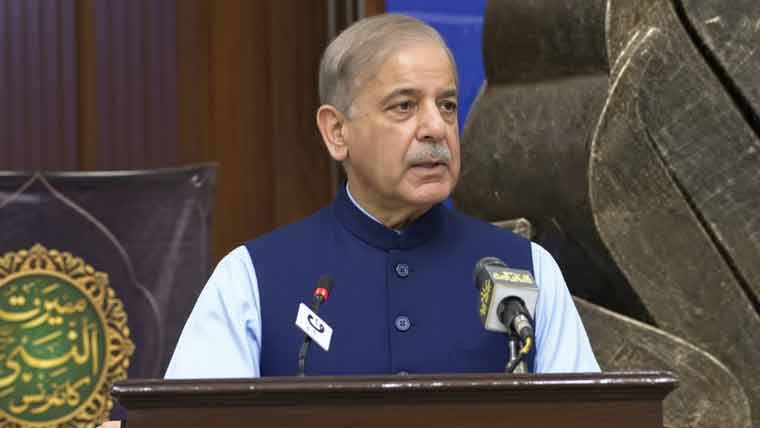
ISLAMABAD – Prime Minister Shehbaz Sharif has called for greater unity among Muslims, saying that following the exemplary life and teachings of Prophet Muhammad (PBUH) is the best way to shape the character and personality of the younger generation.
He expressed these views while addressing the National Seerat Conference in Islamabad on Wednesday, held to mark 12 Rabi-ul-Awwal, the birth anniversary of Prophet Muhammad (PBUH).
The prime minister said Muslims should set aside sectarian identities and unite in the same way they did under the leadership of Quaid-e-Azam Muhammad Ali Jinnah during the Pakistan Movement.
“If Allah gives us the opportunity, we will make sincere efforts to unite the Muslim Ummah,” he said.
He said Saudi Arabia and Turkiye stood with Pakistan like an “iron wall” and urged religious scholars to play their role in promoting unity and protecting people from divisive and self-serving elements.
The prime minister said the annual Seerat conference was a proud national tradition, bringing scholars, researchers, religious leaders and intellectuals from different schools of thought together under one roof.
He stressed that the education and upbringing of the younger generation must remain a top priority, saying the future of Pakistan would depend on the kind of generation the country developed.
“Following the exemplary conduct of Prophet Muhammad (PBUH) is the best model of character available to us,” he said, adding that every aspect of the Prophet’s life offered guidance for humanity.
Referring to events from the Prophet’s life, Shehbaz highlighted lessons of wisdom, patience, forgiveness, brotherhood and compassion. He said the Treaty of Hudaybiyyah demonstrated wisdom and foresight, while the Prophet’s response to persecution in Taif exemplified patience and forgiveness.
He said the brotherhood established between the Muhajirun and Ansar in Madinah showed how mutual support and compassion could help societies overcome economic and social difficulties.
The prime minister also highlighted the Prophet’s teachings on dialogue and respect for others, as well as his declaration of general amnesty at the conquest of Makkah despite the persecution he had faced.
Referring to the Farewell Sermon, Shehbaz said the Prophet (PBUH) established the principle that no Arab was superior to a non-Arab, nor a non-Arab to an Arab, and that no person had superiority based on race or colour.
He said these values should be passed on to the younger generation, adding that the Prophet (PBUH) presented his character as the foremost evidence of his prophethood.
