


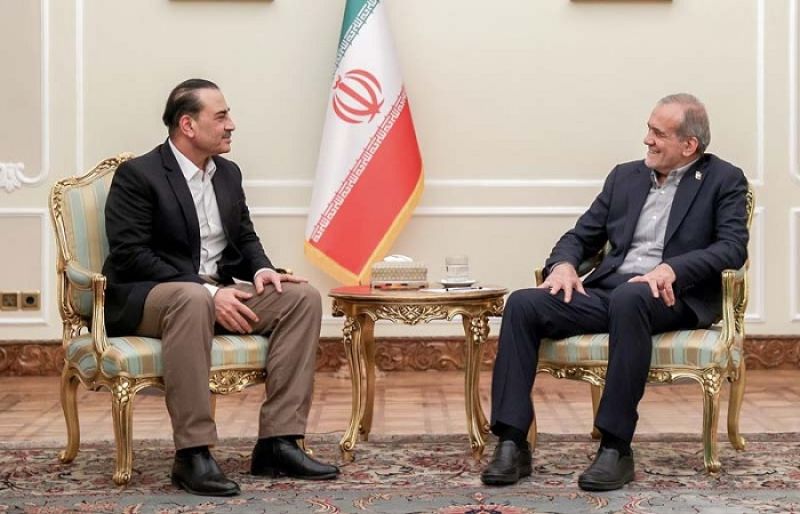
Pakistan and Iran held discussions on reopening the Strait of Hormuz and bringing an “expedited termination” of the US-Iran conflict in the Middle East, the Inter-Services Public Relations (ISPR) said on Tuesday.
The discussions took place during Chief of Defence Forces (CDF) and Chief of Army Staff (COAS) Field Marshal Syed Asim Munir’s day-long visit to Iran, where he met the country’s top leadership, the military’s media wing said in a statement.
The army chief landed in Tehran on Sunday for a visit, which the military’s media wing said was part of Pakistan’s diplomatic efforts to help break the deadlock in the conflict.
During the visit, Field Marshal Munir called on Iran’s President Masoud Pezeshkian, Iranian supreme leader’s representative on the Supreme National Security Council Mohsen Rezaei, Parliament Speaker Bagher Ghalibaf, Foreign Minister Abbas Araghchi and Interior Minister Eskandar Momeni.
“Comprehensive discussions focused on measures to prevent further escalation, reopening of the Strait of Hormuz and expedited termination of the conflict,” the ISPR said.
The two sides also exchanged views on regional peace and the ways to arrive at a negotiated settlement to the disputes, it added.
CDF Munir’s visit comes amid renewed tension in the region after Washington announced an expanded round of sanctions, which US officials said were designed to cut off Tehran’s economic lifeline and put the world on notice to cease doing business with the country.
Later, Interior Minister Mohsin Naqvi, who accompanied the army chief during the visit, said Pakistan had made significant progress in its efforts to help end the US-Iran conflict.
In a post on X, Naqvi said that they had a “very positive and productive meeting” with the Iranian president during the visit.
The discussion focused on the US-Iran conflict, Middle East tensions, and the way forward, as well as the steps needed by both sides to restore the Islamabad memorandum of understanding (MoU) for a comprehensive settlement of the conflict, he added.
“The Iranian President candidly shared his Government’s perspective and concerns, and we had a very constructive exchange on the issues involved,” Naqvi said.
The security czar maintained that the meeting concluded on a highly positive note, saying Islamabad remained hopeful that “this momentum will help pave the way for further progress and lasting peace in the region”.
Pakistan has emerged as a key mediator between Tehran and Washington in efforts to end the conflict that began with US and Israeli strikes on Iran on February 28.
Islamabad brokered a two-week ceasefire between the two sides on April 8, bringing six weeks of fighting to a temporary halt, and has since continued to relay messages between Washington and Tehran.
Iran vows to retaliate after US widens sanctions
Iran promised to retaliate against expanded US economic sanctions that the Americans said would cut off Iran’s economic lifeline, with Tehran expressing confidence that major trading partners would resist Washington’s pressure campaign.
US Treasury Secretary Scott Bessent unveiled the measures on Monday but stopped short of the most punishing sanctions, saying countries that continued trading with Iran risked being forced out of the dollar-based financial system.
Bessent declined to identify the countries that would be targeted or reveal when those penalties would take effect, saying he would instead provide them time to comply with the new directive.
The US Treasury Department did announce new sanctions on 60 individuals, entities and vessels, but the list did not include any of the Chinese financial institutions suspected of facilitating Iran’s oil trade.
Before the announcement, Iran threatened both a possible military response and further reduction in oil exports from the Gulf in response to any US economic measures. Afterward, Iranian Economy Minister Ali Madanizadeh said, “We are fully prepared for the US sanctions.”
“Naturally, the enemies intend to launch an economic terrorist attack on us, but we also have our own tools and know how to play the game. Our defence is no longer so defensive; the enemies should wait for an attack,” Madanizadeh told state television.
He also said neither China nor Russia had “accepted” the US measures, and predicted other countries would resist them.
Brigadier General Hossein Mohebbi, a spokesperson for Iran’s Islamic Revolutionary Guard Corps, vowed heavy blows to US vital interests and energy chokepoints if Iran’s infrastructure is threatened, Press TV reported.
