


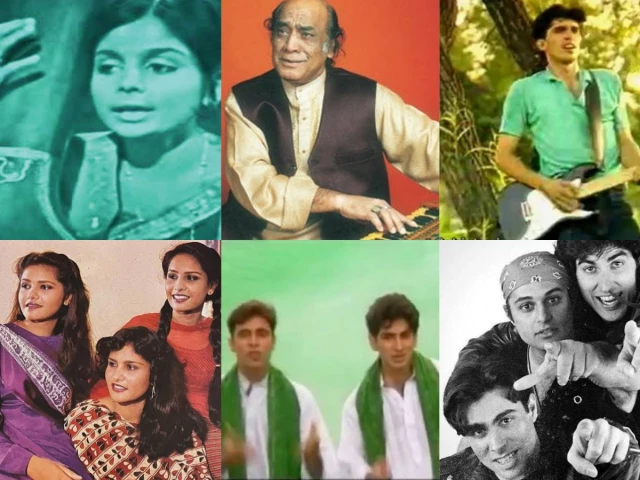
From early patriotic ‘naghmas’ to pop and rock anthems, these songs trace Pakistan’s evolving musical identity
Every August, Pakistan’s Independence Day arrives with a familiar soundtrack.
Some songs take us back to the country’s earliest years. Others belong to school assemblies, cricket matches, family gatherings or the August 14 playlists that seem to return every year.
Their musical styles may have evolved from classical voices and orchestral naghmas to pop, rock and contemporary productions, but the emotion remains remarkably familiar.
Here is a chronological journey through some of the songs that have become part of Pakistan’s musical memory.
1947 — Millat Ka Pasban Hai Muhammad Ali Jinnah
Among the earliest songs associated with the new Pakistan is Millat Ka Pasban Hai Muhammad Ali Jinnah, written by Mian Bashir Ahmed and performed by Munawwar Sultana and Qadir Faridi on Radio Pakistan Lahore in August 1947.
At a time when the country itself was only days old, songs such as this helped establish a musical vocabulary for the new nation, centred on Quaid-e-Azam Muhammad Ali Jinnah and the idea of a newly created homeland.
It belongs to a period when radio was the country’s most powerful mass medium, making these early national songs particularly significant.
1970s — Sohni Dharti Allah Rakhe
The 1970s produced some of the most enduring milli naghmas in Pakistan’s history.
Sohni Dharti Allah Rakhe, associated with Shahnaz Begum, was written by Masroor Anwar and composed by Sohail Rana. Its affectionate language and memorable melody turned it into one of the country’s best-known patriotic songs.
Rather than relying solely on grand declarations of patriotism, the song celebrates the beauty and character of the homeland. Decades later, its opening notes remain instantly recognisable.
1970s — Hum Zinda Qom Hain
Hum Zinda Qom Hain became another defining song of the era, particularly through the voices of the Benjamin Sisters.
The song focuses on the people themselves, offering a collective declaration of resilience and national identity.
It went on to become a familiar part of school functions, television programmes and Independence Day celebrations.
Its simplicity is perhaps part of its longevity: it was made to be sung together.
1974 — Jeevay Jeevay Pakistan
Then came Jeevay Jeevay Pakistan, sung by Shahnaz Begum and written by Jamiluddin Aali, with music by Sohail Rana.
For many Pakistanis, the song is inseparable from childhood memories of August 14. It was the kind of milli naghma that could move effortlessly from television studios to school stages and community celebrations.
Its enduring appeal lies in its combination of an instantly recognisable melody and an uncomplicated expression of national pride.
1980s — Yeh Watan Tumhara Hai
With Yeh Watan Tumhara Hai, the mood becomes more reflective. Mehdi Hassan’s rendition gave the song extraordinary emotional depth.
Instead of simply celebrating the country, it carries an underlying sense of responsibility — the idea that the homeland ultimately belongs to its people.
Hassan’s measured delivery and unmistakable voice helped transform it into one of Pakistan’s most enduring national songs.
1987 — Dil Dil Pakistan
Then Pakistani patriotism found a completely different sound.
Dil Dil Pakistan by Vital Signs, sung by Junaid Jamshed, arrived in 1987 and introduced a new generation to the idea that a national song could also sound like contemporary pop.
Written by Nisar Nasik and developed for Vital Signs by Shoaib Mansoor, the song represented a departure from the traditional milli naghma. Its youthful presentation helped turn it into a phenomenon.
What followed was bigger than anyone expected. Dil Dil Pakistan became one of the defining songs of Pakistani pop culture and is often described as the country’s unofficial second national anthem.
1990s — Ae Jawan
By the 1990s, patriotic music had become firmly embedded in Pakistan’s pop scene. Ae Jawan by Awaz gave the genre another youthful voice.
The song spoke directly to young Pakistanis, reflecting a decade in which local pop music was becoming increasingly influential. Patriotic music no longer belonged exclusively to traditional singers or state television.
1996 — Jazba-e-Junoon
If Vital Signs gave patriotism a pop sound, Junoon gave it rock.
Released on the band’s 1996 album Inquilaab, Jazba-e-Junoon became one of the most recognisable Pakistani rock anthems.
Its appeal was closely tied to the energy of the 1990s, when Pakistani rock was finding a huge youth audience. The song’s association with cricket and national sporting moments further strengthened its place in popular culture.
For a generation growing up with Junoon, patriotism could mean loud guitars, packed stadiums and the unmistakable voice of Ali Azmat.
2003 — Dil Se Maine Dekha Pakistan
Haroon’s Dil Se Maine Dekha Pakistan carried the patriotic pop tradition into the new millennium.
The song approached Pakistan through people, places and memories rather than simply through national slogans. Its imagery and melody gave it a softer, more personal quality.
Haroon later recreated the song for Independence Day in 2017, bringing it back to a new audience while retaining its nostalgic connection with the early 2000s.
2017 — Kabhi Parcham Mein Lipte Hain
By 2017, patriotic music was increasingly exploring stories of sacrifice and the human cost behind national symbols.
Kabhi Parcham Mein Lipte Hain, sung by Atif Aslam, was released as an ISPR song and focused on the relationship between soldiers, their families and the national flag.
It is a more solemn entry in the Independence Day soundtrack. The familiar green and white becomes intertwined with grief, duty and the families who wait for those serving the country.
A soundtrack that keeps evolving
Pakistan’s patriotic music has travelled a long way since 1947.
From the early days of radio to the rise of pop and rock, and eventually to contemporary productions, each generation has added its own sound to the country’s Independence Day soundtrack.
The result is a playlist that spans almost eight decades — and perhaps that is why these songs return every August.
Put them together and they tell a musical story of Pakistan itself: how the country has changed, how its generations have changed, and how the language of patriotism has evolved with them.
