


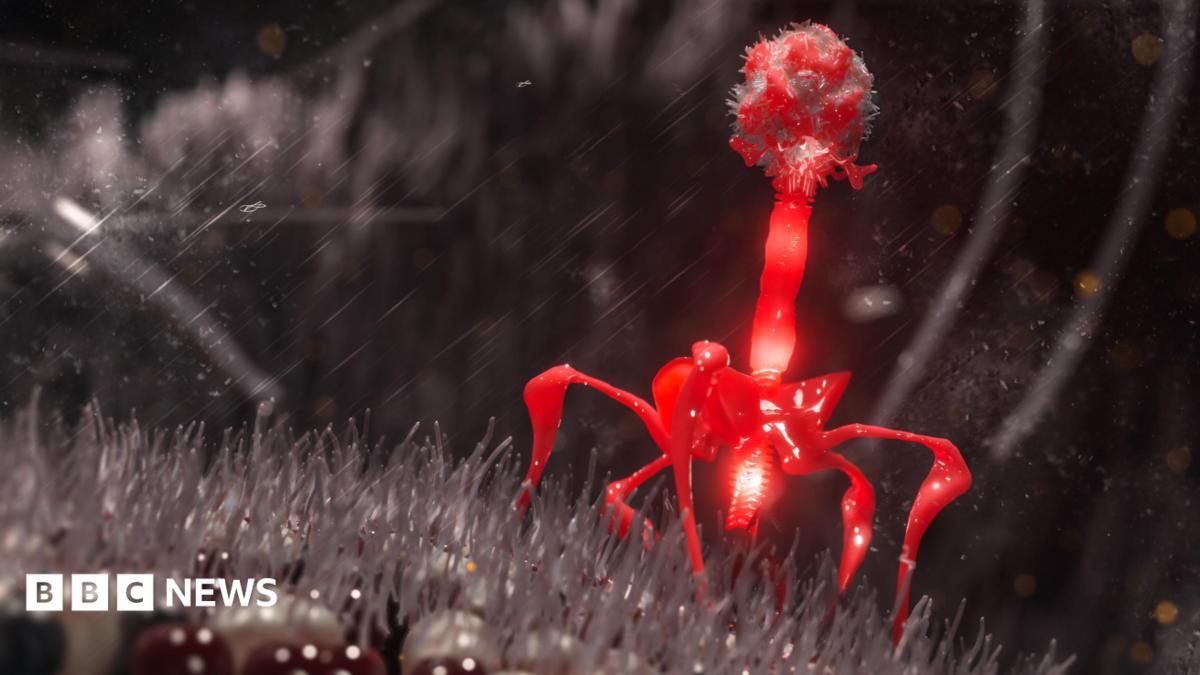
Viruses are not alive and it would take another significant leap for AI to generate living organisms.
The genetic code of the phage is around 5,400 base pairs (letters) long. The smallest genome of a living cell is around 500,000 base pairs. The human genome is three billion base pairs.
Hie says “it would probably be a lot of work, but not impossible” to attempt some simple organisms and they were “definitely interested in working towards” that.
Prof Marc Güell, from the synthetic biology lab at Pompeu Fabra University in Spain, said the study was a “very significant turning point” because for the “first time in history, we are beginning to design biology on a computer”.
He said it “allows us to dream of exciting possibilities for tackling humanity’s greatest challenges” such as developing phages to tackle disease, enzymes to treat genetic disorders and antibodies that could be used in immunotherapy.
Prof Patrick Cai, chair of synthetic genomics at the Manchester Institute of Biotechnology, said the study was an “important milestone”.
“The significance extends far beyond phages – it suggests that genome language models are beginning to learn the design principles encoded by evolution, opening the door to AI-assisted genome writing.”
