


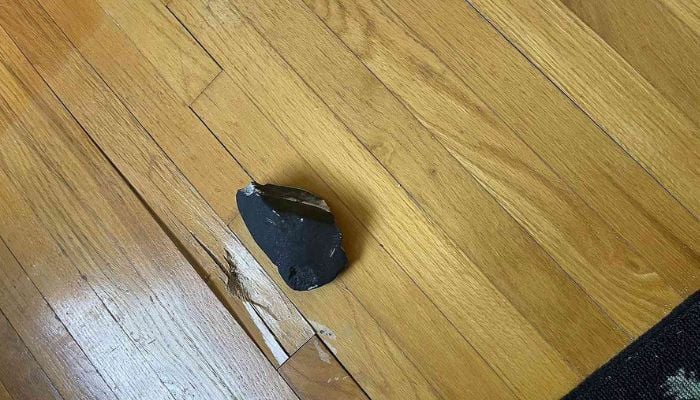
A meteorite that crashed through the roof of a New Jersey home in July 2024 has “alien world chemistry” containing prebiotic molecules and organic compounds that hold clues to how life began on Earth.
The discovery is confirmed by the study published in the journal Science Advances that states the meteorite weighed 2 pounds when it hit the roof of a house in Hillsborough, New Jersey, after having made a sonic boom flying over the Statue of Liberty. The fragments were immediately collected by the owner in glass jars using disposable gloves and aluminium foil, enabling scientists from all over the world to perform a unique forensic examination.
According to the lead author, Peter Jenniskens of the SETI Institute: “Thanks to the homeowner’s quick reaction, these are the most pristine CM1/2 meteorites we know of.”
This meteorite was classified as a CM1/2 carbonaceous chondrite, a type of meteorite rich in carbon-bearing material, and it is only the second known fall of this variety, and “one of the most scientifically valuable meteorites ever found,” says the SETI Institute.
But most amazing of all, it was found that before this rock broke away from its parent asteroid, it had been encrusted with concentrated salty liquids called brine, which had never been observed before on any such space object. High salt concentrations in brine help form important biological compounds through chemical reactions by keeping phosphate in solution.
The chemical composition of the meteorite revealed that it contained 1.8% carbon and 0.07% nitrogen along with a wide variety of soluble organic compounds, including amino acids and magnesium. These chemical compounds are similar to those found in living organisms, including compounds involved in blood and photosynthesis.
Some fragments of the meteorite will now be curated at the American Museum of Natural History in New York City.
