


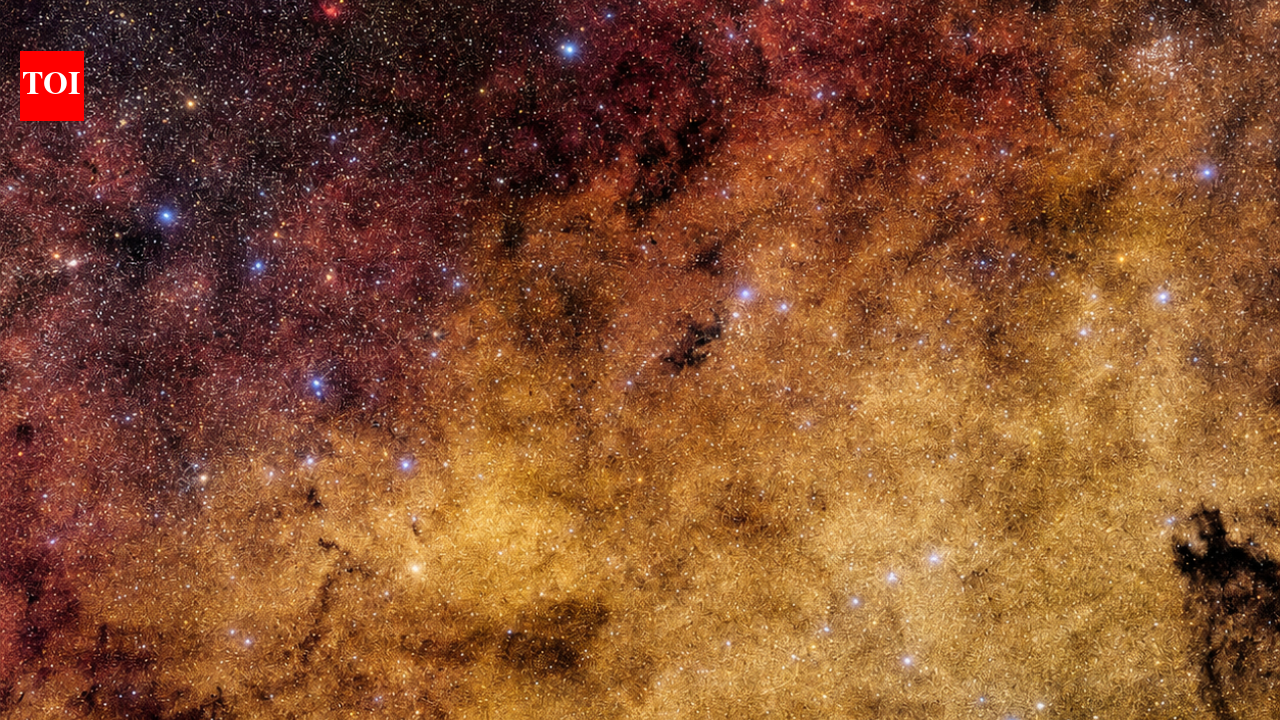
The European Space Agency’s Euclid space telescope has delivered one of the most detailed views ever captured of our galaxy’s crowded heart, revealing more than 60 million stars in a single extraordinary image. The observation offers astronomers an unprecedented look into the densely populated central regions of the Milky Way, a part of the galaxy that has long remained difficult to study because of thick clouds of dust and overlapping stellar populations. Beyond its visual impact, the image represents a scientific treasure trove that researchers expect to analyse for years, if not decades. By mapping stars, star clusters and hidden galactic structures on an enormous scale, Euclid is providing fresh clues about how the Milky Way formed, evolved and continues to shape the cosmic environment around us.
How Euclid captured 60 million stars in the crowded heart of the Milky Way
Launched in 2023, Euclid was designed primarily to investigate the mysterious dark universe, including dark matter and dark energy. However, its powerful instruments are also proving exceptionally valuable for studying our own galaxy.The newly released image focuses on the Milky Way’s central bulge, a densely packed region containing vast numbers of stars concentrated around the galactic centre. According to the European Space Agency, Euclid observed an area covering approximately 500 square degrees of the sky and detected more than 60 million stars, many of which had never been studied in such detail before. “With a single observation, Euclid has captured millions of stars, demonstrating its extraordinary ability to survey vast regions of the sky in remarkable detail,” ESA stated.The telescope’s visible and near-infrared instruments allow it to peer through dust that often obscures observations from Earth, revealing stellar populations hidden deep within the galaxy.
Why astronomers believe the Euclid image will fuel discoveries for decades
The significance of the image extends far beyond its sheer scale. Researchers expect the dataset to help identify previously unknown star clusters, trace the structure of the galactic bulge and improve understanding of stellar evolution.ESA scientists note that the immense catalogue will provide opportunities to investigate how stars are distributed throughout the Milky Way and how different populations formed over billions of years. Because the image contains tens of millions of objects, researchers anticipate years of detailed analysis and follow-up studies.The mission’s advanced imaging capabilities are particularly valuable for detecting faint objects that might otherwise remain hidden among brighter neighbouring stars. This could lead to discoveries ranging from previously overlooked stellar nurseries to rare astronomical phenomena.According to Euclid science team at the European Space Agency: “These observations provide an unprecedented view of the Milky Way’s central regions and will support a wide range of future scientific investigations.”
What Euclid’s Milky Way map reveals about the future of space research
Although Euclid’s primary objective remains understanding the large-scale structure of the universe, its observations are increasingly demonstrating their value for galactic astronomy.By combining visible and infrared observations, the telescope can build detailed maps of stellar distributions, helping scientists reconstruct the history of our galaxy. Researchers hope these observations will shed light on how the Milky Way assembled over cosmic time and how interactions with smaller galaxies influenced its development. The image also highlights Euclid’s ability to produce datasets on a scale rarely achieved in astronomy. As additional observations are collected throughout the mission, scientists expect even larger catalogues and more comprehensive maps of the universe.For astronomers, the release marks more than a striking snapshot of the cosmos. It is the beginning of a long-term scientific resource that could reveal new insights into the Milky Way for decades to come, helping answer some of the most fundamental questions about our place in the universe.
