


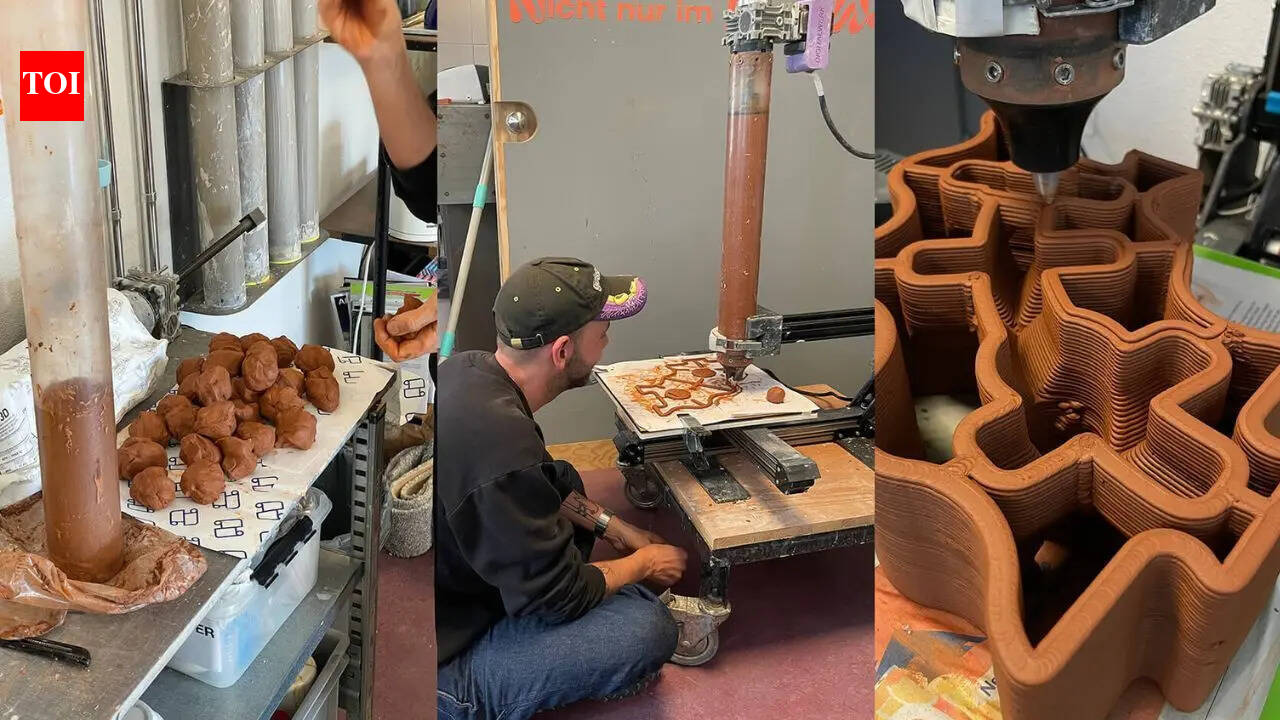
At a bus stop in a midsummer European city, heat does not arrive as a single spike. People wait in that trapped heat, often without shade or airflow, relying on nothing more than chance positioning or a passing breeze. This precise moment of exposure was when a pair of industrial design students at the Zurich University of the Arts tried to intervene with an evaporative cooling brick system they call bloc°.A shaded but still humid space can feel more oppressive than a slightly warmer but well-ventilated one. If evaporative systems increase local humidity without adequate airflow design, they can partially offset their own benefits. That is why bloc° incorporates curved geometries and airflow channels. The design is not just about wet surfaces; it is about guiding air movement through controlled paths, according to The James Dyson Award.Instead of scaling up air conditioning, they went smaller. Their idea turns porous terracotta modules into localised cooling surfaces for bus stops, plazas, and schoolyards. Water moves through the structure, air passes across it, and heat is drawn out through evaporation. In testing, the system reportedly reduced surrounding air temperatures by around 9°C, though real-world performance is still dependent on humidity, airflow, and maintenance conditions.
Why cities become heat traps and stay hotter than the countryside
Cities do not just feel hotter; they are measurably hotter. Surface temperature studies consistently show urban materials, especially asphalt and dark roofing, running 10 to 15°C higher than nearby rural surfaces during peak summer conditions. That difference is not cosmetic. It alters how heat is stored, released, and experienced at street level. The phenomenon is known as the urban heat island effect. It emerges from a combination of dense construction, reduced vegetation, and heat-absorbing materials that retain solar energy well into the night. Once temperatures rise, they do not fully reset after sunset, which means heat stress can accumulate across multiple days.Public health data adds urgency. Extreme heat is now widely recognised as one of the leading weather-related causes of mortality in countries like the United States, surpassing floods and storms in some recent assessments. Exact global death estimates vary by methodology, but most climate-health models converge on the same point: heat exposure is already a major, under-addressed risk in urban environments.
How the evaporative cooling brick system actually works
As reported by The James Dyson Award, at the core of the bloc° design is a simple physical process, evaporation. When water changes from liquid to vapour, it absorbs heat energy from its surroundings. That principle is old, but the architecture around it is increasingly refined.Each module is made from 3D-printed terracotta, chosen for its porosity. Unlike glazed ceramics or concrete, terracotta can absorb and slowly release water through its microstructure. Inside each brick, water is circulated through internal channels. A small pump, reportedly solar-assisted in prototype configurations, keeps the system moving, while external airflow is guided across damp surfaces.As air passes through or alongside the wet ceramic, heat is transferred from the air into the water film, which then evaporates. The result is a localised drop in temperature before the air exits the structure.Laboratory-style tests referenced by the design team indicate cooling on the order of several degrees Celsius, with bloc° prototypes reaching up to around 9°C reduction under controlled conditions. That figure should be treated carefully. Evaporative systems are highly sensitive to ambient humidity. In dry climates, performance improves significantly. In humid conditions, cooling efficiency drops.
Why terracotta is doing more work than it looks like
Terracotta is not just aesthetic. Its micro-porous structure acts like a passive water reservoir. That matters because it removes the need for constant high-pressure pumping systems found in traditional HVAC or misting installations, as reported by The James Dyson Award. There is precedent for this approach. Clay-based cooling systems have been used for centuries in the form of evaporative food storage pots and porous water coolers. More recently, academic studies on terracotta tube panels in hot regions such as India have shown measurable air temperature reductions as air passes through wet ceramic channels, even with minimal mechanical input. The bloc° system extends that idea into architectural scale by stacking modular units into walls or seating structures. Instead of a single cooling device, the city gains a configurable surface, something closer to street furniture than infrastructure.
Where the concept gets complicated: Water, maintenance, and scale
The most common misconception about passive cooling systems like this is that they are maintenance-free alternatives to air conditioning. They are not.Evaporative cooling depends on a steady water supply. In dry urban climates, that can be a constraint. Even if the system uses recycled rainwater or municipal lines, distribution and filtration become part of the infrastructure burden. A clogged channel or empty reservoir immediately reduces performance.There is also the question of scale. Cooling a bus stop is not the same as cooling a street canyon or a district. The evaporative cooling brick system works best at the human scale, where people stand, sit, or wait, not across entire neighbourhoods where heat flows are driven by building density and wind patterns. That is a design strength and a limitation at the same time. It avoids the energy cost of citywide cooling, but it cannot replace it.
