


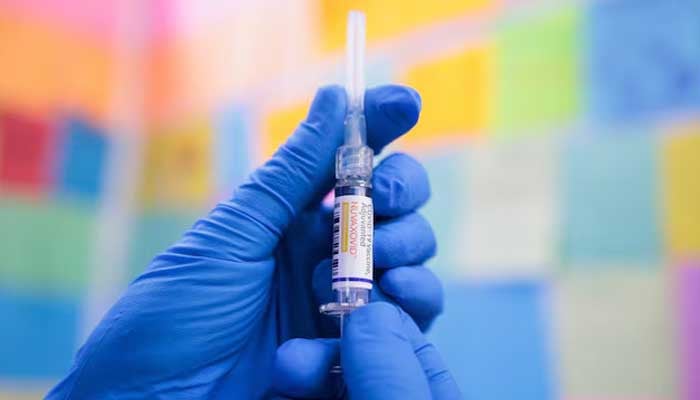
PARIS: A vaccine targeting a broad range of viruses that was designed using artificial intelligence had a “modest” effect on immune systems in a small, early trial, according to a new study.
The trial marks the first time a vaccine whose active ingredient was entirely designed by AI has been tested in humans, researchers at the University of Cambridge in the UK said on Friday.
The experimental jab is intended to be a “universal vaccine” which protects people against a range of viruses that have previously sparked deadly outbreaks including SARS, MERS and Covid-19.
The researchers expressed hopes that this type of vaccine could one day help fend off future pandemics.
“We’ve converted vaccine development from being reactive to being future proof,” Cambridge researcher and study co-author Jonathan Heeney said in a statement.
Currently, vaccines for viruses such as the flu and Covid have to be regularly updated to target the latest strains.
But the new vaccine aims to produce an immune response that will protect against many pathogens — including some circulating among wild animals that might jump over into humans in the future.
“It means we can escape the constant cycle of chasing the virus variants circulating in humans and updating the vaccines to try to catch up, like a dog chasing its tail,” Heeney explained.
To design the vaccine’s active component, called the antigen, the researchers used a machine learning algorithm trained on genetic data for Sarbeco coronaviruses recorded across the world.
Nearly 40 people participated in the trial between late 2021 and 2023. In the study, the researchers acknowledged the lingering Covid pandemic complicated the results.
It was a phase 1 trial, which test whether something is safe and well tolerated, and are not intended to fully measure how effective it is.
No serious side effects were recorded.
However the vaccine only had a “modest” impact on the participants’ immune systems, according to the study published in the Journal of Infection.
Data collected during the trial does “not support a robust vaccine-induced increase in antibody responses beyond pre-existing levels”, it added.
A phase 2 trial involving more people will next find out more about how protective the vaccine could be.
