


Three solar flares burst from the sun toward Earth this week, scientists said, and the enormous beams of energy, light and high-speed particles may increase the odds of seeing the northern lights for people across the United States as they travel closer to our planet.
Solar flares are giant eruptions of electromagnetic radiation, including X-rays and ultraviolet light, which launch into space off the sun’s surface, according to NASA. The explosions are often associated with solar magnetic storms, also known as coronal mass ejections, and they can significantly disrupt technology on Earth if pointed in its direction.
The trio of flares that left the sun a couple of days ago were each expelled from the star at slightly different angles, all within a 24-hour period, according to the National Weather Service’s Space Weather Prediction Center. The center predicts that the three of them will catch up to one another and combine before reaching Earth.
“There is a fair level of confidence about an Earth arrival,” it said in an advisory.
However, it noted that the intensity of the flares, and the extent to which they could impact Earth, remained uncertain. Scientists measure the strength of geomagnetic storms on a scale of 1 to 5, ranking from “minor” to “extreme.” This one is expected to fall somewhere in the middle, with forecasters suggesting it will be either “strong” or “severe.”
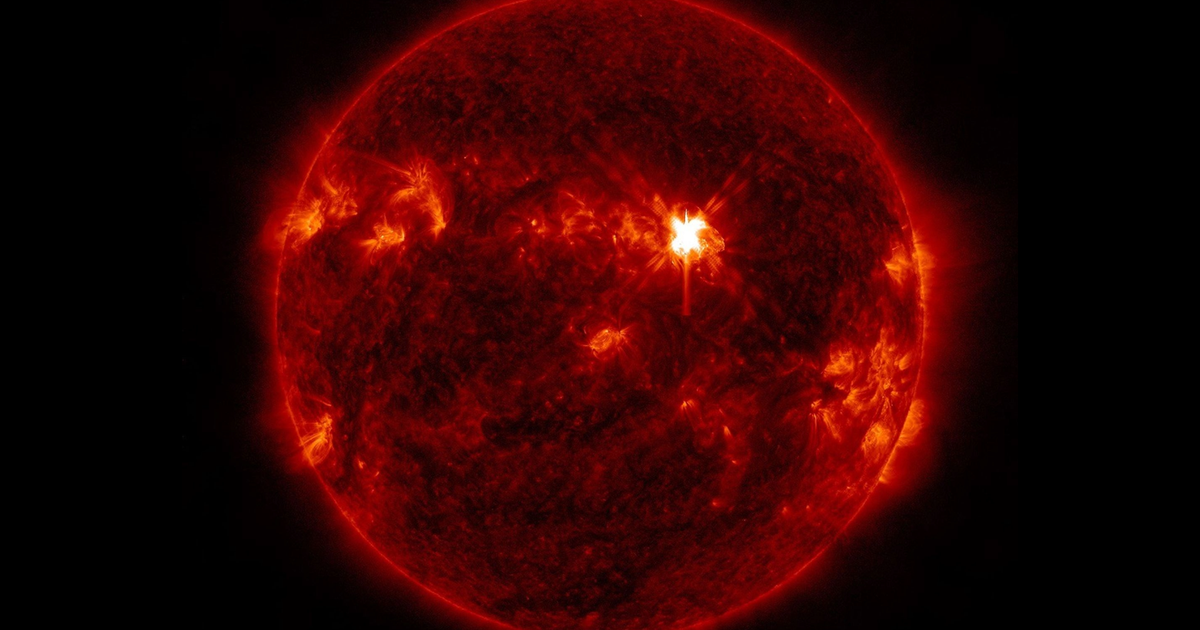
NASA said the powerful solar flare peaked just before 7:30 a.m. ET on Wednesday. It published an image of the fiery event, which shows the flare as a bright flash of light against the sun’s darker silhouette. The space agency said this flare was classified as “X1.0,” with X-class used to describe the largest and most intense flares.
NASA/SDO
Solar flares and geomagnetic storms are capable of impacting telecommunications and satellite systems on Earth, potentially meddling with radios, electric power grids and navigation systems, NASA has warned. They also may damage spacecraft and pose possible safety threats to astronauts.
Flares may also give way to spectacular displays of the aurora borealis, or northern lights, for people in the U.S. on Thursday and Friday. Northern lights are linked to geomagnetic storms, and strong storms have in the past produced northern lights well below the latitudes where they can normally be seen. In May 2024, one record storm caused northern lights as far south as Mexico.
