


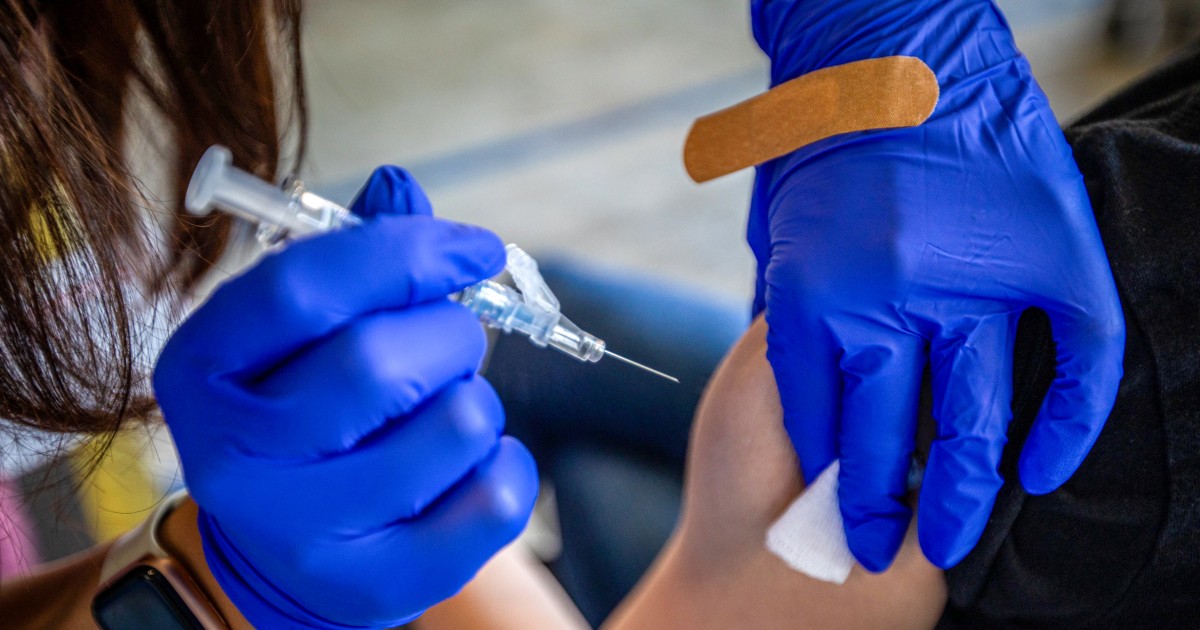
A Food and Drug Administration advisory panel on Thursday recommended updating this fall’s Covid shots to target the XFG variant, a fast-growing strain nicknamed “stratus.”
Subscribe to read this story ad-free
Get unlimited access to ad-free articles and exclusive content.

The recommendation — from the FDA’s Vaccines and Related Biological Products Advisory Committee — is meant to help vaccine makers prepare shots for the fall and winter, when Covid infections typically rise.
Thursday’s meeting was the agency’s first since FDA Commissioner Marty Makary resigned. (His resignation did not play a role; the meeting was already on the calendar before he resigned.) Makary drew criticism last year after the agency imposed stricter requirements on who could get Covid shots.
According to wastewaterSCAN data, Covid activity is at a “medium” level across most of the United States. But newer variants continue to evolve in ways that may help them evade immunity from prior infection or vaccination.
Covid was generally less severe last season, with hospitalizations dropping below the levels of the last three years, according to Centers for Disease Control and Prevention data presented Thursday. The highest hospitalization rates were among babies less than 6 months and adults over the age of 65.
XFG is a hybrid of two omicron variants and carries mutations that could help it partially dodge antibodies, Natalie Thornburg, who leads the CDC’s respiratory division, told the panel Thursday.
As of May 8, XFG and its descendants account for more than half of new infections in the U.S., according to CDC data. XFG.1.1 is currently the dominant strain of the virus, accounting for about 1 in 4 infections.
Dr. William Schaffner, an infectious disease expert at Vanderbilt University Medical Center in Nashville, Tennessee, said XFG and its descendants do not appear to cause more severe illness than earlier strains, although researchers are still studying whether the variants spread more easily.
They also appear to cause similar symptoms to earlier strains, he said, including sore throat, cough, headache, body aches, fever and chills.
During Thursday’s meeting, Moderna and Novavax presented data in mice that suggested vaccines targeting XFG produced higher antibody levels against several circulating strains than the current LP.8.1 formulation in Pfizer’s and Moderna’s vaccines. (Novavax’s current vaccine targets a different variant, called JN.1.) Pfizer presented data showing an XFG vaccine and the current formulation produced similar antibody levels.
In Thursday’s vote, only one committee member abstained: Dr. Hana El Sahly, a professor of molecular virology and microbiology and infectious diseases at Baylor College of Medicine, said data on the effectiveness of an XFG vaccine showed it wasn’t overwhelmingly better than the current formulations.
All other members voted in favor of the recommendation.
The committee’s recommendation is not the final determination. The decision now goes to the FDA, which is expected to give the vaccine makers the go-ahead to begin producing doses for the fall and winter. It’s unclear who would sign off on the shots because the FDA has neither a permanent vaccine chief nor commissioner. Following Makary’s resignation, Kyle Diamantas, the agency’s top food regulator, was named acting commissioner.
Earlier this month, the World Health Organization recommended vaccine makers target the LP.8.1 strain or other closely related circulating variants, including XFG.
