


Some proverbs comfort people and then there are proverbs that almost stop them for a second. This Greek saying belongs to the second group. It sounds sharp, maybe even unfair on first reading. Someone hears it and immediately thinks, that cannot possibly be true. After all, people help friends every day, support family members, lend money and give time without expecting disaster in return.Yet old proverbs rarely survive for centuries because they are meant to be read literally. They usually survive because somewhere inside them there is a human experience that people keep recognising over and over again.This one seems to come from a place of disappointment. Not ordinary disappointment either, but the kind people remember years later. The kind where someone says, “I really did not expect that person to do that.”Almost everybody has a version of that story.Someone helps a friend through difficult times and later feels forgotten. Someone spends months supporting another person and then realises the effort was never valued in the same way. A person gives money, energy or emotional support believing they are strengthening a relationship, only to later discover that generosity and loyalty do not always travel together.That is where this proverb starts becoming less about money and more about human behaviour.
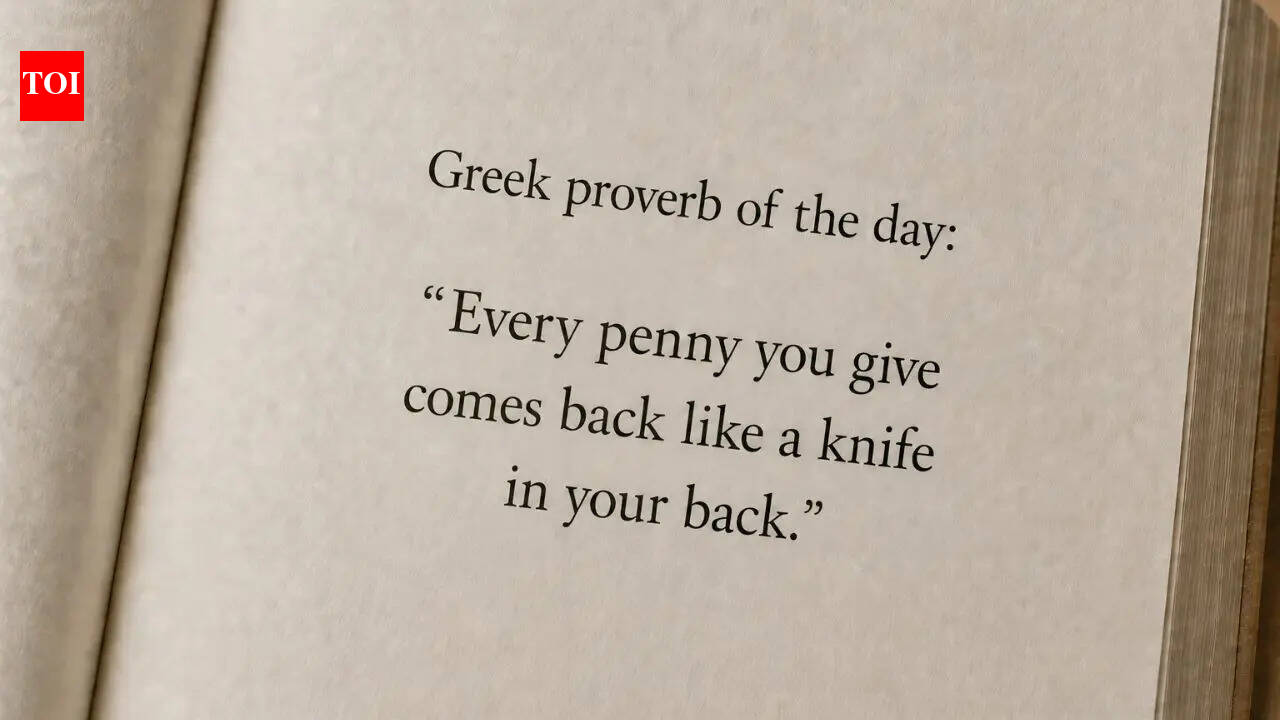
Greek proverb of the day
“Every penny you give comes back like a knife in your back.”
What could be the meaning behind the Greek proverb
The phrase “every penny” is probably not really about coins at all. Traditional sayings often use simple objects to represent larger ideas. In this case, the penny may stand for anything people give away: time, trust, emotional effort, patience or support.The second half of the proverb creates the emotional impact. A knife in the back immediately brings betrayal to mind. People think of trust being broken. They think of disappointment arriving from directions they never expected.The proverb does not necessarily say that generosity itself is dangerous. It seems more like a warning about assumptions. People sometimes quietly expect relationships to work like mathematics. Give kindness and kindness returns. Offer loyalty and loyalty comes back.Life has an awkward habit of refusing to follow clean formulas.Human beings carry different priorities, different values and different levels of gratitude. Sometimes people remember every act of support forever. Sometimes they move on without even realizing how much another person gave for them.That difference is where many disappointments begin.
Why painful memories stay longer than pleasant ones
There is something slightly unfair about memory. Good experiences matter, but painful ones often leave deeper marks.Someone can have ten people support them and one person betray them, and strangely the betrayal may remain louder in memory than all the kindness that came before it.People often notice this in everyday life. A person receives compliments throughout the week but continues thinking about one harsh comment. Somebody experiences years of loyalty and then spends months thinking about one broken promise.Human attention works in odd ways.Part of the reason may go back to survival itself. Remembering danger historically mattered. Forgetting a threat could create serious consequences. Because of that, people naturally pay attention to experiences that hurt them.Maybe that explains why disappointments sometimes feel larger than they actually are.One difficult experience begins influencing future trust. Someone becomes more cautious. Another person becomes slower to open up emotionally. Others convince themselves that depending on people creates unnecessary risks.
The difficult balance between kindness and caution
The interesting thing is that the proverb probably is not advising people to stop helping others entirely. If that were true, relationships would become impossible.Life depends heavily on people supporting one another. Families function because people give. Friendships survive because people give. Communities grow because individuals continue helping one another even when no immediate reward appears.The challenge is finding balance.Some people give endlessly because they believe constant sacrifice automatically creates stronger relationships. Others become so guarded after disappointment that they stop allowing anyone close.Neither extreme usually works particularly well.Healthy relationships often exist somewhere in the middle. People remain generous but also pay attention. They care about others without ignoring their own limits. They help without assuming that every relationship automatically guarantees loyalty.Experience teaches many people that kindness and caution are not enemies. Sometimes they need each other.
Why old sayings still feel strangely modern
The world changes constantly. Technology changes. Communication changes. Entire industries appear and disappear.People, however, remain surprisingly familiar.Friendships still become complicated. Trust still breaks occasionally. Gratitude still matters. People still help one another and people still get hurt sometimes.Perhaps that is why certain proverbs continue surviving. They are less about ancient societies and more about recurring human experiences.This Greek saying may sound harsh at first, but perhaps it is really offering a quieter reminder underneath all its dramatic language. Give with generosity, but keep your judgment close beside it. Not because every act of kindness ends badly, but because wisdom and kindness often work best when they walk together rather than separately.
