


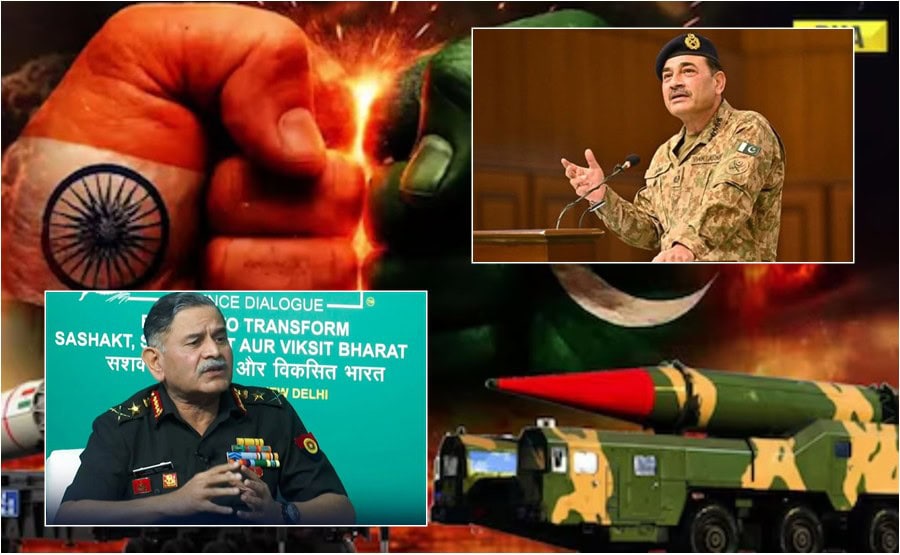
ISLAMABAD – Pakistan and India have once again exchanged sharp rhetoric after Indian Army Chief made a politically charged statement, and warned Pakistan to “choose between geography or history” over terrorism-related allegations. Pakistan Army strongly rejected the statement, calling it a provocative and dangerous remark that could further escalate tensions in an already sensitive regional environment.
In its official statement on Sunday, military’s media wing ISPR rejected the remarks outright, saying Pakistan is not only a sovereign nation but also a “country of consequence” at the global level and a declared nuclear power firmly rooted in South Asia’s geography and history.
The military’s media wing said the statement reflects what it called a persistent inability within sections of India’s leadership to reconcile with the very existence of Pakistan, even after nearly eight decades.
ISPR said the mindset behind such remarks as “jingoistic, hubristic and myopic,” warning that it has repeatedly pushed the region toward crises and military confrontations.
The statement stressed that threatening a nuclear-armed country with elimination from “geography” is not strategic messaging but dangerous rhetoric that reflects “lack of cognitive thinking,” adding that any such scenario would inevitably result in mutual and widespread destruction.
ISPR made it clear that responsible nuclear states are expected to demonstrate restraint, maturity, and strategic balance rather than engage in language suggesting civilizational superiority or national erasure.
The military further cautioned India against pushing South Asia into another war or crisis, saying the consequences would not remain limited geographically or politically but could extend far beyond the region.
It urged the Indian leadership to accept Pakistan’s regional relevance and adopt a policy of peaceful coexistence, warning that any attempt to target Pakistan would trigger outcomes that would be neither geographically contained nor strategically predictable.
ISPR also accused India of selectively ignoring its own alleged role in regional instability, including claims of sponsoring terrorism, conducting transnational assassinations, and running disinformation campaigns globally. It added that India’s current aggressive posture stems not from strength but from frustration over its inability to cause harm to Pakistan, referring to past military tensions between the two countries, including last year’s escalation described by Pakistan as “Marka-e-Haq.”
The remarks by Gen Dwivedi came during an interactive session in New Delhi raised questions over political rhetoric in Indian armed forces where he was asked about potential future scenarios similar to past military operations. While reiterating India’s longstanding allegations against Pakistan, he said Pakistan must decide whether it wants to remain part of “geography or history,” a comment that triggered Islamabad’s strong diplomatic and military response.
The exchange comes amid renewed sensitivities following last year’s four-day military escalation between the two nuclear-armed neighbours, which both sides continue to interpret differently and commemorate in contrasting narratives.
Pakistan’s top military leadership repeatedly warned that any future “misadventure” would be met with an “extremely far-reaching and painful” response, while international observers continue to caution that any renewed conflict between the two countries could quickly spiral beyond control due to the nuclear dimension.
With rhetoric escalating on both sides, analysts warn that South Asia may once again be entering a highly volatile phase where diplomatic restraint will be critical to prevent confrontation.
‘8-0’: PAF says 4 Indian Rafales, Su-30, MiG-29, and Mirage 2000 were shot down
