


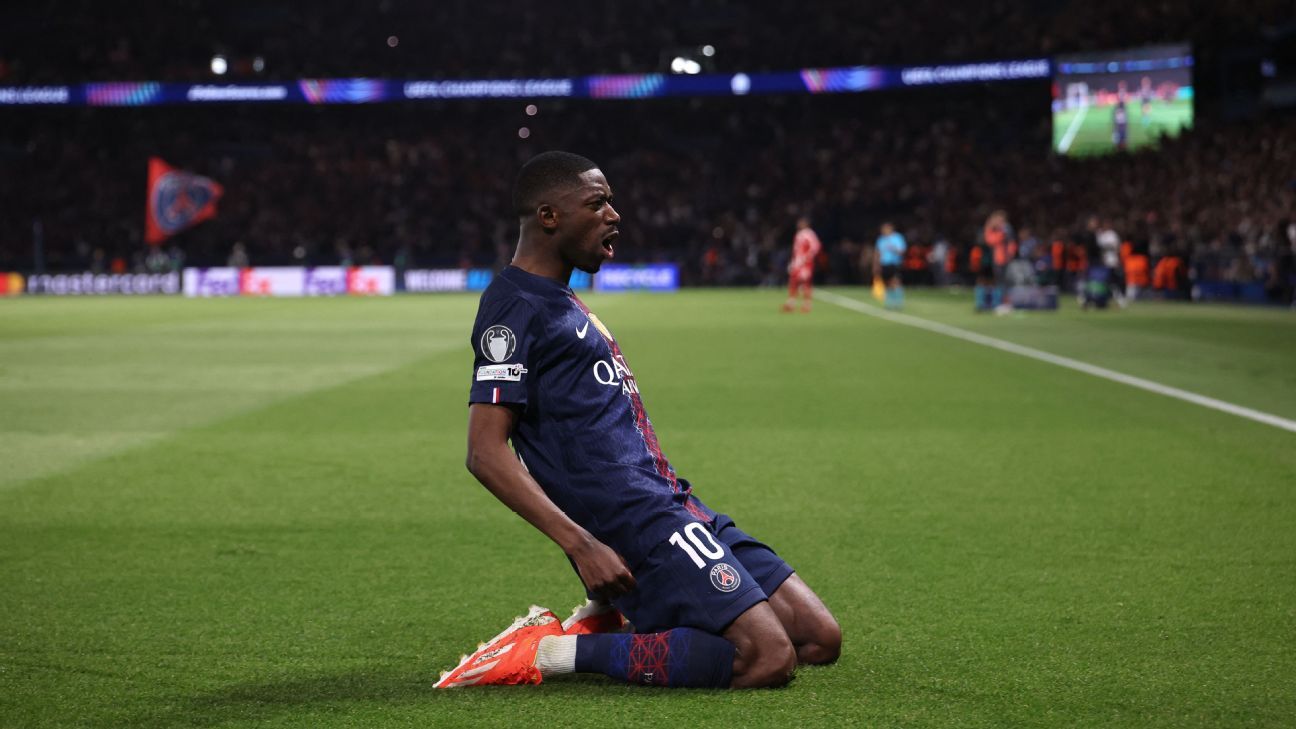
PARIS, FRANCE — Twenty-four hours earlier, Paris Saint-Germain coach Luis Enrique had raised his hand up high to indicate just what dizzying levels his team — who won the Treble last season, lest we forget — had reached, adding that PSG were “the best in the world.”
Bayern Munich boss Vincent Kompany made no such pronouncements, but maybe he felt he didn’t need to. His team are on course for a Treble of their own and had lost just twice all season long.
We all knew that Tuesday’s match was going to be a blockbuster. If the European game had a Top 25 poll, like college football, PSG and Bayern would be first and second, in whatever order you prefer.
What we didn’t know was that it was going to turn into one of the most epic, back-and-forth slugfests in recent memory, the sort of match that could rival the legendary clash between Manchester United and Real Madrid in 2003 (the Ronaldo hat trick, David Beckham coming off the bench to score twice, Roman Abramovich in the stands deciding then and there that he needed to buy a football club to make his life complete…). In the end, two of the world’s best sides delivered a historic performance with PSG edging the Champions League semifinal first leg 5-4 at the Parc des Princes.
– Ogden: PSG, Bayern Munich deliver an instant, nine-goal classic
– As it happened: PSG triumph over Bayern in UCL semifinal 1st leg
– Can Griezmann win the UCL to leave Atlético on the highest of highs?
PSG fans had set the scene pre-match with a typically over-the-top French Revolution-themed tifo. A giant banner framed in gold depicting blue-uniformed soldiers standing above a helpless red-clad infantryman set against a war-torn hellscape. It was a cue for the home fans to start singing the French national anthem, La Marseillaise, with its references to “blood-soaked banners” and enemies coming “to slit your throats” and exhorting their foes to “water our furrows” with their “impure blood.”
Those goosebumps wouldn’t be the last we’d experience. Whether it was the intricacy with which Bayern found Luis Díaz in the box (where he’d win the penalty that Harry Kane converted for the opener) or the way Khvicha Kvaratskhelia made Josip Stanisic dance like a puppet on a string, conjuring up just enough space to stroke the ball into the far corner for the equalizer this was merely the beginning.
And while the fearsomely precise technique of the aforementioned players and the likes of Michael Olise, Désiré Doué, Ousmane Dembélé will make the highlight reels and do the rounds on social media, what struck you just as much being privileged enough to witness it was the sheer, relentless athleticism on display.
Bayern and PSG played on fast-forward, but they did it with precision, with familiar patterns of play that allowed players time to think and create.
Football matches usually have natural “pauses” — it’s a hallmark, traditionally, of the Spanish game — where gifted players slow things down and speed them up, or “control the tempo” in coach-speak. Not here. It was breathless and yet, at the same time, it looked controlled, coordinated. Superb athletes doing things at speed that normal humans can do only at walking pace. And doing it again and again for 90-plus minutes.
But if the tempo was out of control, the play wasn’t. On the contrary, this was surgical stuff, precision controlled — from both coaches. And if there’s a lesson to be learned it ought to be that this is what top players on top teams can do if you give them rest. Luis Enrique had made squad rotation a priority over the past six weeks. Kompany had also rested guys liberally in the Bundesliga. If the powers that be don’t get the message that with proper rest and time to work on the training pitch great players can produce great spectacles like what we saw at the Parc des Princes, then they’re either deaf or dumb. (Or, greedy, because more games equal more money.).
This doesn’t mean the match was flawless, by any stretch. Jamal Musiala could have done a better job on João Neves‘ goal, by not letting the curly-haired midfielder run across him. Dembélé and Olise should probably both have scored earlier than they did. Alphonso Davies should know better than to let his arm flail out when turning, like he did in conceding that penalty. Olise’s finish for his goal was special, but the defending — with four guys around him — wasn’t. Kvaratskhelia’s second was a rocket made possible by a chaotic back line. Marquinhos could have done a better job in playing Díaz offside for the final goal (and it was very close).
Go ahead and do your nit-picking and second-guessing. PSG and Bayern probably have an army of video analysts doing just that as you read this. But remind yourself that most of those imperfections were only exposed as such by moments of sublime skill. If you’re playing in a Champions League semifinal, you don’t need to be perfect against 99% of opponents, 99% of the time. Football is a low-scoring game, and putting the ball in the net is hard. On Tuesday night, however, every flaw was punished.
And, please, let’s not bury Luis Enrique either for letting a 5-2 victory (which would have justified block-booing hotel rooms for the final in Budapest) turn into a 5-4 nail-biter that turns the return leg into a toss-up. Conventional wisdom might have suggested managing the game and keeping possession and eking out the win.
Besides, to be fair to him, he did send on Fabián Ruiz to keep the ball. But Bayern’s one-two punch came so quickly — two goals in the span of 204 seconds, just seven minutes after PSG went 5-2 up — there wouldn’t have time to react and change the game plan. Not that he was likely to do so, anyway: Luis Enrique is nothing if not unconventional.
As for Bayern, they never changed their script, because that’s not what they do. Three goals down or two goals up, you know what you’re going to get. It’s the Kompany way. And it’s working a treat.
Take the two penalties out of the mix and you’ll note PSG scored four goals from an xG of 1.12 and Bayern three from an xG of 1.73. And, combined, the two sides mustered 22 shots: a surprisingly low total for a game with nine goals.
What does that tell you? This is what outstanding players on outstanding teams do: they make the very difficult seem routine. That’s technical proficiency, or, more simply, talent. And that the two coaches gifted us, the attacking intent coupled with the freedom to let the creatives create, well, that’s beauty. And entertainment.
Roll on next Wednesday in Munich. And a message to Atlético Madrid and Arsenal: Don’t get a complex over these two. There’s more than one way to win a football match. It’s just that this route is more special.
