


New Technology Cuts Solar Panel Water Waste
Researchers at City University of Hong Kong develop droplet technology to reduce cleaning water consumption by billions of gallons annually.
Researchers have developed a new cleaning method for solar panels that could reduce global water consumption in the renewable energy sector by billions of gallons each year.
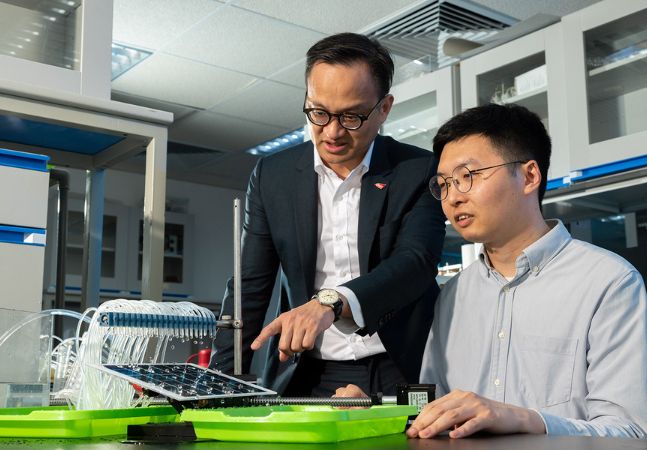
The technology, titled “Liquid Droplet Mops,” was developed by an international team led by the City University of Hong Kong in collaboration with Imperial College London. The findings, published in the journal Nature Sustainability, suggest that precise control of water droplets can remove up to 99.9% of surface contaminants.
Current industry standards for cleaning solar arrays often rely on high-pressure liquid jets. These methods consume more than 12 billion gallons of water annually worldwide. The research team discovered that cleaning efficiency does not increase with force; rather, optimal performance occurs at moderate energy levels.
The “Liquid Droplet Mops” approach uses the physics of droplet spreading and recoiling. When a droplet impacts the panel surface at a specific velocity, it generates hydrodynamic forces that drag and lift pollutants away. This mechanism is effective even against heavy particles with densities six to 10 times greater than water.
The study indicates this method could lower global annual water use for solar maintenance to approximately 2 billion gallons.
“We hope this groundbreaking technology will help conserve global water resources, improve the efficiency of renewable energy utilization and ultimately generate significant economic and environmental benefits,” said Steven Wang, an associate professor at CityUHK.
To simulate real-world desert conditions, the team tested the droplets against various sand particle sizes. They found the droplets effectively coalesce with and remove particles, making the process more stable and efficient than traditional spraying.
The technology is inspired by self-cleaning phenomena found in nature, such as butterfly wings and plant leaves that stay clean through raindrop impacts. Researchers say the breakthrough is particularly relevant for large-scale solar farms in arid regions where water scarcity is a primary concern for energy infrastructure.
About the Author
Jesse Jacobs is Assistant Editor of EPOnline.com.
