


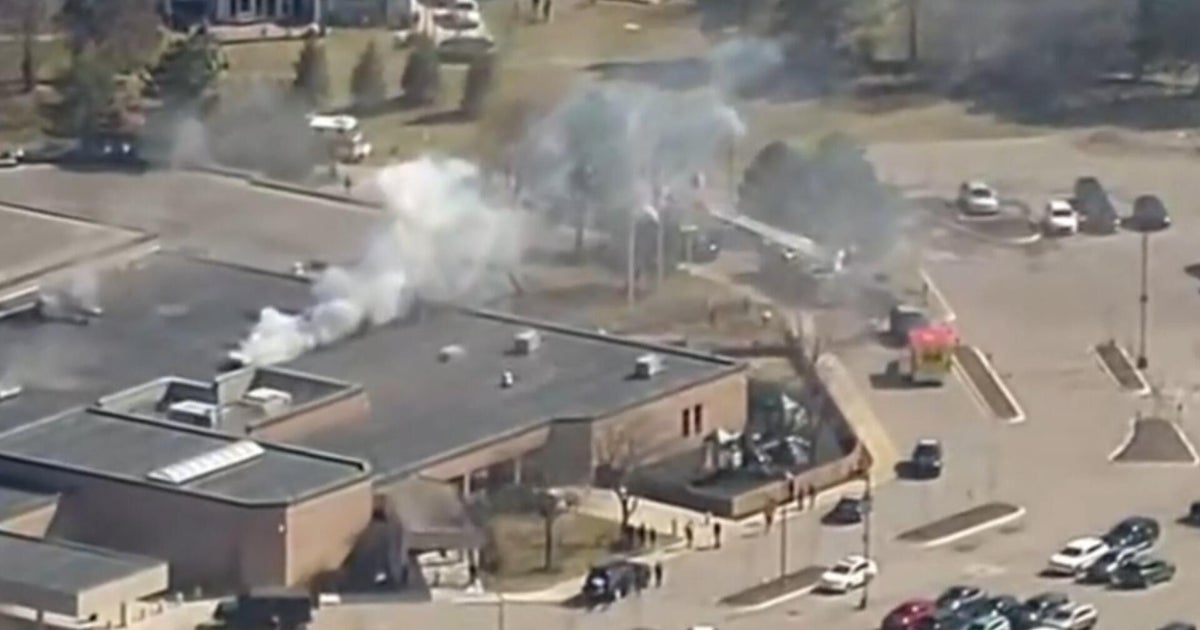
A suspect is dead after ramming a truck into Temple Israel in West Bloomfield, Michigan, on Thursday afternoon, in what the FBI said was a “targeted act of violence against the Jewish community.” No one else was killed in the attack, officials said, but a security guard was injured and dozens of law enforcement officers were treated for smoke inhalation.
The Department of Homeland Security identified the suspect as Ayman Mohamad Ghazali, a Lebanese-born U.S. citizen. A source in Michigan’s Lebanese American community told CBS News that an Israeli airstrike roughly 10 days prior on the Lebanese village of the suspect’s family killed several of his family members, leaving him devastated.
Here’s what we know about the incident.
Ramming attack
Around 1:35 p.m. Thursday, police responded to reports of shots fired in the area of Temple Israel in West Bloomfield, a suburb northwest of Detroit, Oakland County Sheriff Michael Bouchard said.
Bouchard said a man drove through the doors of the building and down a hallway, and that security engaged the suspect with gunfire. Law enforcement sources told CBS News the suspect exited the vehicle with a rifle and was confronted and killed by synagogue security.
Bouchard, however, said the suspect was found dead in the vehicle, and said he couldn’t specify if he was killed by security. It was not immediately clear if the suspect fired any shots. “In situations like this, you never know, if somebody is trapped somewhere, sometimes they kill themselves,” Bouchard said.
Two law enforcement sources told CBS News there were mortar-type explosives in the vehicle, which caught fire when it rammed into the building.
“Something ignited in the vehicle. That’s a work in progress,” Bouchard said.
Two law enforcement sources told CBS News the suspect’s body had been badly burned, complicating identification.
One of the lead security personnel was hit by the vehicle when it rammed the building, losing consciousness, and was taken to an area hospital for treatment. They are expected to be OK, Bouchard said. The security guard was part of a team that had been trained by the FBI Detroit Field office in January.
Bouchard also said Friday that 50 law enforcement officers, including his son, were hospitalized due to smoke inhalation in the building after the suspect’s vehicle was engulfed in flames. He said most of them have since been released and are on the road to recovery.
What we know about the suspect
According to the Department of Homeland Security, the suspect, Ayman Mohamad Ghazali, came to the U.S. legally in May 2011 on a sponsorship from his American spouse, and he became a U.S. citizen himself in 2016.
Ghazali, who was born in Lebanon, first entered the U.S. through Detroit Metropolitan International Airport on an IR1 visa, which is an immigrant visa for a spouse of a U.S. Citizen, DHS said.
He first filed for the visa in December 2009, and it was approved in April 2010, DHS said. He applied for citizenship in October 2015, and his application was granted in February 2016.
A source in the Lebanese American community in Dearborn, Michigan, who has known the suspect for more than a decade, told CBS News that Ghazali was a resident of Dearborn Heights and previously worked at a restaurant in the Dearborn Heights area.
Authorities did not immediately identify a motive in the attack.
The FBI is leading the investigation. CBS News Detroit reported that the FBI was searching his home overnight.
The source said Ghazali had recently experienced severe trauma after an Israeli airstrike in his family’s village in Lebanon roughly 10 days prior, which reportedly killed two of Ghazali’s brothers and two of their children. The strike also severely injured one of his sisters-in-law, the source added.
Ghazali was devastated by the loss and had stopped working, spending time alone at home, the source said. He lived by himself and was divorced, though his children live with their mother in the U.S.
According to the source, shortly before Thursday’s synagogue attack, Ghazali called his ex-wife and told her to take care of their children, which alarmed her. The source said she contacted police and relatives to check on him.
Details on Temple Israel
Temple Israel is the largest Reform synagogue in the United States, according to its website. The facility also houses a school that includes an early childhood center and kindergarten.
The synagogue said there were 140 students at the center on Thursday and that they and all teachers and staff were safe and accounted for.
Rabbi Josh Bennett of Temple Israel said they had security measures in place and staff had received active-shooter training that helped them know how to react in the crisis.
“As part of the Jewish community, we are ready for these kinds of threats. We have a full security team who is tasked with keeping us safe but also training us to know what to do in the event of one of these events,” he said in an interview on “CBS Mornings.”
“We knew something like this might happen. Of course, we hope and pray that it never does come to pass, but when it does, they prepared us with active-shooter trainings, with a sense of security of knowing what we are supposed to do in the moment, and everybody in our building did exactly what they were supposed to do. And because of that, we are sitting here today with what could have been a far worse tragedy.”
Officials react to attack
Michigan Gov. Gretchen Whitmer, who on Thursday called the attack “every community’s worst nightmare,” said Friday that the attack was “hate, plain and simple” and urged Americans to “lower the rhetoric” amid what she called a rising wave of antisemitism.
“At the time of this attack, this was a school,” the governor said in a news conference on Friday. “This is targeting babies who are Jewish. That is antisemitism at its absolute worst.”
Whitmer said the children attending school at the synagogue were 5 and younger.
U.S. Sen. Elissa Slotkin praised Temple Israel’s private security for swiftly stopping the attack.
“If they had not all done their jobs almost perfectly, we would be talking about an immense tragedy here with children gone,” she said.
Michigan Attorney General Dana Nessel issued a statement saying, in part, “Antisemitism has no place in Michigan and cannot be tolerated. In moments like these, it’s more important than ever that we come together, stand with our neighbors, confront hate whenever it appears, and build stronger communities.”
At an event to mark Women’s History Month, President Trump said, “I want to send our love to the Michigan Jewish community and all of the people in the Detroit area following the attack on the Jewish synagogue earlier today,” calling the attack a “terrible thing” and vowing to get “right down to the bottom of it.”
Israeli President Isaac Herzog said on social media that he spoke with Jewish leaders in Detroit following the attack, adding, “This is a grave and serious incident that follows a series of attacks on Jewish institutions around the world. Tonight, we send a message of strength and support from Israel to the Jewish community in Michigan.”
A surge in threats and antisemitic attacks
The attack at Temple Israel came at a time when national security experts have warned of a heightened terror threat and a growing number of antisemitic attacks.
According to the Anti-Defamation League, there has been a sharp increase in terrorist plots or attacks motivated by antisemitism or anti-Zionism targeting Jews or Jewish institutions in the U.S. over the past 18 months. The ADL has tracked 12 such incidents between July 2024 and January 2026, compared to seven during the previous four and a half years.
Michael Masters with the Secure Communities Network, which coordinates security measures with Jewish institutions around the country, said Friday that his organization has seen a dramatic increase in calls for violence in the last six days, and has tracked over 8,000 calls for violence against the Jewish community in the United States.
“It’s the highest number we have ever tracked in that time frame,” he said. “The threat environment is dynamic.”
The Jewish Federation of North America says it costs about $775 million a year to secure Jewish institutions nationwide.
